. 2010 Jul 26;5(7):e11779.
doi: 10.1371/journal.pone.0011779.

Digital genome-wide ncRNA expression, including SnoRNAs, across 11 human tissues using polyA-neutral amplification

Affiliations

Digital genome-wide ncRNA expression, including SnoRNAs, across 11 human tissues using polyA-neutral amplification

John C Castle et al. PLoS One. .

Abstract

Non-coding RNAs (ncRNAs) are an essential class of molecular species that have been difficult to monitor on high throughput platforms due to frequent lack of polyadenylation. Using a polyadenylation-neutral amplification protocol and next-generation sequencing, we explore ncRNA expression in eleven human tissues. ncRNAs 7SL, U2, 7SK, and HBII-52 are expressed at levels far exceeding mRNAs. C/D and H/ACA box snoRNAs are associated with rRNA methylation and pseudouridylation, respectively: spleen expresses both, hypothalamus expresses mainly C/D box snoRNAs, and testes show enriched expression of both H/ACA box snoRNAs and RNA telomerase TERC. Within the snoRNA 14q cluster, 14q(I-6) is expressed at much higher levels than other cluster members. More reads align to mitochondrial than nuclear tRNAs. Many lincRNAs are actively transcribed, particularly those overlapping known ncRNAs. Within the Prader-Willi syndrome loci, the snoRNA HBII-85 (group I) cluster is highly expressed in hypothalamus, greater than in other tissues and greater than group II or III. Additionally, within the disease locus we find novel transcription across a 400,000 nt span in ovaries. This genome-wide polyA-neutral expression compendium demonstrates the richness of ncRNA expression, their high expression patterns, their function-specific expression patterns, and is publicly available.


Conflict of interest statement

Competing Interests: At the time of data acquisition, most authors were employed by Rosetta Inpharmatics LLC, a wholly owned subsidiary of Merck & Co., Inc. Since 2009, authors have been employed by TRON, a not-for-profit translational oncology institute in Germany; by Nugen Inc.; by the University of Washington; and by Merck & Co. Rosetta/Merck paid employee salaries and funded the original research. Merck employees have reviewed the manuscript and approved the data release. Further analysis was done by JCC at TRON, a not-for-profit institute.

Figures

Figure 1
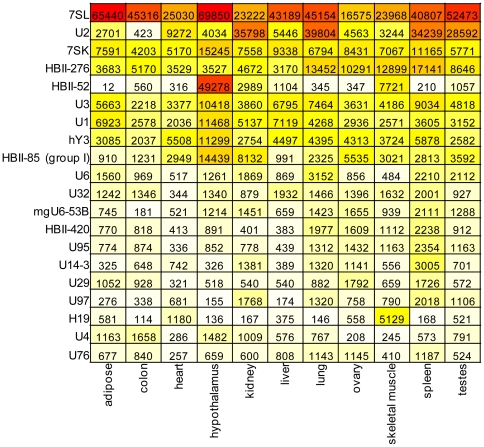
Figure 1. ncRNA expression.
Expression (RPKM units) of the 20 monitored ncRNA with highest mean values across eleven tissues.
Figure 2
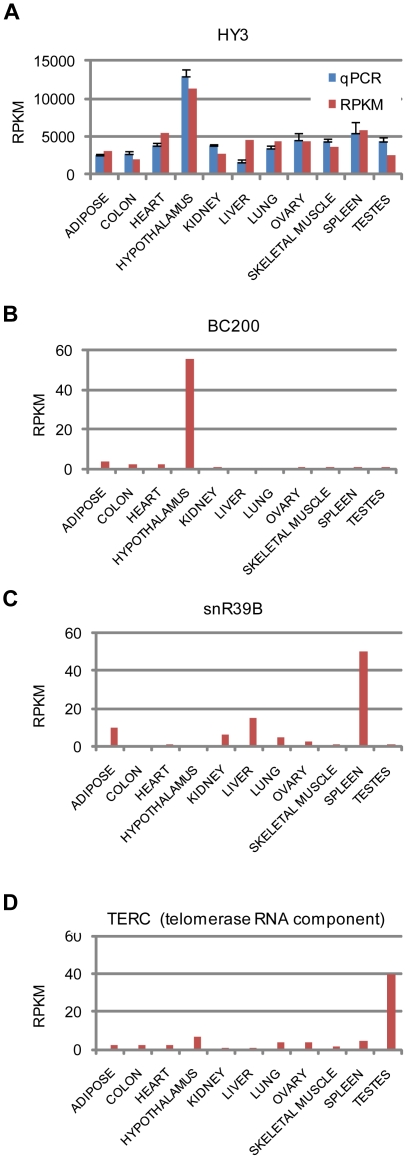
Figure 2. Individual ncRNA expression.
A: HY3 sequencing (RPKM) and qPCR expression. qPCR values are normalized to 18S and the mean sequencing value. B, C, and D: expression of BC200, snR39B, and TERC (telomerase RNA component).
Figure 3
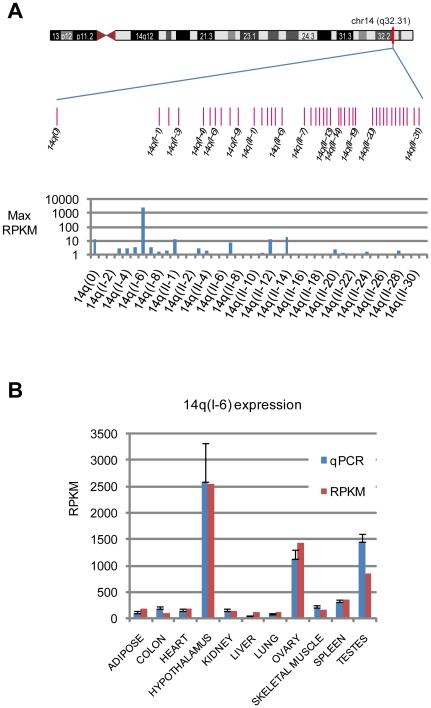
Figure 3. Expression of the 14q snoRNA cluster.
A: genomic layout of the 41 members of the 14q snoRNA cluster (upper) and maximum RPKM values for each member, across all tissues (lower). Every second snoRNA is labeled. Y-axis is log10 scale. B: expression of the highly expressed 14q(I-6) snoRNA. qPCR values are normalized to 18S and the mean sequencing value. Y-axis is linear scale.
Figure 4
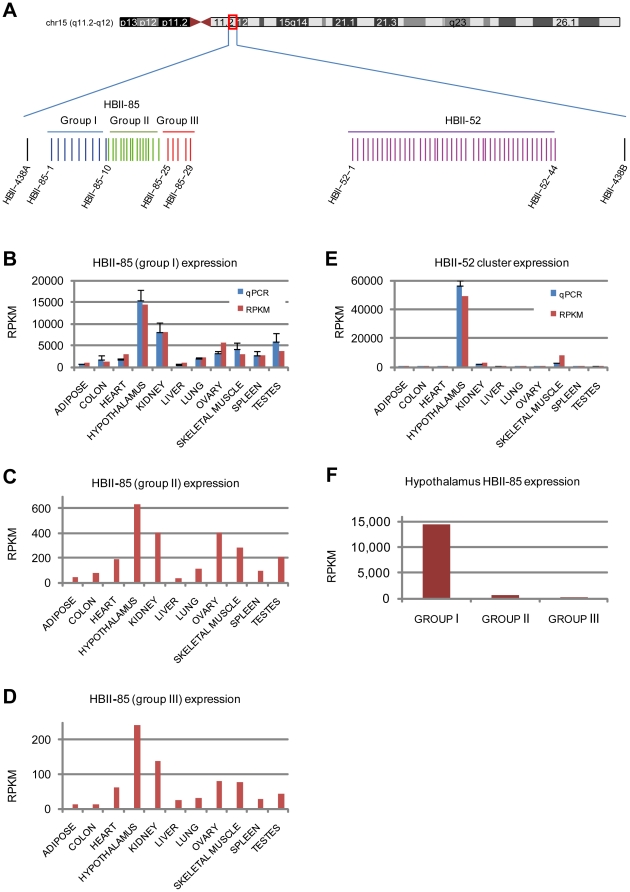
Figure 4. Expression of the HBII-52 and HBII-85 snoRNA clusters.
A: genomic layout of the HBII-52 and HBII-85 snoRNA clusters. B, C, and D: expression of the HBII-85 group I, II, and III clusters. E: expression of the HBII-52 cluster. F: expression of HBII-85 group I, II, and III in hypothalamus.
Figure 5
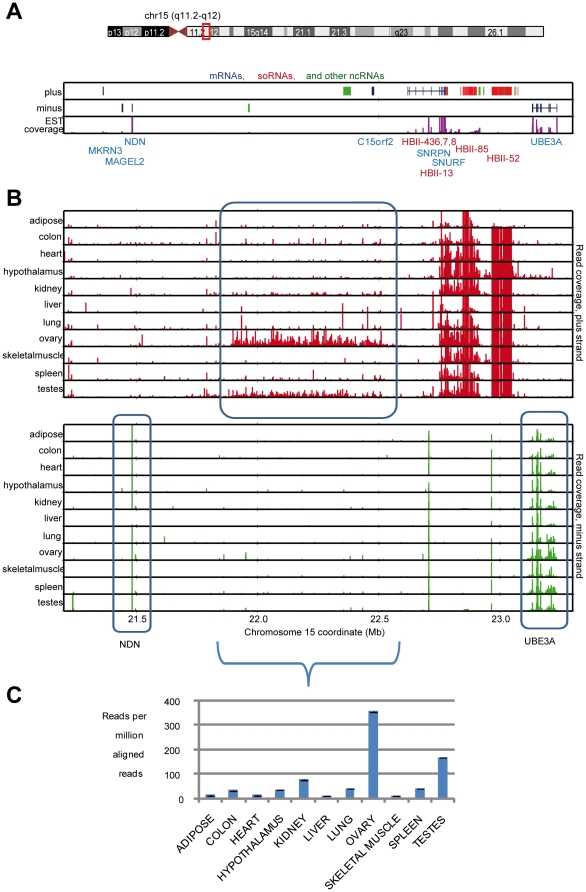
Figure 5. Expression in the PWS/Angelman locus, chromosome 15, 22.0–22.4 Mb.
A: gene location and strand and coverage by ESTs (Expressed Sequence Tags). B: sequence read coverage showing positive (red) and minus (green) strand transcription for each tissue. Transcription for genes NDN and UBE3A along with the novel region are circled in blue. C: summed positive strand expression between chromosome 15; 22.0 to 22.4 Mb.

References

    1. Eddy SR. Non-coding RNA genes and the modern RNA world. Nat Rev Genet. 2001;2:919–929. - PubMed
    1. Mattick JS, Makunin IV. Non-coding RNA. Hum Mol Genet 15 Spec No. 2006;1:R17–29. - PubMed
    1. Sahoo T, del Gaudio D, German JR, Shinawi M, Peters SU, et al. Prader-Willi phenotype caused by paternal deficiency for the HBII-85 C/D box small nucleolar RNA cluster. Nat Genet. 2008;40:719–721. - PMC - PubMed
    1. Wong JM, Collins K. Telomerase RNA level limits telomere maintenance in X-linked dyskeratosis congenita. Genes Dev. 2006;20:2848–2858. - PMC - PubMed
    1. Agarwal S, Loh YH, McLoughlin EM, Huang J, Park IH, et al. Telomere elongation in induced pluripotent stem cells from dyskeratosis congenita patients. Nature 2010 - PMC - PubMed

Publication types