


Outcomes of pediatric bone marrow transplantation for leukemia and myelodysplasia using matched sibling, mismatched related, or matched unrelated donors
- PMID: 20671124
- PMCID: PMC2981549
- DOI: 10.1182/blood-2010-01-261958
Outcomes of pediatric bone marrow transplantation for leukemia and myelodysplasia using matched sibling, mismatched related, or matched unrelated donors
Abstract
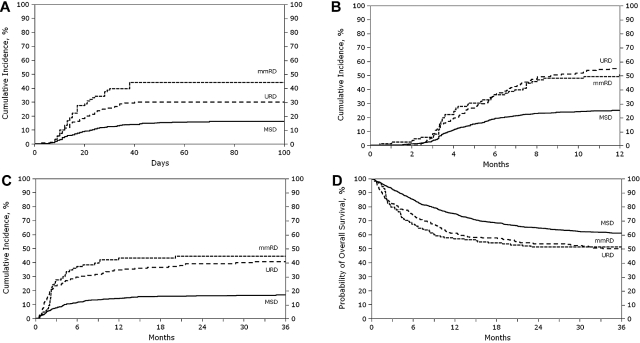
Although some trials have allowed matched or single human leukocyte antigen (HLA)-mismatched related donors (mmRDs) along with HLA-matched sibling donors (MSDs) for pediatric bone marrow transplantation in early-stage hematologic malignancies, whether mmRD grafts lead to similar outcomes is not known. We compared patients < 18 years old reported to the Center for International Blood and Marrow Transplant Research with acute myeloid leukemia, acute lymphoblastic leukemia, chronic myeloid leukemia, and myelodysplastic syndrome undergoing allogeneic T-replete, myeloablative bone marrow transplantation between 1993 and 2006. In total, patients receiving bone marrow from 1208 MSDs, 266 8/8 allelic-matched unrelated donors (URDs), and 151 0-1 HLA-antigen mmRDs were studied. Multivariate analysis showed that recipients of MSD transplants had less transplantation-related mortality, acute graft-versus-host disease (GVHD), and chronic GVHD, along with better disease-free and overall survival than the URD and mmRD groups. No differences were observed in transplant-related mortality, acute and chronic GVHD, relapse, disease-free survival, or overall survival between the mmRD and URD groups. These data show that mmRD and 8/8 URD outcomes are similar, whereas MSD outcomes are superior to the other 2 sources. Whether allele level typing could identify mmRD recipients with better outcomes will not be known unless centers alter practice and type mmRD at the allele level.
Figures
References
-
- Anasetti C, Beatty PG, Storb R, et al. Effect of HLA incompatibility on graft-versus-host disease, relapse, and survival after marrow transplantation for patients with leukemia or lymphoma. Hum Immunol. 1990;29(2):79–91. - PubMed
-
- Beatty PG, Clift RA, Mickelson EM, et al. Marrow transplantation from related donors other than HLA-identical siblings. N Engl J Med. 1985;313(13):765–771. - PubMed
-
- Clift RA, Hansen JA, Thomas ED, et al. Marrow transplantation from donors other than HLA-identical siblings. Transplantation. 1979;28(3):235–242. - PubMed
-
- Neudorf S, Sanders J, Kobrinsky N, et al. Allogeneic bone marrow transplantation for children with acute myelocytic leukemia in first remission demonstrates a role for graft versus leukemia in the maintenance of disease-free survival. Blood. 2004;103(10):3655–3661. - PubMed
-
- Davies SM, Defor TE, McGlave PB, et al. Equivalent outcomes in patients with chronic myelogenous leukemia after early transplantation of phenotypically matched bone marrow from related or unrelated donors. Am J Med. 2001;110(5):339–346. - PubMed
Publication types
MeSH terms
Substances
Grants and funding
LinkOut - more resources
Full Text Sources
Medical
Research Materials
