Shotgun lipidomic analysis of human meibomian gland secretions with electrospray ionization tandem mass spectrometry
- PMID: 20671273
- PMCID: PMC3055753
- DOI: 10.1167/iovs.10-5687
Shotgun lipidomic analysis of human meibomian gland secretions with electrospray ionization tandem mass spectrometry
Abstract
Purpose: The purpose of this investigation was to determine the major molecular components of the lipids in normal human meibomian gland secretions (meibum).
Methods: The meibum samples were studied by direct infusion electrospray ionization (ESI), quadrupole time-of-flight mass spectrometry, and tandem mass spectrometry (MS/MS) analysis, in both positive and negative detection modes.
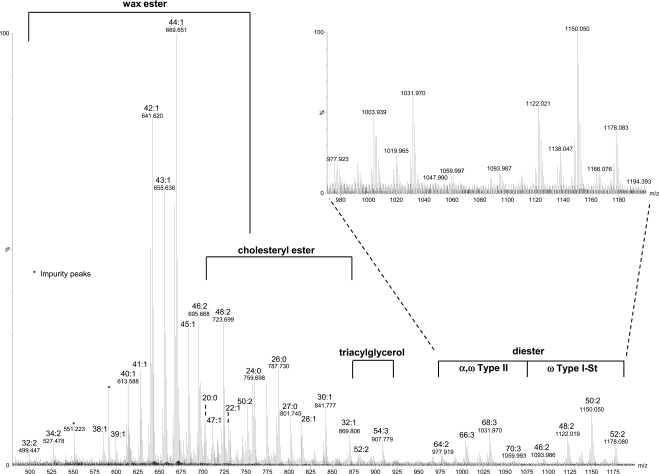
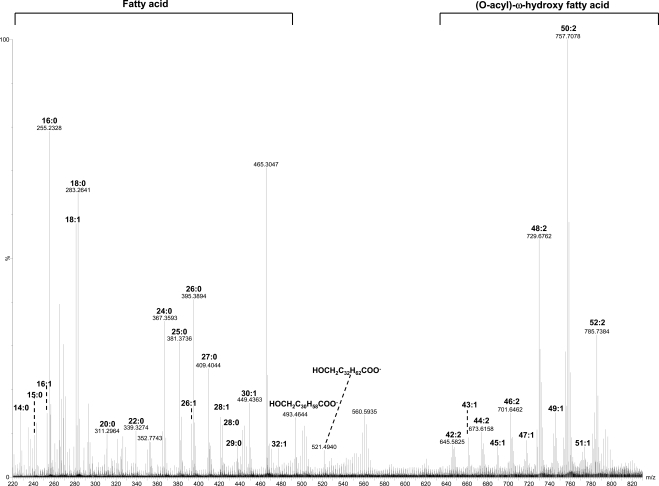
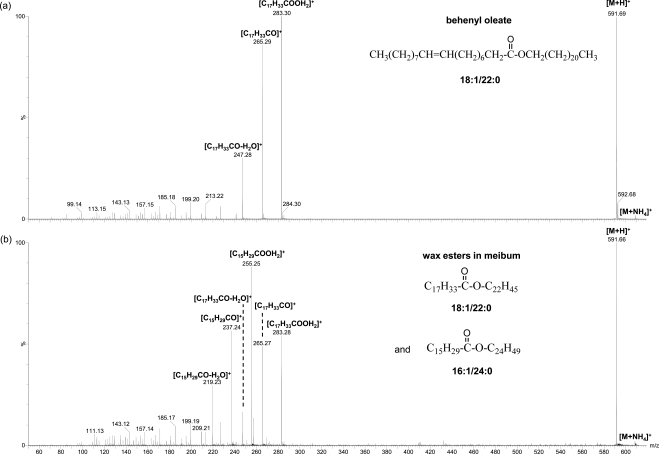
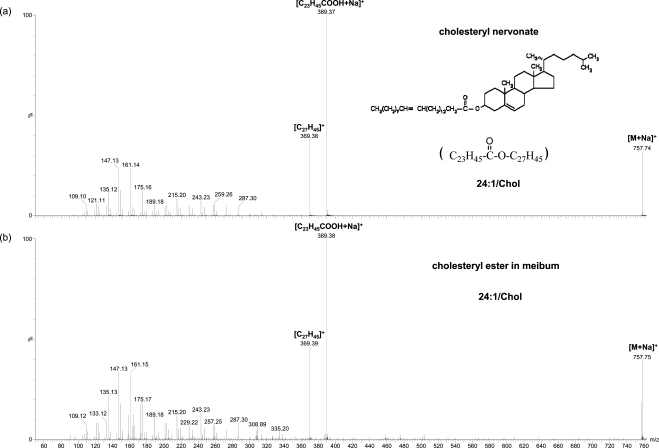
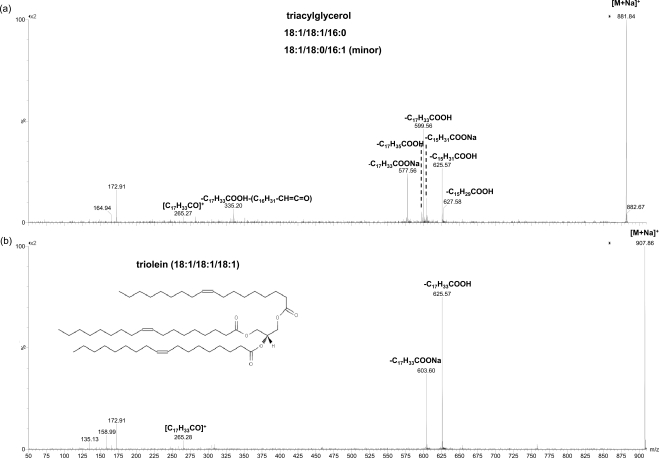
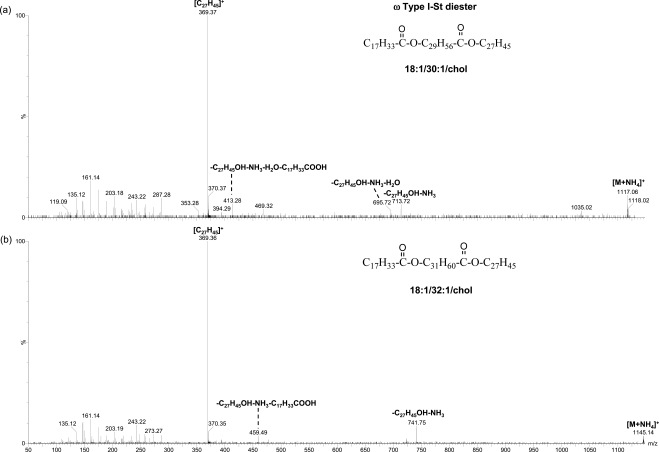
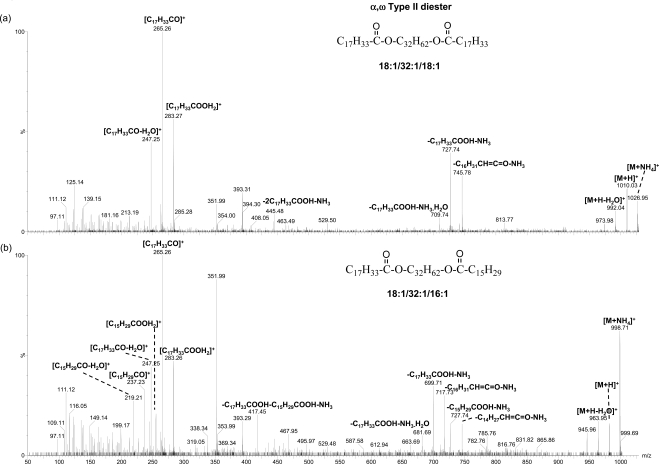
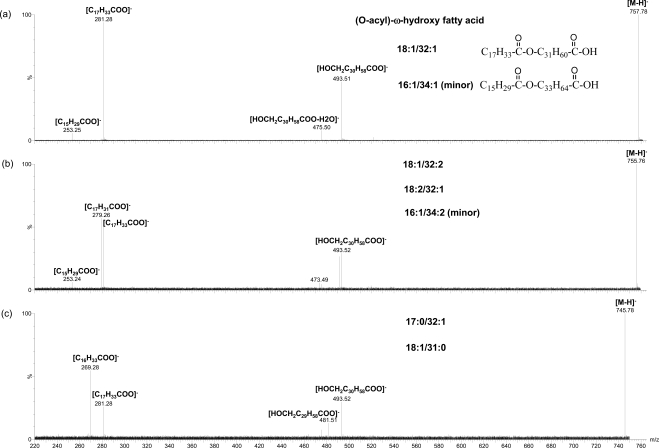
Results: Hundreds of peaks were detected, among which the molecular compositions and subclasses of approximately 160 major peaks were confidently identified. The compositions and subclasses of these peaks were determined from collision-induced dissociation fragmentation patterns, high-resolution and high-mass-accuracy spectra, and references of literature reports. The major peaks detected in positive mode were those of nonpolar lipids, including wax esters, cholesteryl esters, triacylglycerols, and diesters, whereas in negative mode, the major peaks detected were those of polar lipids, including free fatty acids and (O-acyl)-ω-hydroxy fatty acids.
Conclusions: The analysis of intact lipids in meibum with direct infusion ESI-MS/MS analysis has the advantages of minimal sample preparation (no chromatography or pre-separation needed), mild experimental conditions, high throughput, and high sensitivity.
Figures
Comment in
-
On the presence and role of polar lipids in meibum.Invest Ophthalmol Vis Sci. 2010 Dec;51(12):6908-10; author reply 6910-1. doi: 10.1167/iovs.10-6328. Invest Ophthalmol Vis Sci. 2010. PMID: 21123804 Free PMC article. No abstract available.
References
-
- McCulley JP, Shine WE. The lipid layer of tears: dependent on meibomian gland function. Exp Eye Res. 2004;78:361–365 - PubMed
-
- Epidemiology Subcommittee of the International Dry Eye WorkShop The epidemiology of dry eye disease: Report of the Epidemiology Subcommittee of the International Dry Eye WorkShop. Ocul Surf. 2007;5:93–107 - PubMed
-
- Cory CC, Hinks W, Burton JL, Shuster S. Meibomian gland secretion in the red eyes of rosacea. Br J Dermatol. 1973;89:25–27 - PubMed
-
- Mathers WD, Lane JA. Meibomian gland lipids, evaporation, and tear film stability. Adv Exp Med Biol. 1998;438:349–360 - PubMed
Publication types
MeSH terms
Substances
Grants and funding
LinkOut - more resources
Full Text Sources