Review
. 2010 May-Jun;1(3):148-63.
doi: 10.4161/gmic.1.3.11712.

Probiotics-host communication: Modulation of signaling pathways in the intestine

Affiliations
Review

Probiotics-host communication: Modulation of signaling pathways in the intestine

Carissa M Thomas et al. Gut Microbes. 2010 May-Jun.

Abstract

The intestinal microbiota includes a diverse group of functional microorganisms, including candidate probiotics or viable microorganisms that benefit the host. Beneficial effects of probiotics include enhancing intestinal epithelial cell function, protecting against physiologic stress, modulating cytokine secretion profiles, influencing T lymphocyte populations, and enhancing antibody secretion. Probiotics have demonstrated significant potential as therapeutic options for a variety of diseases, but the mechanisms responsible for these effects remain to be fully elucidated. Accumulating evidence demonstrates that probiotics communicate with the host by modulating key signaling pathways, such as NFκB and MAPK, to either enhance or suppress activation and influence downstream pathways. Beneficial microbes can profoundly alter the physiology of the gastrointestinal tract, and understanding these mechanisms may result in new diagnostic and therapeutic strategies.

Keywords: commensal; dendritic cell; innate immune system; intestinal epithelial cell; intestine; macrophage; probiotic; signaling.


Figures
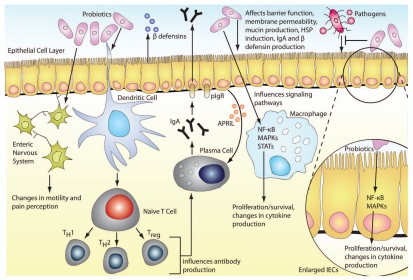
Figure 1
Figure 1
Probiotics benefit the host by communicating with a variety of cell types. Intestinal epithelial cell (IEC) barrier function is enhanced through probiotic modulation of tight junctions as well as enhanced mucin production. Probiotics interfere with pathogens by increasing β defensin secretion from IECs and IgA from plasma cells and by directly blocking the signaling pathways hijacked by pathogens. Cytokine secretion by IECs, macrophages and dendritic cells is regulated by probiotics through modulation of key signaling pathways such as NFκB and MAPKs. Changes in these pathways can also affect proliferation and survival of target cells. Through interactions with dendritic cells, probiotics can influence T cell subpopulations and skew them towards a Th1, Th2 or Treg response. Probiotics can also cause changes in gut motility and pain perception by modulating pain receptor expression and secreting potential neurotransmitter molecules. APRIL, a proliferation-inducing ligand; hsp, heat shock protein; IEC, intestinal epithelial cell; Ig, immunoglobulin; MAPK, mitogen-activated protein kinase; NFκB, nuclear factor-kappaB; pIgR, polymeric immunoglobulin receptor; STAT, signal transducers and activator of transcription; Treg, T regulatory cell.
Figure 2
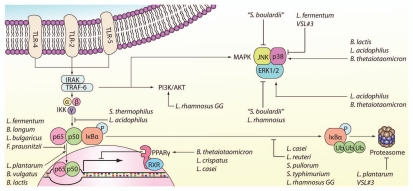
Figure 2
Probiotics modulate key signaling pathways in intestinal epithelial cells. Various probiotics prevent NFκB activation by inhibiting IκBα phosphorylation, ubiquitination, proteasomal degradation, or translocation of NFκB into the nucleus (suppression is indicated by a block sign “??”). Probiotics can also enhance RelA export from the nucleus via PPARγ. Other probiotics increase NFκB activation through enhanced translocation into the nucleus (activation is indicated by an arrow sign “→”). Apoptosis of intestinal epithelial cells can be prevented by probiotic modulation of the PI3K/Akt pathway. Probiotic-induced changes in phosphorylation levels of p38, JNK, and ERK1/2 MAPKs can affect cytokine secretion and apoptosis. ERK, extracellular signal-regulated kinases; IκBα, inhibitor of NFκB α; IKK, IκB kinase; IRAK, interleukin-1 receptor-associated kinase; JNK, c-Jun N-terminal kinase; P, phosphorylation; PPARγ, peroxisome proliferator activated receptor-γ; RXR, retinoid X receptor; TLR, Toll-like receptor; Ub, ubiquitin.
Figure 3
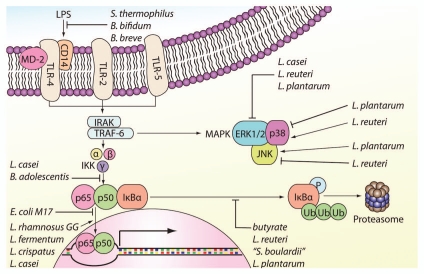
Figure 3
Probiotics modulate inflammatory signaling pathways in macrophages. Select probiotics can block binding of LPS to the CD14 receptor, interfering with LPS signal transduction. Various probiotics prevent activation of NFκB by decreasing phosphorylation or ubiquitination of IκBα or blocking NFκB translocation into the nucleus (suppression is indicated by a block sign “??”). NFκB activation is enhanced by other probiotics via increased nuclear translocation of transcriptionally active NFκB subunits (activation is indicated by an arrow sign “→”). MAPK proteins p38, JNK and ERK1/2 are also targets of probiotic modulation in macrophages. ERK, extracellular signal-regulated kinases; IκBa, inhibitor of NFκBα; IKK, IκB kinase; IRAK, interleukin-1 receptor-associated kinase; JNK, c-Jun N-terminal kinase; LPS, lipopolysaccharide; MD-2, myeloid differentiation 2; P, phosphorylation; TLR, Toll-like receptor; Ub, ubiquitin.

References

    1. Backhed F, Ley RE, Sonnenburg JL, Peterson DA, Gordon JI. Host-bacterial mutualism in the human intestine. Science. 2005;307:1915–1920. - PubMed
    1. Ley RE, Peterson DA, Gordon JI. Ecological and evolutionary forces shaping microbial diversity in the human intestine. Cell. 2006;124:837–848. - PubMed
    1. Cani PD, Delzenne NM. The role of the gut microbiota in energy metabolism and metabolic disease. Curr Pharm Des. 2009;15:1546–1558. - PubMed
    1. Hooper LV, Gordon JI. Commensal host-bacterial relationships in the gut. Science. 2001;292:1115–1118. - PubMed
    1. Preidis GA, Versalovic J. Targeting the human microbiome with antibiotics, probiotics and prebiotics: gastroenterology enters the metagenomics era. Gastroenterology. 2009;136:2015–2031. - PMC - PubMed

Publication types

LinkOut - more resources