Validation of a urine test and characterization of the putative genetic mutation for hyperuricosuria in Bulldogs and Black Russian Terriers
- PMID: 20673090
- PMCID: PMC5551899
- DOI: 10.2460/ajvr.71.8.909
Validation of a urine test and characterization of the putative genetic mutation for hyperuricosuria in Bulldogs and Black Russian Terriers
Abstract
Objective: To determine whether hyperuricosuria was a predisposing factor for urate urolithiasis in Bulldogs and Black Russian Terriers (BRTs) and to estimate the allele frequency of the Cys181Phe genetic mutation in urate transporter SLC2A9 in these breeds.
Animals: 192 Bulldogs, 101 BRTs, 10 Dalmatians, and 9 dogs of other breeds.
Procedures: Uric acid (UA) and creatinine (Cr) concentrations were quantified in urine samples collected from all dogs via midstream catch during natural voiding. Buccal swab or blood samples were also obtained, and DNA was extracted and used to genotype SLC2A9 sequence variants by use of pyrosequencing assays. A urine test for hyperuricosuria was validated in adult dogs by comparing urinary UA:Cr ratios between known hyperuricosuric and nonhyperuricosuric dogs.
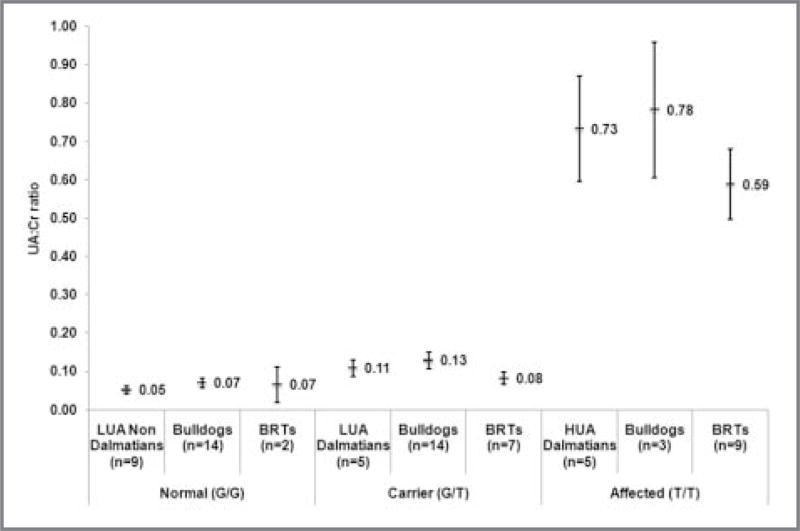
Results: Significantly higher UA:Cr ratios were found in some Bulldogs and BRTs, compared with ratios in other dogs from these breeds. These dogs were also homozygous for the SLC2A9 Cys181Phe mutation. The allele frequency of the Cys181Phe mutation was 0.16 in Bulldogs and 0.51 in BRTs. On the basis of these allele frequencies, 3% of the Bulldog population and 27% of the BRT population were estimated to be hyperuricosuric.
Conclusions and clinical relevance: Results suggested the genetic mutation associated with hyperuricosuria, first identified in Dalmatians, also appears to cause hyperuricosuria in Bulldogs and BRTs, indicating that similar management strategies for urate urolithiasis can be used in these breeds. The allele frequency of the mutation was high in both breeds, and DNA testing can be used to select against the mutation.
Figures
Comment in
-
The link between hyperuricosuria and urate urolithiasis.Am J Vet Res. 2010 Nov;71(11):1257; author reply 1257-8. doi: 10.2460/ajvr.71.11.1257. Am J Vet Res. 2010. PMID: 21034314 No abstract available.
References
-
- Benedict SR. Uric acid in its relations to metabolism. Harvey Lect. 1916;11:346–365.
-
- Wells HG. The purine metabolism of the Dalmatian coach hound. J Biol Chem. 1918;35:221–225.
-
- Friedman TB, Polanco GE, Appold JC, et al. On the loss of uricolytic activity during primate evolution—I. Silencing of urate oxidase in a hominoid ancestor. Comp Biochem Physiol B. 1985;81:653–659. - PubMed
-
- Oda M, Satta Y, Takenaka O, et al. Loss of urate oxidase activity in hominoids and its evolutionary implications. Mol Biol Evol. 2002;19:640–653. - PubMed
-
- Giesecke D, Tiemeyer W. Defect of uric acid uptake in Dalmatian dog liver. Experientia. 1984;40:1415–1416. - PubMed
Publication types
MeSH terms
Substances
Grants and funding
LinkOut - more resources
Full Text Sources