


Contralateral acupuncture versus ipsilateral acupuncture in the rehabilitation of post-stroke hemiplegic patients: a systematic review
- PMID: 20673364
- PMCID: PMC2924268
- DOI: 10.1186/1472-6882-10-41
Contralateral acupuncture versus ipsilateral acupuncture in the rehabilitation of post-stroke hemiplegic patients: a systematic review
Abstract
Background: Contralateral acupuncture (CAT) involves inserting needles in the meridian on the side opposite the disease location and is often used in post-stroke rehabilitation. The aim of this systematic review is to summarize and critically evaluate the evidence for and against the effectiveness of CAT for post-stroke rehabilitation as compared to ipsilateral acupuncture (IAT).
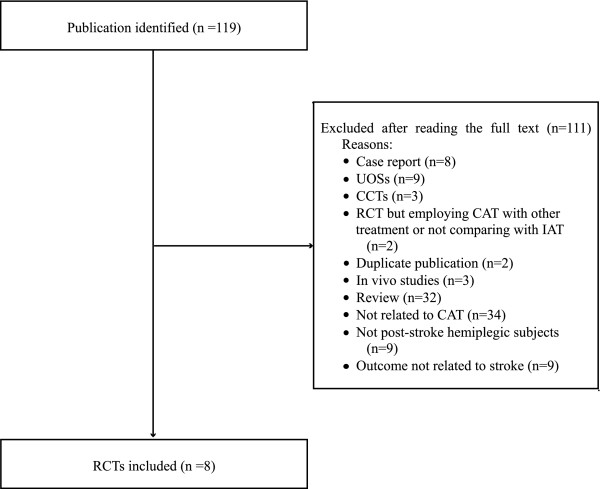
Methods: Seventeen databases were searched from their inceptions through June 2010. Prospective clinical trials were included if CAT was tested as the sole treatment or as an adjunct to other treatments for post-stroke rehabilitation and compared to IAT.
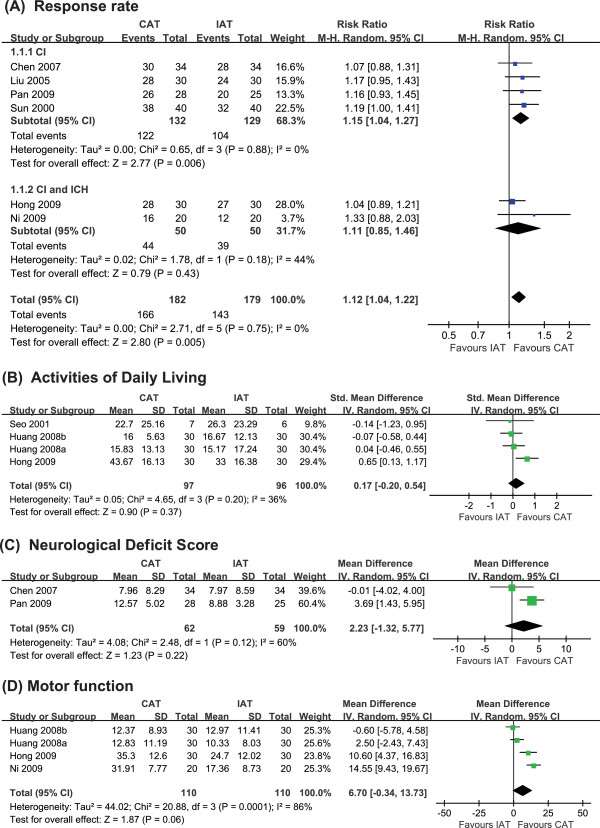
Results: Eight randomized clinical trials (RCTs) met our inclusion criteria. Four of them reported favorable effects of CAT compared to IAT for at least one outcome. A meta-analysis showed superior effects of CAT compared to IAT on recovery rate (n = 361; risk ratio (RR), 1.12; 95% confidence intervals (CIs), 1.04 to 1.22, P = 0.005). Subgroup analysis also showed favorable effects of using CAT on patients with cerebral infarction (n = 261; RR, 1.15; 95% CIs, 1.04 to 1.27, P = 0.006). Further analysis including patients with cerebral infarction and intracranial hemorrhage, however, failed to show these advantages (n = 100; RR, 1.11; 95% CIs, 0.85 to 1.46, P = 0.43).
Conclusion: The results of our systematic review and meta-analysis suggest that there is limited evidence for CAT being superior to IAT in the treatment of cerebral infarction. The total number of RCTs included in our analysis was low, however, and the RCTs included had a high risk of bias. Future RCTs appear to be warranted.
Figures
References
-
- Brown RD Jr, Ransom J, Hass S, Petty GW, O'Fallon WM, Whisnant JP, Leibson CL. Use of nursing home after stroke and dependence on stroke severity: a population-based analysis. Stroke. 1999;30(5):924–929. - PubMed
-
- Ernst E, Pittler MH, Wider B, Boddy K. The desktop guide to complementary and alternative medicine. Philadelphia, PA: Mosby Elservier; 2006.
-
- Yellow Emperor. Yellow Emperor's Inner Classic of Internal Medicine, Spiritual Pivot (Ling Shu) Seoul: Euisungdang publishing; 2002. p. 214.
Publication types
MeSH terms
LinkOut - more resources
Full Text Sources
Medical
Miscellaneous
