


Higher sensitivity to patupilone versus paclitaxel chemotherapy in primary uterine serous papillary carcinoma cell lines with high versus low HER-2/neu expression in vitro
- PMID: 20673976
- PMCID: PMC2939197
- DOI: 10.1016/j.ygyno.2010.06.024
Higher sensitivity to patupilone versus paclitaxel chemotherapy in primary uterine serous papillary carcinoma cell lines with high versus low HER-2/neu expression in vitro
Abstract
Objective: To compare the in vitro sensitivity/resistance to patupilone versus paclitaxel in uterine serous papillary carcinoma (USPC) with high versus low HER-2/neu expression.
Methods: Six primary USPC cell lines, half of which overexpress HER-2/neu at a 3+ level, were evaluated for growth rate and tested for their in vitro sensitivity/resistance to patupilone versus paclitaxel by MTS assays. Quantitative RT-PCR was used to identify potential mechanisms underlying the differential sensitivity/resistance to patupilone versus paclitaxel in primary USPC cell lines.
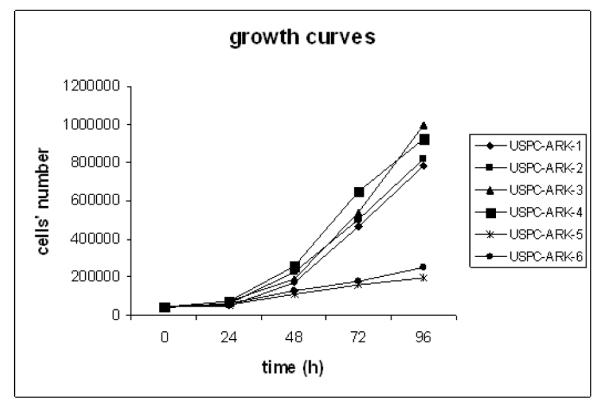
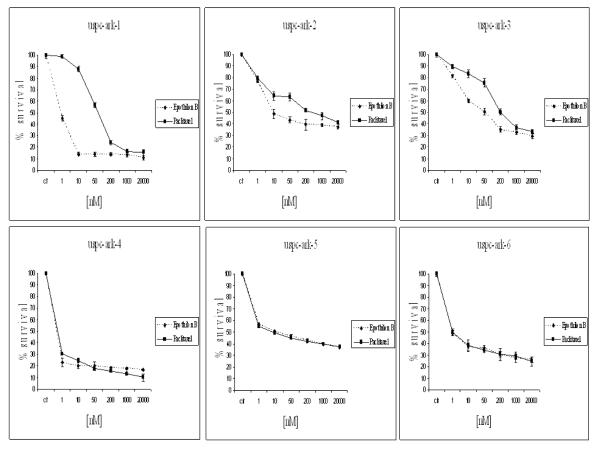
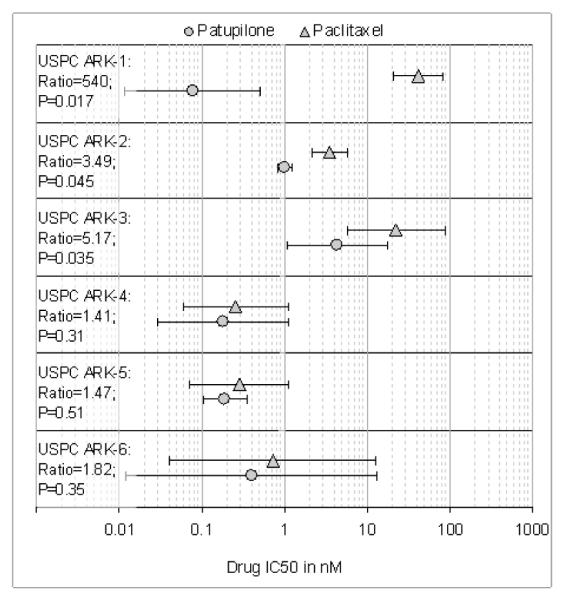
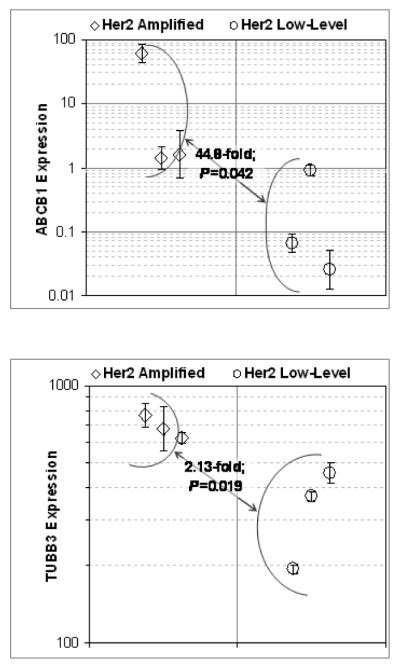
Results: Cell lines overexpressing HER-2/neu showed higher proliferation when compared to low HER-2/neu-expressing cell lines. Compared to low-expressing cell lines, high HER-2/neu expressors were significantly more sensitive to patupilone than to paclitaxel (P<0.0002). In contrast, there was no appreciable difference in sensitivity to patupilone versus paclitaxel in primary USPC cell lines with low HER-2/neu expression. Higher levels of β-tubulin III (TUBB3) and P-glycoprotein (ABCB1) were detected in USPC cell lines with high versus low HER-2/neu expression (P<0.05).
Conclusions: USPC overexpressing HER-2/neu display greater in vitro sensitivity to patupilone and higher levels of the patupilone molecular target TUBB3 when compared to low HER-2/neu expressors. Due to the adverse prognosis associated with HER-2/neu overexpression in USPC patients, patupilone may represent a promising novel drug to combine to platinum compounds in this subset of aggressive endometrial tumors.
Copyright © 2010 Elsevier Inc. All rights reserved.
Figures
References
-
- Thun M, Xu J, Hao Y, Ward E, Siegel R, Jemal A. Cancer statistics, 2009. CA Cancer J Clin. 2009;59:225. - PubMed
-
- Bokhman JV. Two pathogenetic types of endometrial carcinoma. Gynecol Oncol. 1983;15:10. - PubMed
-
- Hendrickson M, Ross J, Eifel P, Martinez A, Kempson R. Uterine papillary serous carcinoma: a highly malignant form of endometrial adenocarcinoma. Am J Surg Pathol. 1982;6:93–108. - PubMed
-
- Levenback C, Burke TW, Silva E, et al. Uterine papillary serous carcinoma (USPC) treated with cisplatin, doxorubicin, and cyclophosphamide (PAC) Gynecol Oncol. 1992;46:317–321. - PubMed
-
- Nicklin L, Copeland LJ. Endometrial papillary serous carcinoma: pattern of spread and treatment. Clin Obstet Gynecol. 1996;39:686–695. - PubMed
Publication types
MeSH terms
Substances
Grants and funding
LinkOut - more resources
Full Text Sources
Medical
Research Materials
Miscellaneous
