. 2010 Sep;6(9):652-9.
doi: 10.1038/nchembio.416. Epub 2010 Aug 1.

Replication-dependent instability at (CTG) x (CAG) repeat hairpins in human cells

Affiliations

Replication-dependent instability at (CTG) x (CAG) repeat hairpins in human cells

Guoqi Liu et al. Nat Chem Biol. 2010 Sep.

Abstract

Instability of (CTG) x (CAG) microsatellite trinucleotide repeat (TNR) sequences is responsible for more than a dozen neurological or neuromuscular diseases. TNR instability during DNA synthesis is thought to involve slipped-strand or hairpin structures in template or nascent DNA strands, although direct evidence for hairpin formation in human cells is lacking. We have used targeted recombination to create a series of isogenic HeLa cell lines in which (CTG) x (CAG) repeats are replicated from an ectopic copy of the Myc (also known as c-myc) replication origin. In this system, the tendency of chromosomal (CTG) x (CAG) tracts to expand or contract was affected by origin location and the leading or lagging strand replication orientation of the repeats, and instability was enhanced by prolonged cell culture, increased TNR length and replication inhibition. Hairpin cleavage by synthetic zinc finger nucleases in these cells has provided the first direct evidence for the formation of hairpin structures during replication in vivo.


Figures
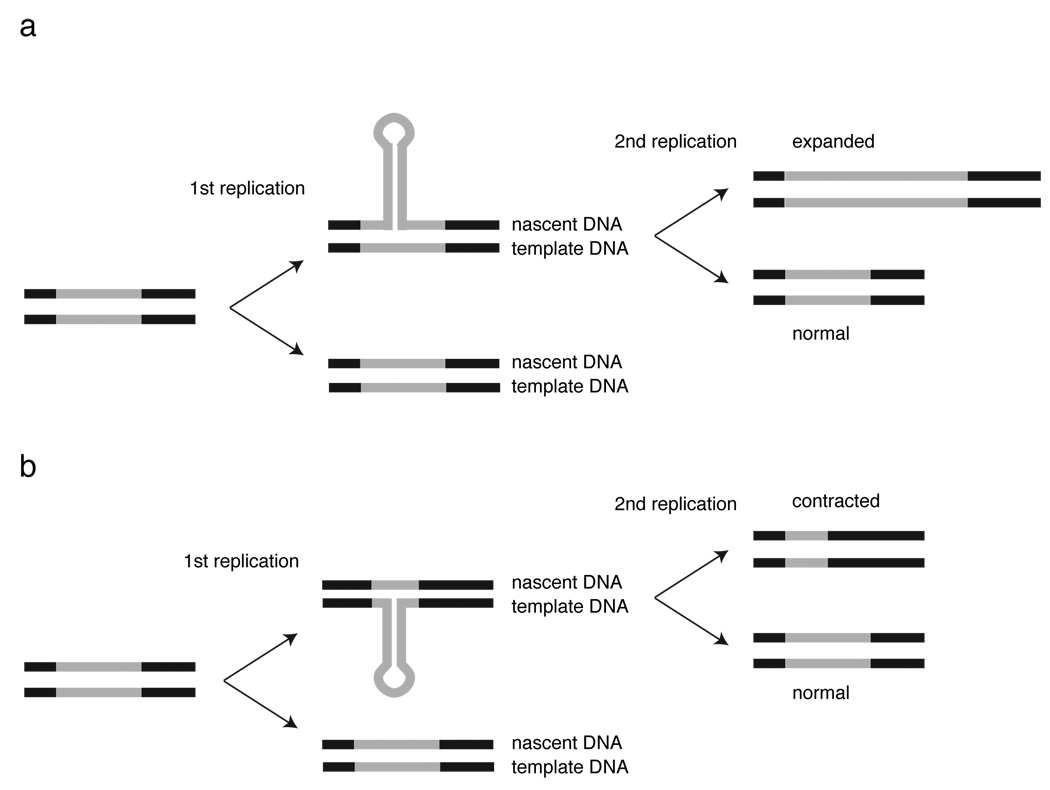
Figure 1
Figure 1
Hairpin induced trinucleotide repeat instability. The TNR is indicated by grey lines, flanking DNA by black lines. (a) Nascent strand hairpin formation results in overreplication of a segment of the TNR in one chromatid. A second round of replication of the hairpin strand fixes the expanded allelle in the genome. (b) Template strand hairpin formation results in underreplication of a segment of the TNR in one chromatid. A second round of replication of the non-hairpin strand fixes the contracted allelle in the genome. (Adapted from 9).
Figure 2
Figure 2
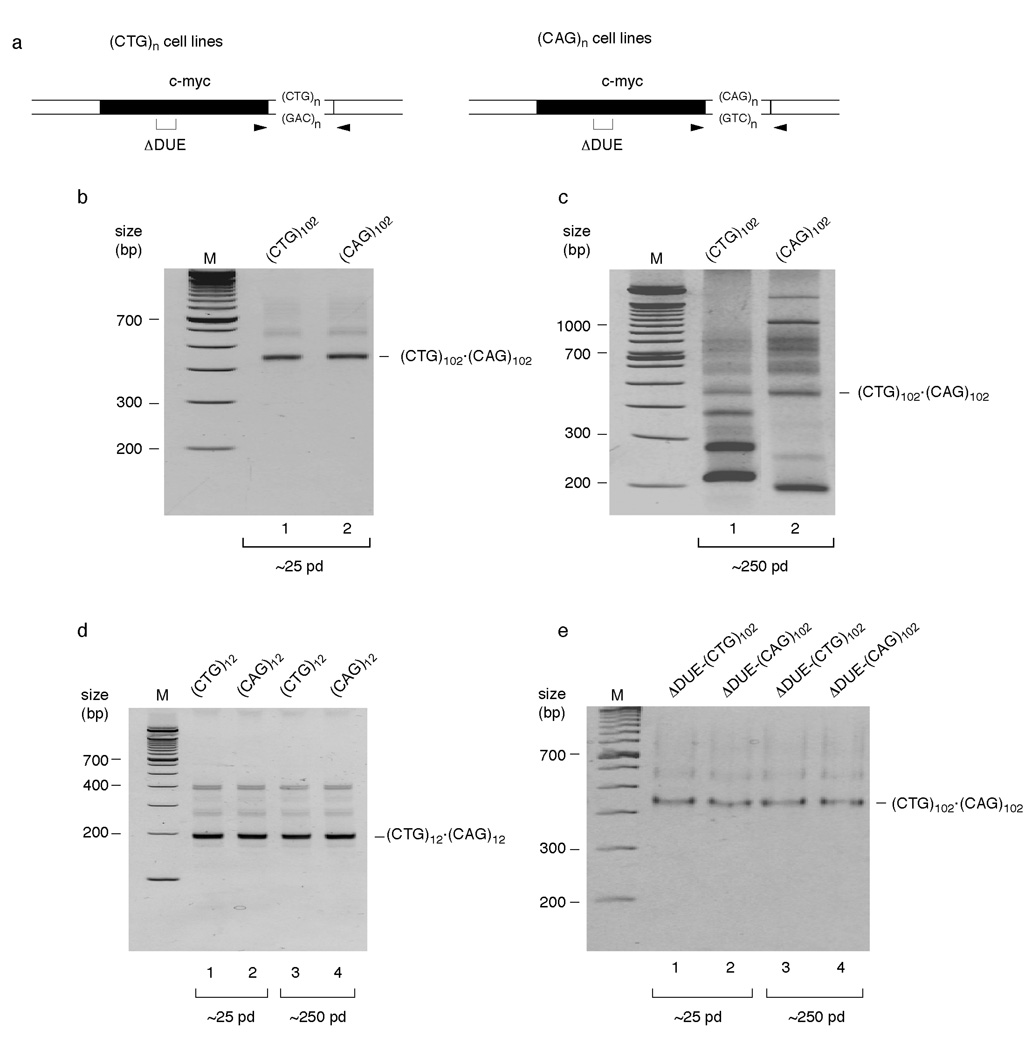
DNA replication affects TNR instability. (a) Diagram of ectopic origin sites. Arrowheads, PCR primer positions; bracket, DUE deletion (ΔDUE). (b) PCR analysis of (CTG)102•(CAG)102 cells cultured for 25 population doublings. Lane 1, (CTG)102 cells; lane 2, (CAG)102 cells; M, molecular weight marker. The progenitor (CTG)102•(CAG)102 band is indicated. (c) PCR analysis of (CTG)102•(CAG)102 cells cultured for 250 population doublings. Lane 1, (CTG)102 cells; lane 2, (CAG)102 cells. (d) PCR analysis of (CTG)12•(CAG)12 cells cultured for 25 or 250 population doublings. Lanes 1, 3, (CTG)12 cells; lanes 2, 4, (CAG)12 cells. The progenitor (CTG)12•(CAG)12 band is indicated. (e) PCR analysis of ΔDUE-(CTG)102•(CAG)102 cells cultured for 25 or 250 population doublings. Lanes 1, 3, ΔDUE-(CTG)102 cells; lanes 2, 4, ΔDUE-(CAG)102 cells.
Figure 3
Figure 3
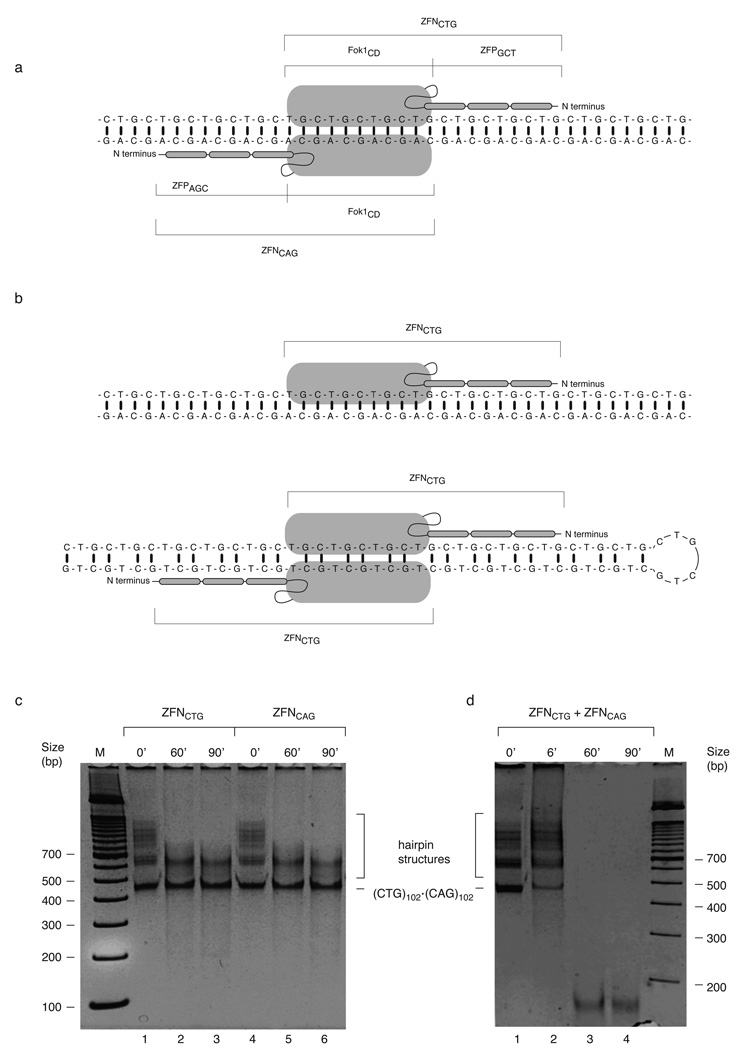
ZFN cleave specifically in vitro. (a) Binding of a ZFNCTG and ZFNCAG heterodimer capable of cleaving heteroduplex DNA. Fok ICD, Fok I catalytic domain; ZFPGCT, GCT recognition zinc finger protein; ZFAGC, AGC recognition zinc finger protein. (b) Predicted modes of ZFNCTG monomer binding to heteroduplex DNA (upper) or homodimeric ZFNCTG capable of cleaving (CTG)n hairpin DNA (lower). (c) The linear (CTG)102•(CAG)102 PCR product was gel purified and reamplified. Time course of cleavage of the reamplified (CTG)102•(CAG)102 PCR products with ZFNCTG (10% of immunoprecipitate, lanes 1–3) or ZFNCAG (10% of immunoprecipitate, lanes 4–6). (d) Time course of cleavage of the reamplified (CTG)102•(CAG)102 PCR products with a mixture of ZFNCTG and ZFNCAG (5% of each immunoprecipitate).
Figure 4
Figure 4
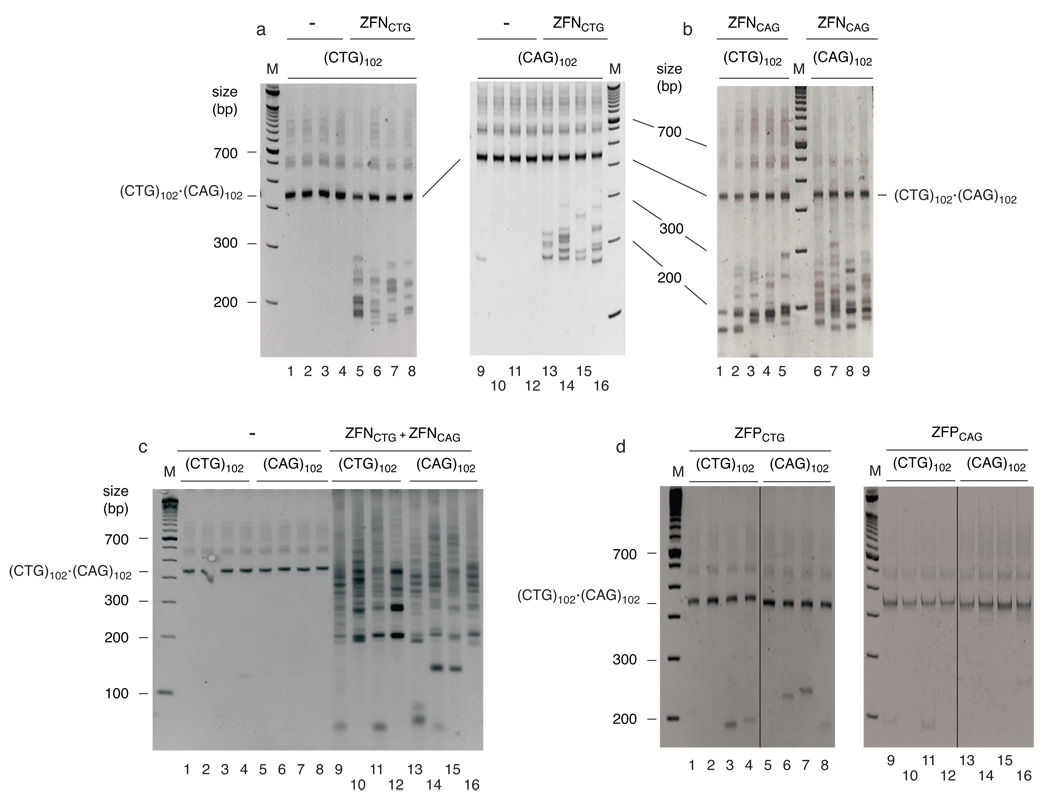
(CTG)102•(CAG)102 TNRs form hairpins in vivo. (CTG)102•(CAG)102 cells were cultured for 25 population doublings. (a) spPCR of DNA from (CTG)102 cells or (CAG)102 cells transfected, respectively, with empty vector (lanes 1–4, 9–12) or ZFNCTG expression plasmid (lanes 5–8, 13–16). (b) spPCR of DNA from (CTG)102 cells (lanes 1–5) or (CAG)102 cells (lanes 6–9) transfected with ZFNCAG expression plasmid. (c) spPCR of DNA from (CTG)102 cells or (CAG)102 cells transfected, respectively, with empty vector (lanes 1–4, 5–8) or a 0.5:0.5 mixture of ZFNCTG and ZFNCAG expression plasmids (lanes 9–12, 13–16). (d) spPCR of DNA from (CTG)102 cells or (CAG)102 cells transfected with ZFPCTG (lanes 1–8) or ZFPCAG (lanes 9–16) expression plasmids. Lanes 1–4 and 5–8 were merged from nonadjacent lanes of the same gel, as were lanes 9–12 and lanes 13–16. (See Supplementary Figure 11 for full gel images).
Figure 5
Figure 5
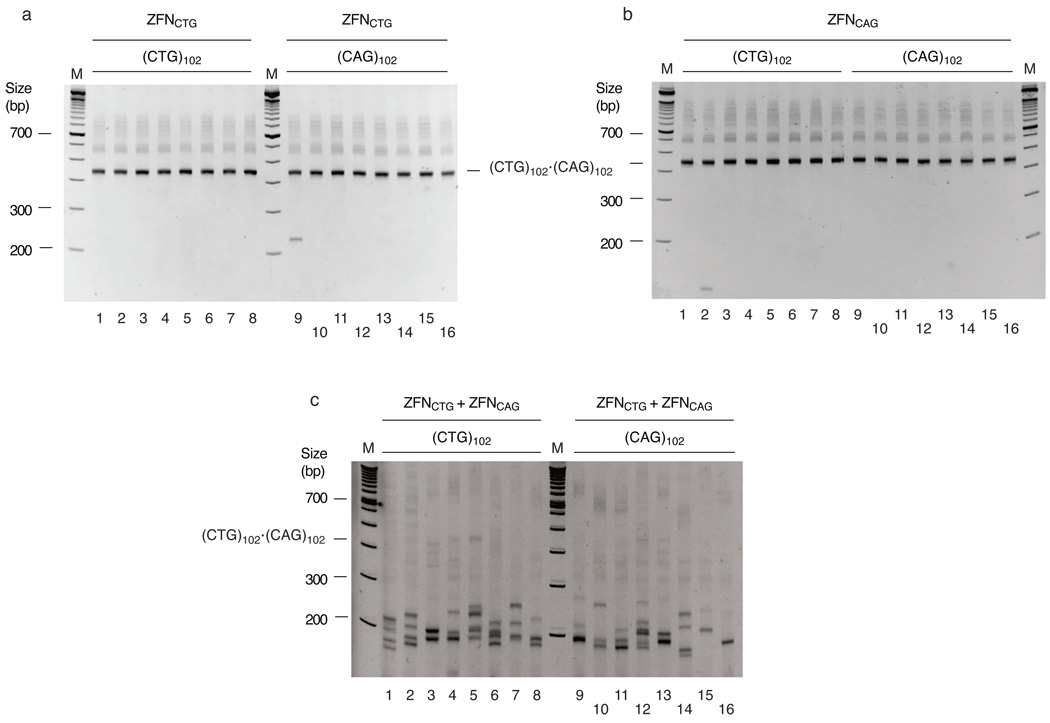
(CTG)102•(CAG)102 hairpin formation is suppressed by serum starvation. (CTG)102•(CAG)102 cells were grown for 25 population doublings and transferred to medium containing 0.5% serum for 48 hr. (a) spPCR of DNA from (CTG)102 cells (lanes 1–8) or (CAG)102 cells (lanes 9–16) transfected with the ZFNCTG expression plasmid. (b) spPCR of DNA from (CTG)102 cells (lanes 1–8) or (CAG)102 cells (lanes 9–16) transfected with the ZFNCAG expression plasmid. (c) spPCR of DNA from (CTG)102 cells (lanes 1–8) or (CAG)102 cells (lanes 9–16) transfected with the ZFNCAG and ZFNCAG expression plasmids.
Figure 6
Figure 6
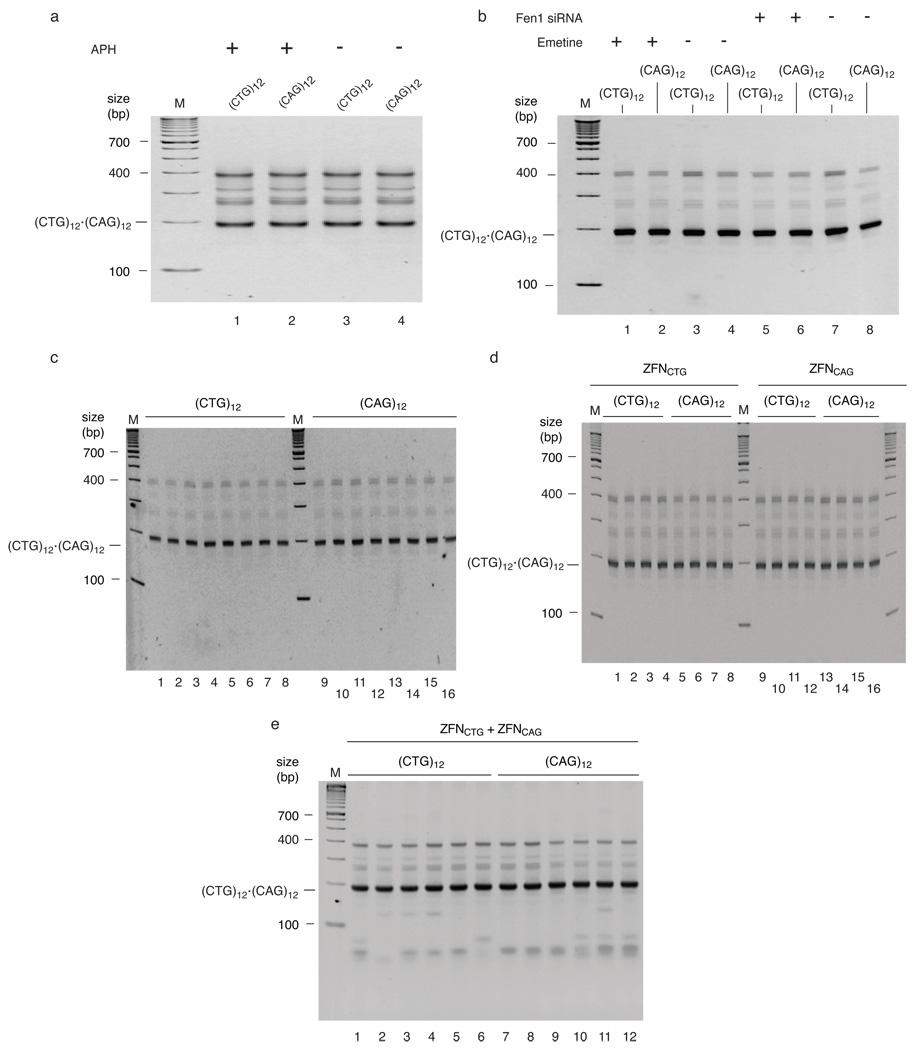
(CTG)12•(CAG)12 TNRs are stable in vivo. (CTG)12 or (CAG)12 cells were cultured for 25 population doublings. (a) PCR of DNA from (CTG)12 (lane 1, 3) or (CAG)12 cells (lane 2, 4) treated with aphidicolin, or mock treated, as indicated. (b) PCR of DNA from (CTG)12 (lane 1, 3, 5, 7) or (CAG)12 cells (lane 2, 4, 6, 8) treated with emetine, Fen1 siRNA, or mock treated, as indicated. (c) spPCR of DNA from untreated (CTG)12 (lane 1–8) or (CAG)12 cells (lane 9–16). (d) spPCR of DNA from (CTG)12 or (CAG)12 cells expressing ZFNCTG (lanes 1–8) or ZFNCAG (lanes 9–16), as indicated. (e) spPCR of DNA from (CTG)12 (Lanes 1–6) or (CAG)12 cells (lanes 7–12) expressing a 0.5:0.5 mixture of ZFNCTG and ZFNCAG.

References

    1. Pearson CE, Edamura KN, Cleary JD. Repeat instability: mechanisms of dynamic mutations. Nat Rev Genet. 2005;6:729–742. - PubMed
    1. Lia AS, et al. Somatic instability of the CTG repeat in mice transgenic for the myotonic dystrophy region is age dependent but not correlated to the relative intertissue transcription levels and proliferative capacities. Hum Mol Genet. 1998;7:1285–1291. - PubMed
    1. Fortune MT, Vassilopoulos C, Coolbaugh MI, Siciliano MJ, Monckton DG. Dramatic, expansion-biased, age-dependent, tissue-specific somatic mosaicism in a transgenic mouse model of triplet repeat instability. Hum Mol Genet. 2000;9:439–445. - PubMed
    1. Miret JJ, Pessoa-Brandao L, Lahue RS. Orientation-dependent and sequence-specific expansions of CTG/CAG trinucleotide repeats in Saccharomyces cerevisiae. Proc Natl Acad Sci U S A. 1998;95:12438–12443. - PMC - PubMed
    1. Petruska J, Arnheim N, Goodman MF. Stability of intrastrand hairpin structures formed by the CAG/CTG class of DNA triplet repeats associated with neurological diseases. Nucleic Acids Res. 1996;24:1992–1998. - PMC - PubMed

Publication types

MeSH terms