


Drug addiction endophenotypes: impulsive versus sensation-seeking personality traits
- PMID: 20678754
- PMCID: PMC3485555
- DOI: 10.1016/j.biopsych.2010.06.015
Drug addiction endophenotypes: impulsive versus sensation-seeking personality traits
Abstract
Background: Genetic factors have been implicated in the development of substance abuse disorders, but the role of pre-existing vulnerability in addiction is still poorly understood. Personality traits of impulsivity and sensation-seeking are highly prevalent in chronic drug users and have been linked with an increased risk for substance abuse. However, it has not been clear whether these personality traits are a cause or an effect of stimulant drug dependence.
Method: We compared self-reported levels of impulsivity and sensation-seeking between 30 sibling pairs of stimulant-dependent individuals and their biological brothers/sisters who did not have a significant drug-taking history and 30 unrelated, nondrug-taking control volunteers.
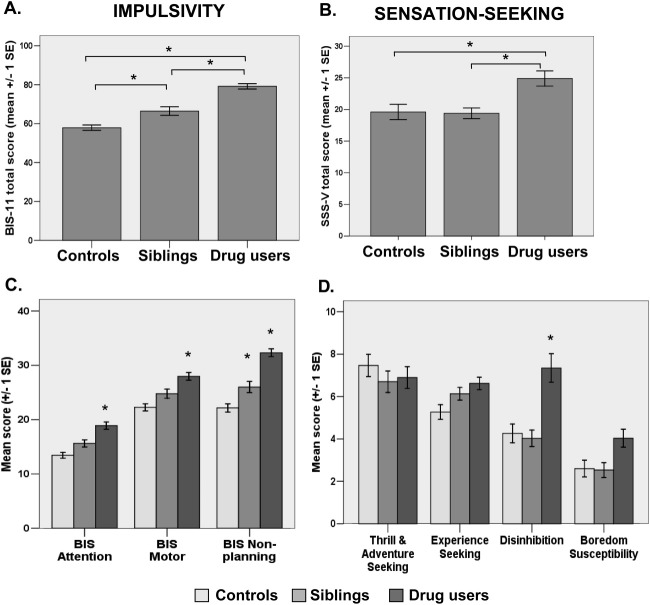
Results: Siblings of chronic stimulant users reported significantly higher levels of trait-impulsivity than control volunteers but did not differ from control volunteers with regard to sensation-seeking traits. Stimulant-dependent individuals reported significantly higher levels of impulsivity and sensation-seeking compared with both their siblings and control volunteers.
Conclusions: These data indicate that impulsivity is a behavioral endophenotype mediating risk for stimulant dependence that may be exacerbated by chronic drug exposure, whereas abnormal sensation-seeking is more likely to be an effect of stimulant drug abuse.
Copyright © 2010 Society of Biological Psychiatry. Published by Elsevier Inc. All rights reserved.
Figures
References
-
- Blanchard M.M., Mendelsohn D., Stamp J.A. The HR/LR model: Further evidence as an animal model of sensation-seeking. Neurosci Biobehav Rev. 2009;33:1145–1154. - PubMed
-
- Stanford M.S., Mathias C.W., Dougherty D.M., Lake S.L., Anderson N.E., Patton J.H. Fifty years of the Barratt Impulsiveness Scale: An update and review. Pers Individ Dif. 2009;47:385–395.
-
- Zuckerman M. Cambridge University Press; Cambridge, UK: 1994. Behavioural Expressions and Biosocial Bases of Sensation-Seeking.
