Impact of a mentoring and skills group program on mental health outcomes for maltreated children in foster care
- PMID: 20679165
- PMCID: PMC3009469
- DOI: 10.1001/archpediatrics.2010.124
Impact of a mentoring and skills group program on mental health outcomes for maltreated children in foster care
Abstract
Objective: To evaluate the efficacy of the Fostering Healthy Futures program in reducing mental health problems and associated problems.
Design: Randomized controlled trial.
Setting: Denver metropolitan area.
Participants: Children aged 9 to 11 years who were maltreated and placed in foster care.
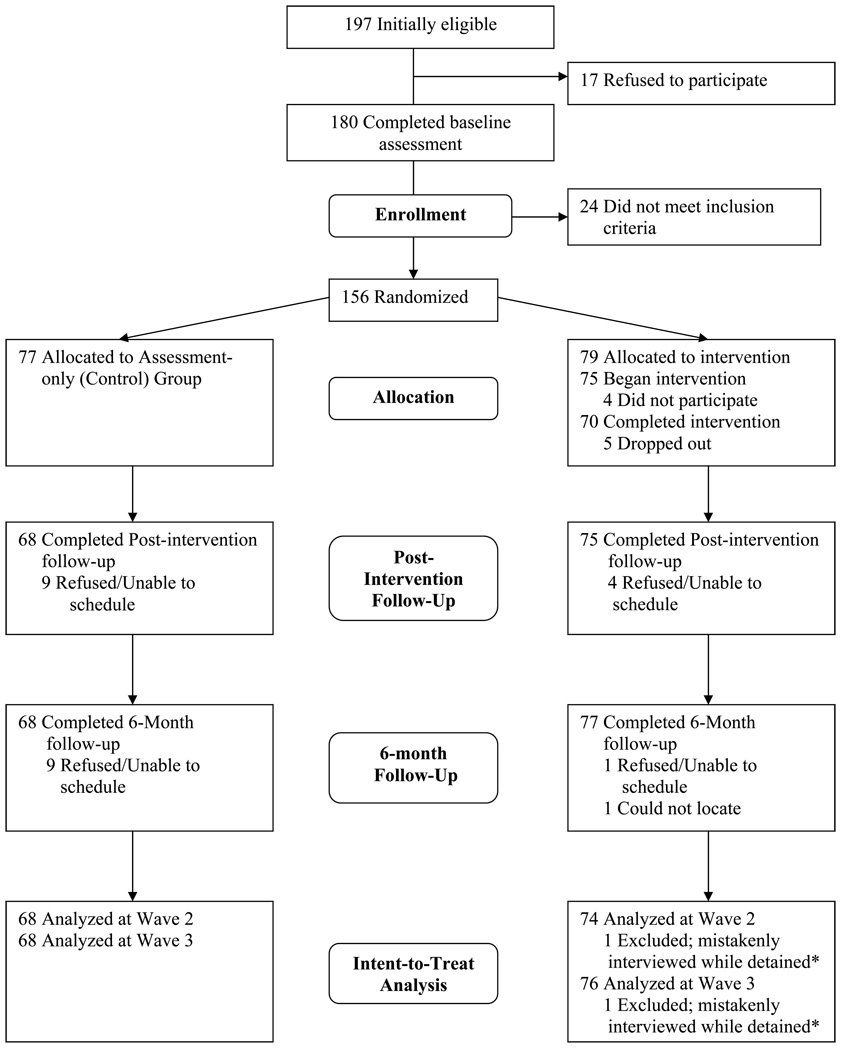
Intervention: Children in the control group (n=77) received an assessment of their cognitive, educational, and mental health functioning. Children in the intervention group (n=79) received the assessment and participated in a 9-month mentoring and skills group program.
Main outcome measures: Children and caregivers were interviewed at baseline prior to randomization, immediately following the intervention, and 6 months after the intervention. Teachers were interviewed 2 times after baseline. Measures included a multi-informant index of mental health problems, youth-reported symptoms of posttraumatic stress, dissociation, and quality of life, and caregiver- and youth-reported use of mental health services and psychotropic medications.
Results: After adjusting for covariates, intent-to-treat analyses demonstrated that the treatment group had fewer mental health problems on a multi-informant factor 6 months after the intervention (mean difference, -0.51; 95% confidence interval, -0.84 to -0.19), reported fewer symptoms of dissociation 6 months after the intervention (mean difference, -3.66; 95% confidence interval, -6.58 to -0.74), and reported better quality of life immediately following the intervention (mean difference, 0.11; 95% confidence interval, 0.03 to 0.19). Fewer youths in the intervention group than in the control group had received recent mental health therapy 6 months after the intervention according to youth report (53% vs 71%, respectively; relative risk=0.75; 95% confidence interval, 0.57 to 0.98).
Conclusions: A 9-month mentoring and skills group intervention for children in foster care can be implemented with fidelity and high uptake rates, resulting in improved mental health outcomes. Trial Registration clinicaltrials.gov Identifier: NCT00809315.
Figures
References
-
- Child Maltreatment 2007. Washington, DC: U.S. Government Printing Office; 2009. U.S. Department of Health and Human Services, Administration on Children, Youth and Families.
-
- U.S. Census Bureau. Statistical Abstract of the United States: 2009. 128th ed. Washington, DC: 2008. http://www.census.gov/prod/2008pubs/09statab/pop.pdf.
-
- US Department of Health & Human Services: Administration on Children, Youth and Families. The AFCARS Report Preliminary FY 2006 Estimates as of January 2008. 2009. [Accessed June 29, 2009]. http://www.acf.hhs.gov/programs/cb/stats_research/afcars/tar/report14.htm.
-
- Briere J. The APSAC handbook on child maltreatment. Thousand Oaks: Sage Publications; 1996. American Professional Society on the Abuse of Children.
-
- Child Welfare Information Gateway. Long-term consequences of child abuse and neglect. 2008. [Accessed April, 2008]. http://www.childwelfare.gov/pubs/factsheets/long_term_consequences.cfm.