


Probing the conformation of a prion protein fibril with hydrogen exchange
- PMID: 20679344
- PMCID: PMC2952231
- DOI: 10.1074/jbc.M110.114504
Probing the conformation of a prion protein fibril with hydrogen exchange
Abstract
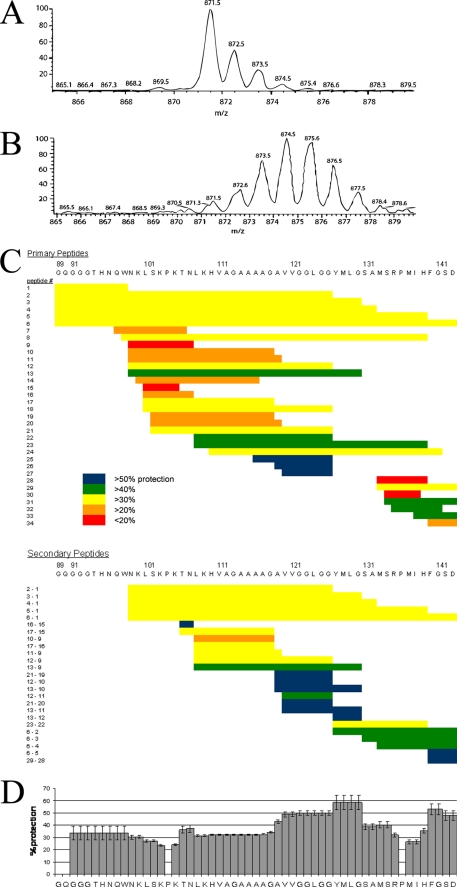
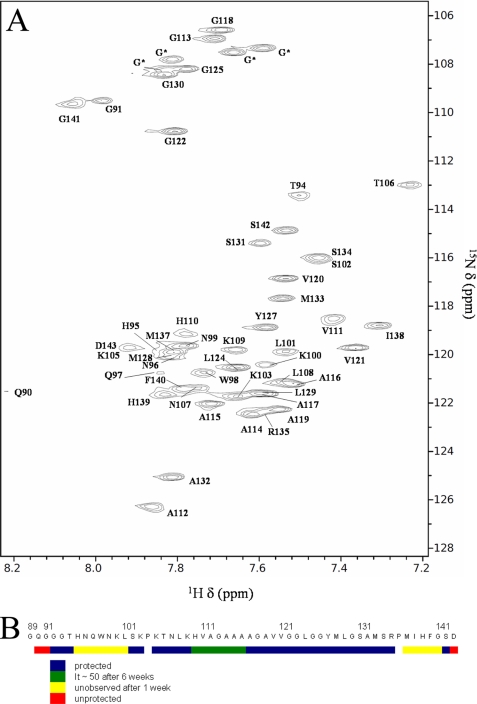
A fragment of the prion protein, PrP(89-143, P101L), bearing a mutation implicated in familial prion disease, forms fibrils that have been shown to induce prion disease when injected intracerebrally into transgenic mice expressing full-length PrP containing the P101L mutation. In this study, we utilize amide hydrogen exchange measurements to probe the organization of the peptide in its fibrillar form. We determined the extent of hydrogen exchange first by tandem proteolysis, liquid chromatography, and mass spectrometry (HXMS) and then by exchange-quenched NMR. Although single amide resolution is afforded by NMR measurements, HXMS is well suited to the study of natural prions because it does not require labeling with NMR active isotopes. Thus, natural prions obtained from infected animals can be compared with model systems such as PrP(89-143, P101L) studied here. In our study, we find two segments of sequence that display a high level of protection from exchange, residues 102-109 and 117-136. In addition, there is a region that displays exchange behavior consistent with the presence of a conformationally heterogeneous turn. We discuss our data with respect to several structural models proposed for infectious PrP aggregates and highlight HXMS as one of the few techniques well suited to studying natural prions.
Figures
References
-
- DeArmond S. J., Prusiner S. B. (1996) Current Topics in Microbiology and Immunology (Prusiner S. B. ed) Vol. 207, pp. 125–146, Springer, New York - PubMed
-
- Prusiner S. B. (2004) in Prion Biology and Diseases (Prusiner S. B. ed) pp. 89–141, Cold Spring Harbor Laboratory Press, Cold Spring Harbor, NY
-
- Legname G., Baskakov I. V., Nguyen H. O., Riesner D., Cohen F. E., DeArmond S. J., Prusiner S. B. (2004) Science 305, 673–676 - PubMed
Publication types
MeSH terms
Substances
Grants and funding
- GM037684/GM/NIGMS NIH HHS/United States
- R01 AI081982/AI/NIAID NIH HHS/United States
- CA099835/CA/NCI NIH HHS/United States
- AI068730/AI/NIAID NIH HHS/United States
- R01 GM020501/GM/NIGMS NIH HHS/United States
- GM020501/GM/NIGMS NIH HHS/United States
- AI2008031/AI/NIAID NIH HHS/United States
- R01 GM037684/GM/NIGMS NIH HHS/United States
- R33 CA099835/CA/NCI NIH HHS/United States
- AI076961/AI/NIAID NIH HHS/United States
- CA118595/CA/NCI NIH HHS/United States
- R21 CA099835/CA/NCI NIH HHS/United States
- AI081982/AI/NIAID NIH HHS/United States
- R21 CA118595/CA/NCI NIH HHS/United States
- R21 AI076961/AI/NIAID NIH HHS/United States
- AI072106/AI/NIAID NIH HHS/United States
- F32 GM020501/GM/NIGMS NIH HHS/United States
- GM066170/GM/NIGMS NIH HHS/United States
- P01 AI068730/AI/NIAID NIH HHS/United States
- R01 AI072106/AI/NIAID NIH HHS/United States
- R01 GM066170/GM/NIGMS NIH HHS/United States
LinkOut - more resources
Full Text Sources
Research Materials
