


Prolonged ischaemia impairs muscle blood flow and oxygen uptake dynamics during subsequent heavy exercise
- PMID: 20679356
- PMCID: PMC2998226
- DOI: 10.1113/jphysiol.2010.188698
Prolonged ischaemia impairs muscle blood flow and oxygen uptake dynamics during subsequent heavy exercise
Erratum in
-
Corrigendum. Prolonged ischaemia impairs muscle blood flow and oxygen uptake dynamics during subsequent heavy exercise.J Physiol. 2016 Apr 1;594(7):1957. doi: 10.1113/JP272229. Epub 2016 Mar 9. J Physiol. 2016. PMID: 27038108 Free PMC article. No abstract available.
Abstract
Muscle oxygen uptake ( ˙VO₂,mus) dynamics at the onset of exercise can be affected by prior heavy exercise.We tested the hypothesis that elevated forearm blood flow (FBF) following prior circulatory occlusion would also be associated with accelerated ˙VO₂,mus dynamics during subsequent heavy hand-grip exercise. Ten trained young men performed 5 min of heavy hand-grip exercise at 30% MVC as a control (CON), and four additional heavy bouts after brief recovery from: (1) prior heavy exercise (Heavy A), (2) heavy exercise followed by 2 min occlusion (Heavy B), (3) 15 min occlusion (Heavy C), and (4) 5 min occlusion with 1 min of moderate exercise during occlusion (Heavy D). FBF was measured by ultrasound and arterial venous oxygen content difference was calculated from venous blood samples to estimate ˙VO₂,mus. FBF and ˙VO₂,mus dynamics were quantified from the rise time. All priming conditions elevated FBF immediately before the start of subsequent heavy bout (Heavy A: 207.4 ±92.8, B: 207.8±75.8, C: 135.8±59.2, D: 199.5±59.0 vs. CON: 57.4±16.6mlmin−1, P <0.01). Unexpectedly, prior occlusion reduced FBF and O2 extraction at the onset of subsequent heavy exercise and consequently slowed ˙VO₂,mus dynamics (Heavy C: rise time=95.9±28.9 vs. CON: 58.6±14.3 s, P <0.01). FBF and ˙VO₂,mus dynamics were faster in Heavy A, B and D compared to CON (P <0.05). Overall, there was a positive correlation between the rise times for ˙VO₂,mus and FBF (r² =0.75) indicating that ˙VO₂,mus dynamics during heavy forearm exercise are linked to O₂ delivery in trained young men. To investigate a possible mechanism for slower adaptation of ˙VO₂,mus following ischaemia, the prior occlusion condition was repeated after ingesting a high dose of ibuprofen. This resulted in restoration of the FBF and ˙VO₂,mus to control levels suggesting that a prostaglandin-mediated mechanism after occlusion retarded the adaptation of blood flow and oxygen consumption at the onset of subsequent heavy exercise.
Figures

 and forearm blood flow (FBF) responses during a subsequent heavy exercise bout. The specific testing heavy bouts are named based on the testing protocol, Heavy A, Heavy B, Heavy C, and Heavy D. The moderate and heavy exercise bouts were set at 15% and 30% MVC, respectively.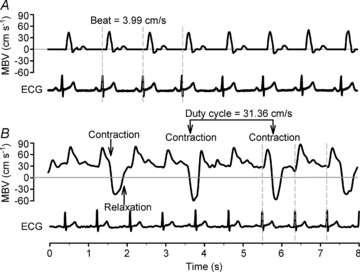


 at the start of the subsequent heavy exercise (bouts Heavy A–D) compared to the CON. By 45 s of exercise there were no significant differences in
  between CON and Heavy A, B and D. However,
  was lower up to 90 s of exercise in Heavy C compared to CON. There was an overshoot of
  at 90 s of exercise in CON and Heavy A compared to end exercise. Data points are the average responses of 10 subjects. Data are means ±
 in all conditions was not different compared to the CON.
  in Heavy A was significantly higher than CON from the 1st minute through the end of exercise.
 in Heavy B was significantly higher during exercise onset (from 30 s through 2 min).
  in Heavy C was depressed during exercise onset, but reached the same level as CON by the 4th minute of exercise. Heavy D was not different from the CON condition. Data points are the average responses of 10 subjects. Data are means ±
 ; r2= 0.75, P < 0.001. Data points are individual values of 10 subjects in each of 5 conditions (CON and Heavy A–D).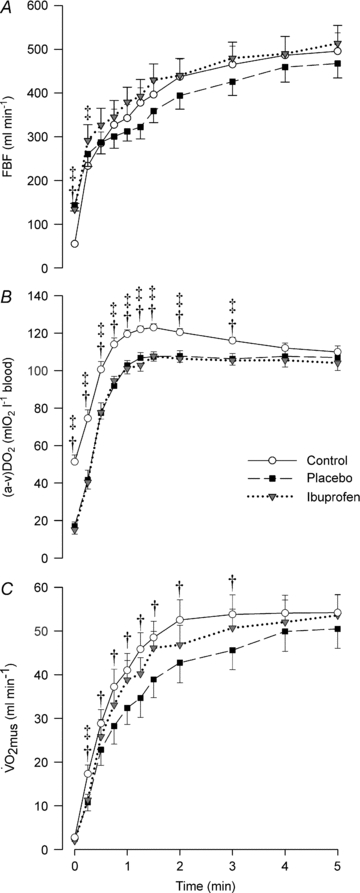
 at the start of the subsequent heavy exercise (Placebo and Ibuprofen) compared to Control. During exercise in the Placebo condition,
  and
and  responses were lower than Control up to 3 min, while with ibuprofen
  was lower than Control through the first 3 min with no differences in
  . Data points are the average responses of 8 subjects not included in previous figures. Data are means ±
References
-
- Agewall S, Doughty RN, Bagg W, Whalley GA, Braatvedt G, Sharpe N. Comparison of ultrasound assessment of flow-mediated dilatation in the radial and brachial artery with upper and forearm cuff positions. Clin Physiol. 2001;21:9–14. - PubMed
-
- Bangsbo J, Gibala MJ, Krustrup P, Gonzalez-Alonso J, Saltin B. Enhanced pyruvate dehydrogenase activity does not affect muscle O2 uptake at onset of intense exercise in humans. Am J Physiol Regul Integr Comp Physiol. 2002;282:R273–R280. - PubMed
-
- Bangsbo J, Krustrup P, Gonzalez-Alonso J, Boushel R, Saltin B. Muscle oxygen kinetics at onset of intense dynamic exercise in humans. Am J Physiol Regul Integr Comp Physiol. 2000;279:R899–R906. - PubMed
-
- Barstow TJ, Mole PA. Linear and nonlinear characteristics of oxygen uptake kinetics during heavy exercise. J Appl Physiol. 1991;71:2099–2106. - PubMed
-
- Betik AC, Luckham VB, Hughson RL. Flow-mediated dilation in human brachial artery after different circulatory occlusion conditions. Am J Physiol Heart Circ Physiol. 2004;286:H442–H448. - PubMed
Publication types
MeSH terms
Substances
LinkOut - more resources
Full Text Sources
Other Literature Sources
Medical
