


Skin thickness progression rate: a predictor of mortality and early internal organ involvement in diffuse scleroderma
- PMID: 20679474
- PMCID: PMC3881170
- DOI: 10.1136/ard.2009.127621
Skin thickness progression rate: a predictor of mortality and early internal organ involvement in diffuse scleroderma
Erratum in
- Ann Rheum Dis. 2011 Jul;70(7):1350
Abstract
Objective: To examine the association of skin thickness progression rate (STPR) with mortality, and as a predictor of future internal organ involvement in an inception cohort of diffuse cutaneous systemic sclerosis (SSc) patients.
Methods: Diffuse cutaneous SSc patients older than 16 years of age evaluated at the University of Pittsburgh within 2 years of the first evidence of skin thickening between 1980 and 2005 were eligible. The authors calculated the STPR on these patients, and examined the relationship of this variable to the development of early internal organ involvement and short-term mortality using logistic regression.
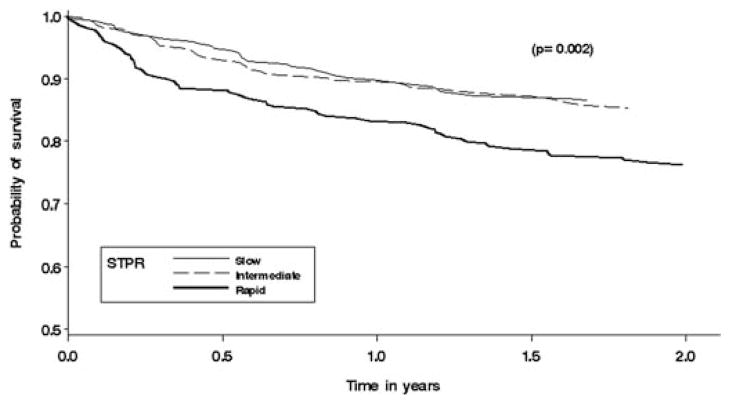
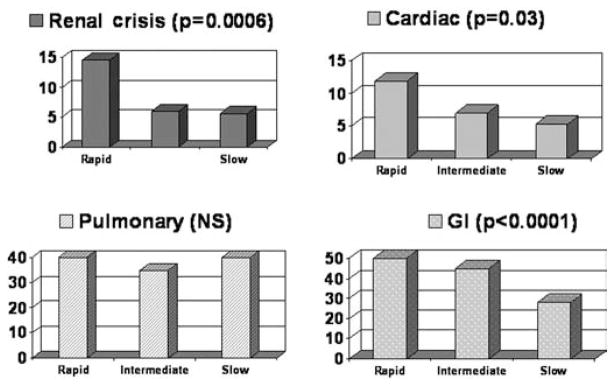
Results: 826 patients were included in the analysis. Patients with a rapid STPR experienced significantly reduced short-term survival at 1 and 2 years from the time of first Pittsburgh evaluation (p=0.002). Patients with a rapid STPR were more likely to develop renal crisis within 1-2 years of follow-up. Rapid STPR was found to be an independent predictor of both mortality (OR 1.72; 95% CI 1.13 to 2.62; p=0.01) and 'renal crisis' (OR 2.05, 95% CI 1.10 to 3.85; p=0.02) within 2 years from first evaluation.
Conclusion: The STPR is an easy measure to perform at the time of initial evaluation for identifying those diffuse cutaneous SSc patients who are at increased risk of mortality and the development of renal crisis during the following 2 years.
Conflict of interest statement
Figures
References
-
- Steen VD, Medsger TA, Jr, Osial TA, Jr, et al. Factors predicting development of renal involvement in progressive systemic sclerosis. Am J Med. 1984;76:779–86. - PubMed
-
- Medsger TA, Jr, Bombardieri S, Czirjak L, et al. Assessment of disease severity and prognosis. Clin Exp Rheumatol. 2003;21(3 Suppl 29):S42–6. - PubMed
-
- Perera A, Fertig N, Lucas M, et al. Clinical subsets, skin thickness progression rate, and serum antibody levels in systemic sclerosis patients with anti-topoisomerase I antibody. Arthritis Rheum. 2007;56:2740–6. - PubMed
-
- Clements PJ, Hurwitz EL, Wong WK, et al. Skin thickness score as a predictor and correlate of outcome in systemic sclerosis: high-dose versus low-dose penicillamine trial. Arthritis Rheum. 2000;43:2445–54. - PubMed
-
- Shand L, Lunt M, Nihtyanova S, et al. Relationship between change in skin score and disease outcome in diffuse cutaneous systemic sclerosis: application of a latent linear trajectory model. Arthritis Rheum. 2007;56:2422–31. - PubMed
Publication types
MeSH terms
Grants and funding
LinkOut - more resources
Full Text Sources
Other Literature Sources
