


Origin and molecular evolution of the determinant of methicillin resistance in staphylococci
- PMID: 20679504
- PMCID: PMC2944575
- DOI: 10.1128/AAC.00356-10
Origin and molecular evolution of the determinant of methicillin resistance in staphylococci
Erratum in
- Antimicrob Agents Chemother. 2011 Feb;55(2):946
Abstract
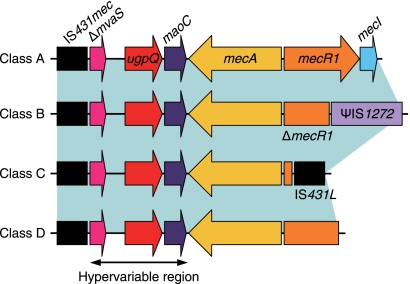
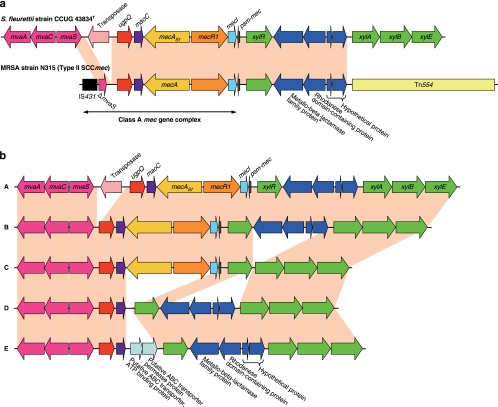
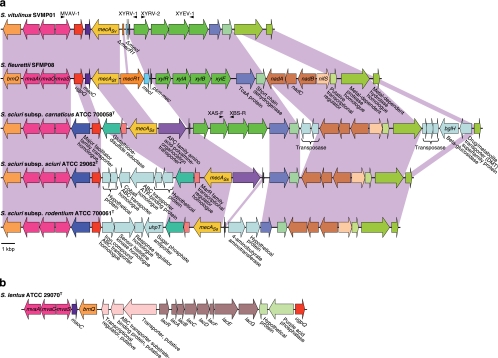
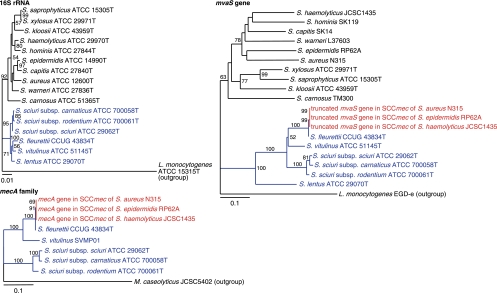
Methicillin-resistant Staphylococcus aureus (MRSA) is one of the most important multidrug-resistant pathogens around the world. MRSA is generated when methicillin-susceptible S. aureus (MSSA) exogenously acquires a methicillin resistance gene, mecA, carried by a mobile genetic element, staphylococcal cassette chromosome mec (SCCmec), which is speculated to be transmissible across staphylococcal species. However, the origin/reservoir of the mecA gene has remained unclear. Finding the origin/reservoir of the mecA gene is important for understanding the evolution of MRSA. Moreover, it may contribute to more effective control measures for MRSA. Here we report on one of the animal-related Staphylococcus species, S. fleurettii, as the highly probable origin of the mecA gene. The mecA gene of S. fleurettii was found on the chromosome linked with the essential genes for the growth of staphylococci and was not associated with SCCmec. The mecA locus of the S. fleurettii chromosome has a sequence practically identical to that of the mecA-containing region (∼12 kbp long) of SCCmec. Furthermore, by analyzing the corresponding gene loci (over 20 kbp in size) of S. sciuri and S. vitulinus, which evolved from a common ancestor with that of S. fleurettii, the speciation-related mecA gene homologues were identified, indicating that mecA of S. fleurettii descended from its ancestor and was not recently acquired. It is speculated that SCCmec came into form by adopting the S. fleurettii mecA gene and its surrounding chromosomal region. Our finding suggests that SCCmec was generated in Staphylococcus cells living in animals by acquiring the intrinsic mecA region of S. fleurettii, which is a commensal bacterium of animals.
Figures
References
-
- Chandler, M., and J. Mahillon. 2002. Insertion sequences revisited, p. 305-366. In N. L. Craig et al. (ed.), Mobile DNA II, 2nd ed. ASM Press, Washington, DC.
-
- Clinical and Laboratory Standards Institute. 2009. Methods for dilution antimicrobial susceptibility tests for bacteria that grow aerobically, 8th ed., vol. 29, p. 2. Approved standard M7-A8. Clinical and Laboratory Standards Institute, Wayne, PA.
-
- Clinical and Laboratory Standards Institute. 2009. Performance standards for antimicrobial susceptibility testing; 19th informational supplement M100-S19, vol. 29, p. 3. Clinical and Laboratory Standards Institute, Wayne, PA.
-
- Couto, I., H. de Lencastre, E. Severina, W. Kloos, J. A. Webster, R. J. Hubner, I. S. Sanches, and A. Tomasz. 1996. Ubiquitous presence of a mecA homologue in natural isolates of Staphylococcus sciuri. Microb. Drug Resist. 2:377-391. - PubMed
Publication types
MeSH terms
Substances
Associated data
- Actions
- Actions
- Actions
- Actions
- Actions
- Actions
- Actions
- Actions
- Actions
- Actions
- Actions
LinkOut - more resources
Full Text Sources
