


Positional and neighboring base pair effects on the thermodynamic stability of RNA single mismatches
- PMID: 20681613
- PMCID: PMC2991393
- DOI: 10.1021/bi100146z
Positional and neighboring base pair effects on the thermodynamic stability of RNA single mismatches
Abstract
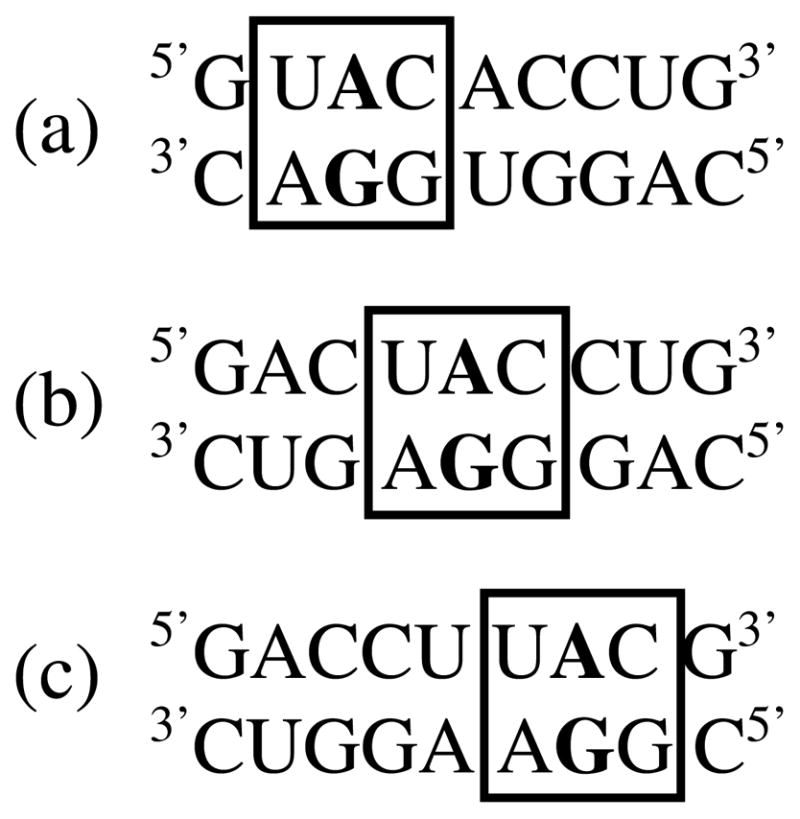
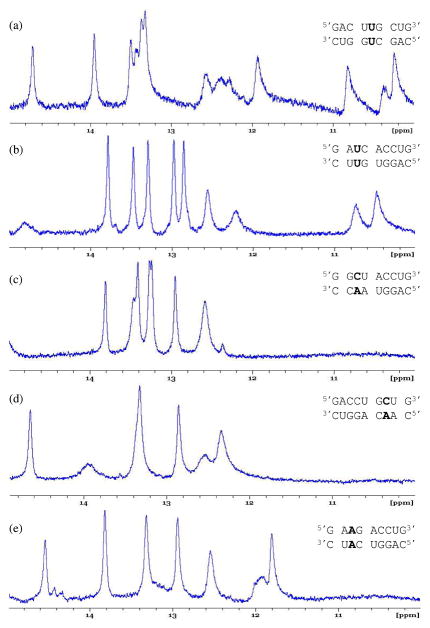
Many naturally occurring RNA structures contain single mismatches, many of which occur near the ends of helices. However, previous thermodynamic studies have focused their efforts on thermodynamically characterizing centrally placed single mismatches. Additionally, algorithms currently used to predict secondary structure from sequence are based on two assumptions for predicting the stability of RNA duplexes containing this motif. It has been assumed that the thermodynamic contribution of small RNA motifs is independent of both its position in the duplex and the identity of the non-nearest neighbors. Thermodynamically characterizing single mismatches three nucleotides from both the 3' and 5' ends (i.e., off-center) of an RNA duplex and comparing these results to those of the same single mismatch-nearest neighbor combination centrally located have allowed for the investigation of these effects. The thermodynamic contributions of 13 single mismatch-nearest neighbor combinations are reported, but only nine combinations are studied at all three duplex positions and are used to determine trends and patterns. In general, the 5'- and 3'-shifted single mismatches are relatively similar, on average, and more favorable in free energy than centrally placed single mismatches. However, close examination and comparison shows there are several associated idiosyncrasies with these identified general trends. These peculiarities may be due, in part, to the identities of the single mismatch, the nearest neighbors, and the non-nearest neighbors, along with the effects of the single mismatch position in the duplex. The prediction algorithm recently proposed by Davis and Znosko [Davis, A. R., and Znosko, B. M. (2008) Biochemistry 47, 10178-10187] is used to predict the thermodynamic parameters of single mismatch contribution, and those values are compared to the measured values presented here. This comparison suggests the proposed model is a good approximation but could be improved by the addition of parameters that account for positional and/or non-nearest neighbor effects. However, more data are required to improve our understanding of these effects and to accurately account for them.
Figures
References
-
- Peritz AE, Kierzek R, Sugimoto N, Turner DH. Thermodynamic study of internal loops in oligoribonucleotides: Symmetric loops are more stable than asymmetric loops. Biochemistry. 1991;30:6428–6436. - PubMed
-
- Calin-Jageman I, Nicholson AW. Mutational analysis of an RNA internal loop as a reactivity epitope for Escherichia coli ribonuclease III substrates. Biochemistry. 2003;42:5025–5034. - PubMed
-
- Saito H, Richardson CC. Processing of mRNA by ribonuclease III regulates expression of gene 1.2 of bacteriophage T7. Cell. 1981;27:533–542. - PubMed
-
- Du T, Zamore PD. MicroPrimer: the biogenesis and function of microRNA. Development. 2005;132:4645–4652. - PubMed
Publication types
MeSH terms
Substances
Grants and funding
LinkOut - more resources
Full Text Sources
