


Enantioselective synthesis of allylboronates bearing a tertiary or quaternary B-substituted stereogenic carbon by NHC-Cu-catalyzed substitution reactions
- PMID: 20681681
- PMCID: PMC2917266
- DOI: 10.1021/ja104254d
Enantioselective synthesis of allylboronates bearing a tertiary or quaternary B-substituted stereogenic carbon by NHC-Cu-catalyzed substitution reactions
Abstract
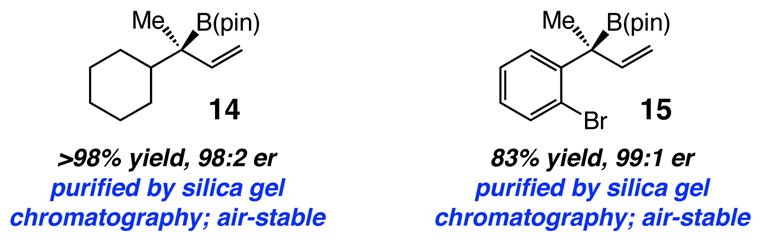
Allylic substitutions that afford alpha-substituted allylboronates bearing B-substituted tertiary or quaternary carbon stereogenic centers are presented. C-B bond-forming reactions, catalyzed by chiral bidentate Cu-NHC complexes, are performed in the presence of commercially available bis(pinacolato)diboron. Transformations proceed in high yield (up to >98%) and site selectivity (>98% S(N)2'), and in up to >99:1 enantiomer ratio. Trans- or cis-disubstituted alkenes can be used; alkyl- (linear as well as branched) and aryl-trisubstituted allylic carbonates serve as effective substrates. Allylboronates that bear a quaternary carbon center are air-stable and can be easily purified by silica gel chromatography; in contrast, secondary allylboronates cannot be purified in the same manner and are significantly less stable. Oxidation of the enantiomerically enriched products furnishes secondary or tertiary allylic alcohols, valuable small molecules that cannot be easily obtained in high enantiomeric purity by alternative synthesis or kinetic resolution approaches.
Figures
References
-
- Hall DG, editor. Boronic Acids. Wiley-VCH; Weinheim, Germany: 2000.
-
- Ito H, Ito S, Sasaki Y, Matsuura K, Sawamura M. J Am Chem Soc. 2007;129:14856. - PubMed
-
-
For catalytic enantioselective synthesis of α-substituted allyl boronates (tertiary C–B), see: Gao X, Hall DG. J Am Chem Soc. 2003;125:9308.Pelz NF, Woodward AR, Burks HE, Sieber JD, Morken JP. J Am Chem Soc. 2004;126:16328.Gerdin M, Moberg C. Adv Synth Catal. 2005;347:749.Carosi L, Hall DG. Angew Chem, Int Ed. 2007;46:5913.Peng F, Hall DG. Tetrahedron Lett. 2007;48:3305.For related auxiliary-based methods, see: Fang GY, Aggarwal VK. Angew Chem, Int Ed. 2007;46:359. and references cited therein.
-
-
-
For example, see: Larsen AO, Leu W, Oberhuber CN, Campbell JE, Hoveyda AH. J Am Chem Soc. 2004;126:11130.Van Veldhuizen JJ, Campbell JE, Giudici RE, Hoveyda AH. J Am Chem Soc. 2005;127:6877.Brown MK, May TL, Baxter CA, Hoveyda AH. Angew Chem, Int Ed. 2007;46:1097.May TL, Brown MK, Hoveyda AH. Angew Chem, Int Ed. 2008;47:7358.Brown MK, Hoveyda AH. J Am Chem Soc. 2008;130:12904.
-
-
-
To the best of our knowledge, there is only a limited number of reported examples involving a chiral enantiomerically enriched substrate (non-catalytic) for enantioselective synthesis of an α-substituted allyl boronate with a quaternary carbon stereogenic center. See: Stymiest JL, Bagutski V, French RM, Aggarwal VK. Nature. 2008;456:778.Bagutski V, Ros A, Aggarwal VK. Tetrahedron. 2009;65:9956.
-
Publication types
MeSH terms
Substances
Grants and funding
LinkOut - more resources
Full Text Sources
Other Literature Sources
Miscellaneous
