


Singing teaching as a therapy for chronic respiratory disease--a randomised controlled trial and qualitative evaluation
- PMID: 20682030
- PMCID: PMC2920262
- DOI: 10.1186/1471-2466-10-41
Singing teaching as a therapy for chronic respiratory disease--a randomised controlled trial and qualitative evaluation
Abstract
Background: Despite optimal pharmacological therapy and pulmonary rehabilitation, patients with COPD continue to be breathless. There is a need to develop additional strategies to alleviate symptoms. Learning to sing requires control of breathing and posture and might have benefits that translate into daily life.
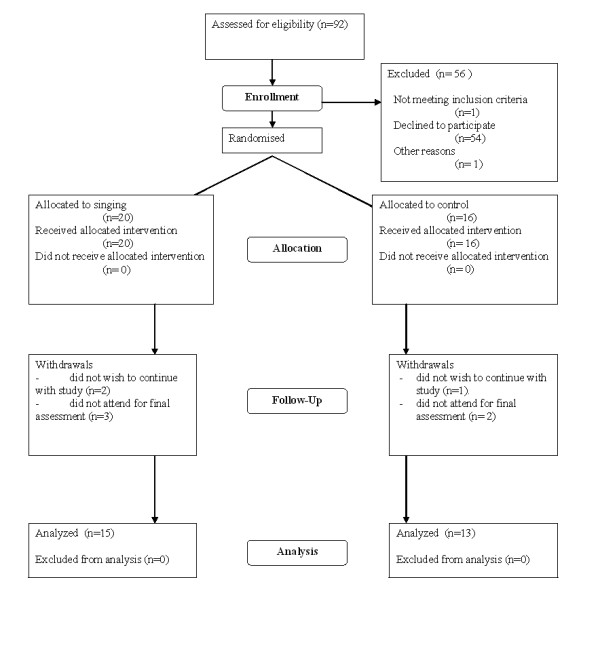
Methods: To test this hypothesis we performed a randomised controlled trial, comparing a six week course of twice weekly singing classes to usual care, in 28 COPD patients. The experience of singing was assessed in a qualitative fashion, through interviews with a psychologist. In addition, we surveyed patients with chronic respiratory conditions who participated in a series of open singing workshops.
Results: In the RCT, the physical component score of the SF36 improved in the singers (n = 15) compared to the controls (n = 13); +7.5(14.6) vs. -3.8(8.4) p = 0.02. Singers also had a significant fall in HAD anxiety score; -1.1(2.7) vs. +0.8(1.7) p = 0.03. Singing did not improve single breath counting, breath hold time or shuttle walk distance. In the qualitative element, 8 patients from the singing group were interviewed. Positive effects on physical sensation, general well-being, community/social support and achievement/efficacy emerged as common themes. 150 participants in open workshops completed a questionnaire. 96% rated the workshops as "very enjoyable" and 98% thought the workshop had taught them something about breathing in a different way. 81% of attendees felt a "marked physical difference" after the workshop.
Conclusion: Singing classes can improve quality of life measures and anxiety and are viewed as a very positive experience by patients with respiratory disease; no adverse consequences of participation were observed.
Trial registration: Current Controlled Trials--ISRCTN17544114.
References
-
- O'Donnell DE, Bertley JC, Chau LK, Webb KA. Qualitative aspects of exertional breathlessness in chronic airflow limitation: pathophysiologic mechanisms. Am J Respir Crit Care Med. 1997;155:109–115. - PubMed
-
- Bausewein C, Booth S, Gysels M, Higginson I. Non-pharmacological interventions for breathlessness in advanced stages of malignant and non-malignant diseases. Cochrane Database Syst Rev. 2008. p. CD005623. - PubMed
Publication types
MeSH terms
Associated data
LinkOut - more resources
Full Text Sources
Other Literature Sources
Medical
