


Electron microscopy and persistence length analysis of semi-rigid smooth muscle tropomyosin strands
- PMID: 20682264
- PMCID: PMC2913205
- DOI: 10.1016/j.bpj.2010.05.004
Electron microscopy and persistence length analysis of semi-rigid smooth muscle tropomyosin strands
Abstract
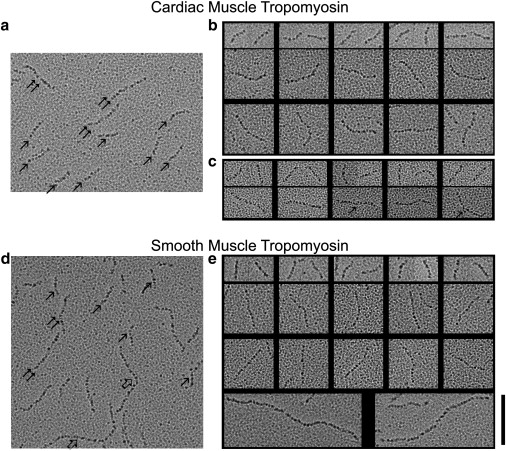
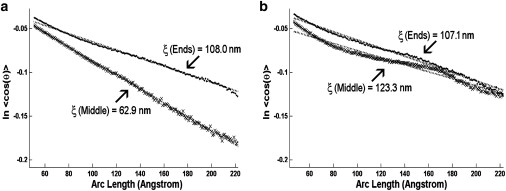
The structural mechanics of tropomyosin are essential determinants of its affinity and positioning on F-actin. Thus, tissue-specific differences among tropomyosin isoforms may influence both access of actin-binding proteins along the actin filaments and the cooperativity of actin-myosin interactions. Here, 40 nm long smooth and striated muscle tropomyosin molecules were rotary-shadowed and compared by means of electron microscopy. Electron microscopy shows that striated muscle tropomyosin primarily consists of single molecules or paired molecules linked end-to-end. In contrast, smooth muscle tropomyosin is more a mixture of varying-length chains of end-to-end polymers. Both isoforms are characterized by gradually bending molecular contours that lack obvious signs of kinking. The flexural stiffness of the tropomyosins was quantified and evaluated. The persistence lengths along the shaft of rotary-shadowed smooth and striated muscle tropomyosin molecules are equivalent to each other (approximately 100 nm) and to values obtained from molecular-dynamics simulations of the tropomyosins; however, the persistence length surrounding the end-to-end linkage is almost twofold higher for smooth compared to cardiac muscle tropomyosin. The tendency of smooth muscle tropomyosin to form semi-rigid polymers with continuous and undampened rigidity may compensate for the lack of troponin-based structural support in smooth muscles and ensure positional fidelity on smooth muscle thin filaments.
2010 Biophysical Society. Published by Elsevier Inc. All rights reserved.
Figures
References
-
- Gunning P.W., Schevzov G., Hardeman E.C. Tropomyosin isoforms: divining rods for actin cytoskeleton function. Trends Cell Biol. 2005;15:333–341. - PubMed
-
- Gunning P.W., O'Neill G., Hardeman E. Tropomyosin-based regulation of the actin cytoskeleton in time and space. Physiol. Rev. 2008;88:1–35. - PubMed
-
- Perry S.V. What is the role of tropomyosin in the regulation of muscle contraction? J. Muscle Res. Cell Motil. 2001;24:593–596. - PubMed
-
- Brown J.H., Cohen C. Regulation of muscle contraction by tropomyosin and troponin: how structure illuminates function. Adv. Protein Chem. 2005;71:121–159. - PubMed
-
- Hitchcock-DeGregori S.E. Tropomyosin: function follows form. Tropomyosin and the steric mechanism of muscle regulation. Adv. Exp. Med. Biol. 2008;644:60–72. - PubMed
Publication types
MeSH terms
Substances
Grants and funding
- HL63774/HL/NHLBI NIH HHS/United States
- R01 HL036153/HL/NHLBI NIH HHS/United States
- R01 HL063774/HL/NHLBI NIH HHS/United States
- AR55958/AR/NIAMS NIH HHS/United States
- T32 HL007224/HL/NHLBI NIH HHS/United States
- HL38834/HL/NHLBI NIH HHS/United States
- RR08426/RR/NCRR NIH HHS/United States
- R37 HL036153/HL/NHLBI NIH HHS/United States
- HL007224/HL/NHLBI NIH HHS/United States
- HL36153/HL/NHLBI NIH HHS/United States
- R01 AR055958/AR/NIAMS NIH HHS/United States
- HL86655/HL/NHLBI NIH HHS/United States
- P01 HL086655/HL/NHLBI NIH HHS/United States
- R01 HL038834/HL/NHLBI NIH HHS/United States
LinkOut - more resources
Full Text Sources
Molecular Biology Databases
