


Molecular analyses of human induced pluripotent stem cells and embryonic stem cells
- PMID: 20682452
- PMCID: PMC3276111
- DOI: 10.1016/j.stem.2010.06.019
Molecular analyses of human induced pluripotent stem cells and embryonic stem cells
Abstract
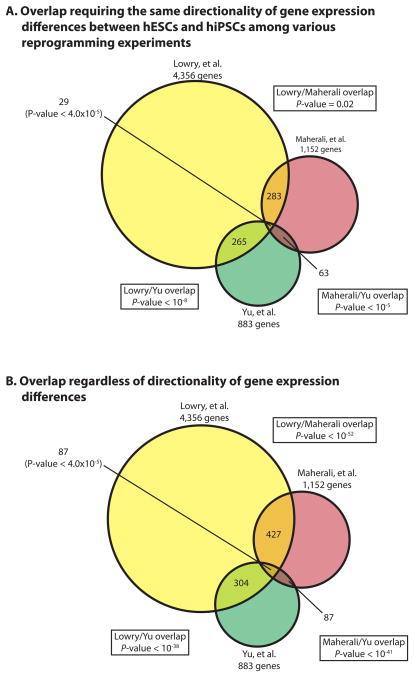
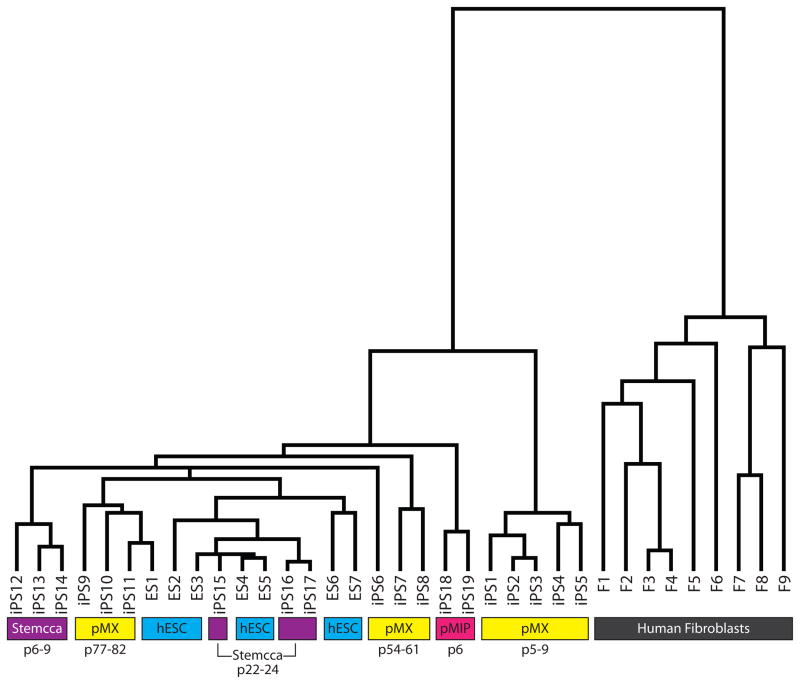
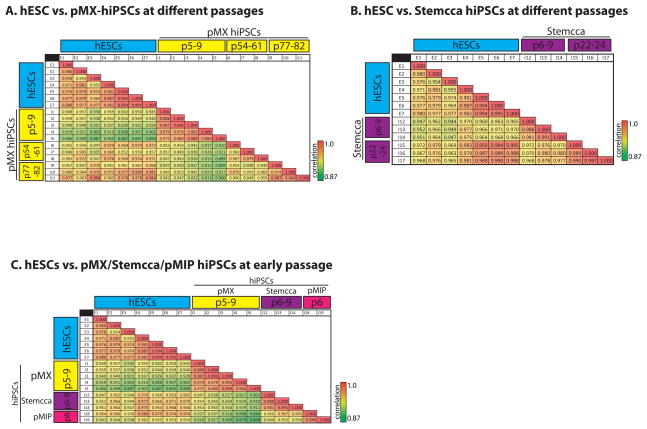
Recent work from our group and others has argued that human induced pluripotent stem cells (hiPSCs) generated by the introduction of four viruses bearing reprogramming factors differ from human embryonic stem cells (hESCs) at the level of gene expression (Chin et al., 2009). Many of the differences seen were common across independent labs and, at least to some extent, are thought to be a result of residual expression of donor cell-specific genes (Chin et al., 2009; Ghosh et al., 2010; Marchetto et al., 2009). Two new reports reanalyze similar expression data sets as those used in Chin et al. (2009) and come to different conclusions (Newman and Cooper, 2010; Guenther et al., 2010). We compare various approaches to perform gene expression meta-analysis that all support our original conclusions and present new data to demonstrate that polycistronic delivery of the reprogramming factors and extended culture brings hiPSCs transcriptionally closer to hESCs.
Copyright 2010 Elsevier Inc. All rights reserved.
Figures
Comment on
-
Chromatin structure and gene expression programs of human embryonic and induced pluripotent stem cells.Cell Stem Cell. 2010 Aug 6;7(2):249-57. doi: 10.1016/j.stem.2010.06.015. Cell Stem Cell. 2010. PMID: 20682450 Free PMC article.
-
Lab-specific gene expression signatures in pluripotent stem cells.Cell Stem Cell. 2010 Aug 6;7(2):258-62. doi: 10.1016/j.stem.2010.06.016. Cell Stem Cell. 2010. PMID: 20682451
References
-
- Baldi P, Long AD. A Bayesian framework for the analysis of microarray expression data: regularized t -test and statistical inferences of gene changes. Bioinformatics (Oxford, England) 2001;17:509–519. - PubMed
-
- Boland MJ, Hazen JL, Nazor KL, Rodriguez AR, Gifford W, Martin G, Kupriyanov S, Baldwin KK. Adult mice generated from induced pluripotent stem cells. Nature. 2009;461:91–94. - PubMed
-
- Chang CW, Lai YS, Pawlik KM, Liu K, Sun CW, Li C, Schoeb TR, Townes TM. Polycistronic lentiviral vector for “hit and run” reprogramming of adult skin fibroblasts to induced pluripotent stem cells. Stem Cells. 2009;27:1042–1049. - PubMed
Publication types
MeSH terms
Grants and funding
LinkOut - more resources
Full Text Sources
Other Literature Sources
Molecular Biology Databases
