The Salmonella mutagenicity assay: the stethoscope of genetic toxicology for the 21st century
- PMID: 20682480
- PMCID: PMC2974687
- DOI: 10.1289/ehp.1002336
The Salmonella mutagenicity assay: the stethoscope of genetic toxicology for the 21st century
Abstract
Objectives: According to the 2007 National Research Council report Toxicology for the Twenty-First Century, modern methods (e.g., "omics," in vitro assays, high-throughput testing, computational methods) will lead to the emergence of a new approach to toxicology. The Salmonella mammalian microsome mutagenicity assay has been central to the field of genetic toxicology since the 1970s. Here we document the paradigm shifts engendered by the assay, the validation and applications of the assay, and how the assay is a model for future in vitro toxicology assays.
Data sources: We searched PubMed, Scopus, and Web of Knowledge using key words relevant to the Salmonella assay and additional genotoxicity assays.
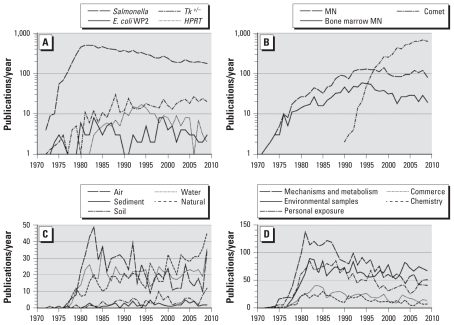
Data extraction: We merged the citations, removing duplicates, and categorized the papers by year and topic.
Data synthesis: The Salmonella assay led to two paradigm shifts: that some carcinogens were mutagens and that some environmental samples (e.g., air, water, soil, food, combustion emissions) were mutagenic. Although there are > 10,000 publications on the Salmonella assay, covering tens of thousands of agents, data on even more agents probably exist in unpublished form, largely as proprietary studies by industry. The Salmonella assay is a model for the development of 21st century in vitro toxicology assays in terms of the establishment of standard procedures, ability to test various agents, transferability across laboratories, validation and testing, and structure-activity analysis.
Conclusions: Similar to a stethoscope as a first-line, inexpensive tool in medicine, the Salmonella assay can serve a similar, indispensable role in the foreseeable future of 21st century toxicology.
Figures
Similar articles
-
In silico assessment of chemical mutagenesis in comparison with results of Salmonella microsome assay on 909 chemicals.Mutat Res. 2005 Dec 30;588(2):129-35. doi: 10.1016/j.mrgentox.2005.09.009. Epub 2005 Oct 28. Mutat Res. 2005. PMID: 16257575
-
Detection of mutagenic impurities in carcinogens and noncarcinogens by high-pressure liquid chromatography and the Salmonella/microsome test.Cancer Res. 1978 Feb;38(2):431-8. Cancer Res. 1978. PMID: 340030
-
A perspective on the development of the Ames Salmonella/mammalian-microsome mutagenicity assay.Mutat Res Genet Toxicol Environ Mutagen. 2019 May;841:14-16. doi: 10.1016/j.mrgentox.2019.04.004. Epub 2019 Apr 20. Mutat Res Genet Toxicol Environ Mutagen. 2019. PMID: 31138405
-
Mutagenic potential of medicinal plants evaluated by the Ames Salmonella/microsome assay: A systematic review.Mutat Res Rev Mutat Res. 2020 Oct-Dec;786:108338. doi: 10.1016/j.mrrev.2020.108338. Epub 2020 Oct 18. Mutat Res Rev Mutat Res. 2020. PMID: 33339578
-
The Ames Salmonella/microsome mutagenicity assay.Mutat Res. 2000 Nov 20;455(1-2):29-60. doi: 10.1016/s0027-5107(00)00064-6. Mutat Res. 2000. PMID: 11113466 Review.
Cited by
-
Influences of cold atmospheric plasma on microbial safety, physicochemical and sensorial qualities of meat products.J Food Sci Technol. 2018 Mar;55(3):846-857. doi: 10.1007/s13197-017-3020-y. Epub 2017 Dec 30. J Food Sci Technol. 2018. PMID: 29487426 Free PMC article.
-
In vitro and in vivo effects of 5-aminotetrazole (5-AT), an energetic compound.Regul Toxicol Pharmacol. 2020 Mar;111:104573. doi: 10.1016/j.yrtph.2019.104573. Epub 2019 Dec 26. Regul Toxicol Pharmacol. 2020. PMID: 31884155 Free PMC article.
-
Assessment of the Acute and Subchronic Toxicity and Mutagenicity of Sideritis scardica Griseb. Extracts.Toxins (Basel). 2018 Jun 24;10(7):258. doi: 10.3390/toxins10070258. Toxins (Basel). 2018. PMID: 29937516 Free PMC article.
-
Chemistry, lung toxicity and mutagenicity of burn pit smoke-related particulate matter.Part Fibre Toxicol. 2021 Dec 16;18(1):45. doi: 10.1186/s12989-021-00435-w. Part Fibre Toxicol. 2021. PMID: 34915899 Free PMC article.
-
Analysis of chemical structures and mutations detected by Salmonella TA98 and TA100.Mutat Res. 2023 Jul-Dec;827:111838. doi: 10.1016/j.mrfmmm.2023.111838. Epub 2023 Sep 30. Mutat Res. 2023. PMID: 37804576 Free PMC article.
References
-
- Aguayo S, Munoz MJ, de la Torre A, Roset J, de la Pena E, Carballo M. Identification of organic compounds and ecotoxicological assessment of sewage treatment plants (STP) effluents. Sci Total Environ. 2004;328:69–81. - PubMed
-
- Ames BN. The detection of chemical mutagens with enteric bacteria. In: Hollaender A, editor. Chemical Mutagens: Principles and Methods for Their Detection. Vol. 1. New York: Plenum Press; 1971. pp. 267–282.
-
- Ames BN. Identifying environmental chemicals causing mutations and cancer. Science. 1979;204:587–593. - PubMed
Publication types
MeSH terms
Substances
LinkOut - more resources
Full Text Sources