


Femoral adipose tissue may accumulate the fat that has been recycled as VLDL and nonesterified fatty acids
- PMID: 20682685
- PMCID: PMC3279526
- DOI: 10.2337/db10-0678
Femoral adipose tissue may accumulate the fat that has been recycled as VLDL and nonesterified fatty acids
Abstract
Objective: Gluteo-femoral, in contrast to abdominal, fat accumulation appears protective against diabetes and cardiovascular disease. Our objective was to test the hypothesis that this reflects differences in the ability of the two depots to sequester fatty acids, with gluteo-femoral fat acting as a longer-term "sink."
Research design and methods: A total of 12 healthy volunteers were studied after an overnight fast and after ingestion of a mixed meal. Blood samples were taken from veins draining subcutaneous femoral and abdominal fat and compared with arterialized blood samples. Stable isotope-labeled fatty acids were used to trace specific lipid fractions. In 36 subjects, adipose tissue blood flow in the two depots was monitored with (133)Xe.
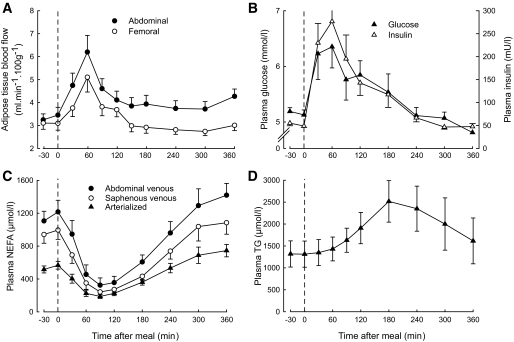
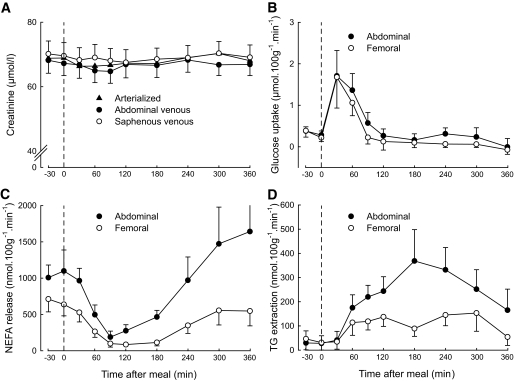
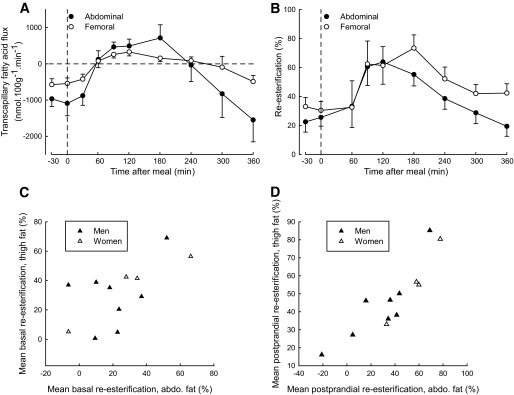
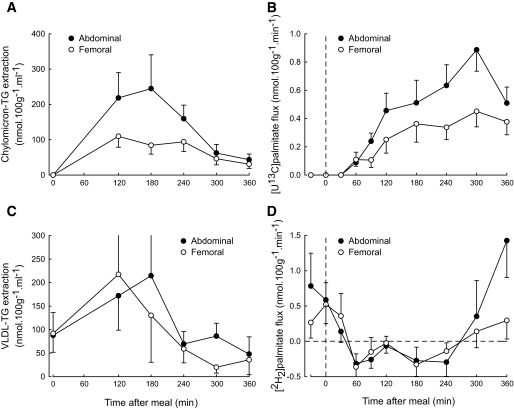
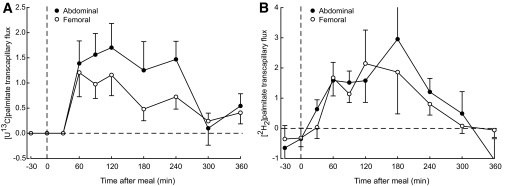
Results: Blood flow increased in response to the meal in both depots, and these responses were correlated (r(s) = 0.44, P < 0.01). Nonesterified fatty acid (NEFA) release was suppressed after the meal in both depots; it was lower in femoral fat than in abdominal fat (P < 0.01). Plasma triacylglycerol (TG) extraction by femoral fat was also lower than that by abdominal fat (P = 0.05). Isotopic tracers showed that the difference was in chylomicron-TG extraction. VLDL-TG extraction and direct NEFA uptake were similar in the two depots.
Conclusions: Femoral fat shows lower metabolic fluxes than subcutaneous abdominal fat, but differs in its relative preference for extracting fatty acids directly from the plasma NEFA and VLDL-TG pools compared with chylomicron-TG.
Figures
References
-
- Yusuf S, Hawken S, Ounpuu S, Bautista L, Franzosi MG, Commerford P, Lang CC, Rumboldt Z, Onen CL, Lisheng L, Tanomsup S, Wangai P, Jr, Razak F, Sharma AM, Anand SS. INTERHEART Study Investigators Obesity and the risk of myocardial infarction in 27,000 participants from 52 countries: a case-control study. Lancet 2005;366:1640–1649 - PubMed
-
- Pischon T, Boeing H, Hoffmann K, Bergmann M, Schulze MB, Overvad K, van der Schouw YT, Spencer E, Moons KG, Tjønneland A, Halkjaer J, Jensen MK, Stegger J, Clavel-Chapelon F, Boutron-Ruault MC, Chajes V, Linseisen J, Kaaks R, Trichopoulou A, Trichopoulos D, Bamia C, Sieri S, Palli D, Tumino R, Vineis P, Panico S, Peeters PH, May AM, Bueno-de-Mesquita HB, van Duijnhoven FJ, Hallmans G, Weinehall L, Manjer J, Hedblad B, Lund E, Agudo A, Arriola L, Barricarte A, Navarro C, Martinez C, Quirós JR, Key T, Bingham S, Khaw KT, Boffetta P, Jenab M, Ferrari P, Riboli E. General and abdominal adiposity and risk of death in Europe. N Engl J Med 2008;359:2105–2120 - PubMed
-
- Manolopoulos KN, Karpe F, Frayn KN. Gluteofemoral body fat as a determinant of metabolic health. Int J Obes 2010;34:949–959 - PubMed
-
- Rebuffé-Scrive M, Lönnroth P, Mårin P, Wesslau C, Björntorp P, Smith U. Regional adipose tissue metabolism in men and postmenopausal women. Int J Obes 1987;11:347–355 - PubMed
Publication types
MeSH terms
Substances
Grants and funding
LinkOut - more resources
Full Text Sources
Medical
Miscellaneous
