


Comment
doi: 10.1038/nsmb0810-918.
Nucleosome sequence preferences influence in vivo nucleosome organization
- PMID: 20683473
- PMCID: PMC2969171
- DOI: 10.1038/nsmb0810-918
Item in Clipboard
Comment
Nucleosome sequence preferences influence in vivo nucleosome organization
Nat Struct Mol Biol.
2010 Aug.
No abstract available
Figures
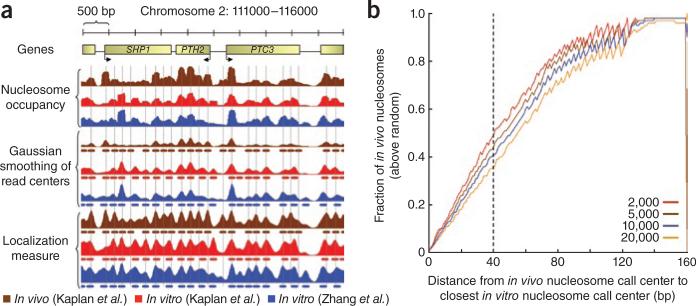
Nucleosome positions in vitro compared to those in vivo. (a) In vivo and in vitro nucleosome data on an arbitrary 5-kbp genomic region from yeast. For each of the three experimental nucleosome datasets (brown and red, in vivo and in vitro from Kaplan et al., respectively; blue, in vitro from Zhang et al.2) we show the nucleosome occupancy, a Gaussian smoothing (s.d. = 40 bp) of read centers (73 bp downstream from read start) and the localization measure (also smoothed with a Gaussian, s.d. = 40 bp), along with nucleosome calls made on each of the data tracks. Vertical lines, center positions of the nucleosome calls made on the Gaussian-smoothed read centers in vivo. (b) Cumulative distribution of distances between centers of nucleosome calls in vivo and in vitro, normalized by a randomized control. Nucleosomes were called in vivo and in vitro (Kaplan et al. datasets) by taking the track of Gaussian-smoothed read centers and iteratively selecting the position with the highest value and excluding the 147 base pairs surrounding it. We selected 50,000 nucleosomes from the in vitro data and 2,000, 5,000, 10,000 and 20,000 nucleosomes from the in vivo data. Next, we computed the cumulative distribution by calculating the fraction of in vivo nucleosome call centers that are within k base pairs of the closest in vitro call center for every k = 0...160 bp. As a control, we performed the same computation on in vivo calls that were shuffled randomly while preserving pairwise distances between neighboring nucleosomes. Finally, we subtracted the shuffled from real distribution and divided the resulting distribution by 1 minus the shuffled distribution, thus scaling the results between 0 (not improving from random) and 1 (explaining all in vivo positions). Dashed vertical line, fraction above random of in vivo nucleosome centers within 40 bp of in vitro nucleosome centers.
Comment in
-
Evidence against a genomic code for nucleosome positioning. Reply to "Nucleosome sequence preferences influence in vivo nucleosome organization.".Nat Struct Mol Biol. 2010 Aug;17(8):920-3. doi: 10.1038/nsmb0810-920. Nat Struct Mol Biol. 2010. PMID: 20683474 Free PMC article. No abstract available.
-
A preoccupied position on nucleosomes.Nat Struct Mol Biol. 2010 Aug;17(8):923. doi: 10.1038/nsmb0810-923. Nat Struct Mol Biol. 2010. PMID: 20683475 No abstract available.
Comment on
-
Intrinsic histone-DNA interactions are not the major determinant of nucleosome positions in vivo.Nat Struct Mol Biol. 2009 Aug;16(8):847-52. doi: 10.1038/nsmb.1636. Epub 2009 Jul 20. Nat Struct Mol Biol. 2009. PMID: 19620965 Free PMC article.
References
-
- Satchwell SC, Drew HR, Travers AA. J. Mol. Biol. 1986;191:659–675. - PubMed
Publication types
MeSH terms
Substances
Grants and funding
LinkOut - more resources
Full Text Sources
Molecular Biology Databases
