


Overcoming heterogeneity in pediatric asthma: tobacco smoke and asthma characteristics within phenotypic clusters in an African American cohort
- PMID: 20684733
- PMCID: PMC3325290
- DOI: 10.3109/02770903.2010.491142
Overcoming heterogeneity in pediatric asthma: tobacco smoke and asthma characteristics within phenotypic clusters in an African American cohort
Abstract
Objective: Asthma in children and adolescents is a heterogeneous syndrome comprised of multiple subgroups with variable disease expression and response to environmental exposures. The goal of this study was to define homogeneous phenotypic clusters within a cohort of children and adolescents with asthma and to determine overall and within-cluster associations between environmental tobacco smoke (ETS) exposure and asthma characteristics.
Methods: A combined hierarchical/k-means cluster analysis of principal component variables was used to define phenotypic clusters within a cohort of 6- to 20-year-old urban and largely minority subjects.
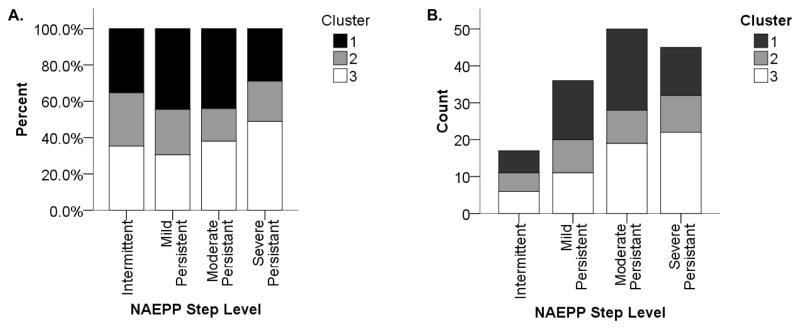
Results: Among the 154 subjects, phenotypic cluster analysis defined three independent clusters (Cluster 1 [n = 57]; Cluster 2 [n = 33]; Cluster 3 [n = 58]). A small fourth cluster (n = 6) was excluded. Patients in Cluster 1 were predominantly males, with a relative abundance of neutrophils in their nasal washes. Patients in Cluster 2 were predominantly females with high body mass index percentiles and later-onset asthma. Patients in Cluster 3 had higher eosinophil counts in their nasal washes and lower Asthma Control Test (ACT) scores. Within-cluster regression analysis revealed several significant associations between ETS exposure and phenotypic characteristics that were not present in the overall cohort. ETS exposure was associated with a significant increase in nasal wash neutrophils (beta coefficient = 0.73 [95% confidence interval, CI: 0.11 to 1.35]; p = .023) and a significant decrease in ACT score (-5.17 [-8.42 to -1.93]; p = .003) within Cluster 1 and a significant reduction in the bronchodilator-induced % change in forced expiratory volume in one second (FEV(1)) (-36.32 [-62.18 to -10.46]; p = .009) within Cluster 3.
Conclusions: Clustering techniques defined more homogeneous subgroups, allowing for the detection of otherwise undetectable associations between environmental tobacco smoke exposure and asthma characteristics.
Conflict of interest statement
Figures
References
-
- Borish L, Culp JA. Asthma: a syndrome composed of heterogeneous diseases. Ann Allergy Asthma Immunol. 2008;101(1):1–8. quiz 8–11, 50. - PubMed
-
- Martinez FD. Definition of pediatric asthma and associated risk factors. Pediatr Pulmonol Suppl. 1997;15:9–12. - PubMed
-
- Wenzel SE. Asthma: defining of the persistent adult phenotypes. Lancet. 2006;368(9537):804–13. - PubMed
-
- Hartigan JA. Clustering. Annu Rev Biophys Bioeng. 1973;2:81–101. - PubMed
-
- Slonim DK. From patterns to pathways: gene expression data analysis comes of age. Nat Genet. 2002;32 (Suppl):502–8. - PubMed
Publication types
MeSH terms
Substances
Grants and funding
LinkOut - more resources
Full Text Sources
Medical
