


Five preference-based indexes in cataract and heart failure patients were not equally responsive to change
- PMID: 20685077
- PMCID: PMC3973151
- DOI: 10.1016/j.jclinepi.2010.04.010
Five preference-based indexes in cataract and heart failure patients were not equally responsive to change
Abstract
Objective: To compare the responsiveness to clinical change of five widely used preference-based health-related quality-of-life indexes in two longitudinal cohorts.
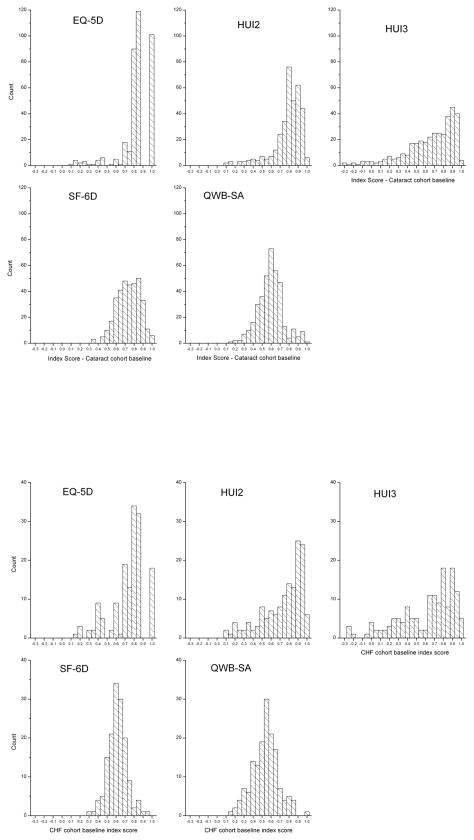
Study design and setting: Five generic instruments were simultaneously administered to 376 adults undergoing cataract surgery and 160 adults in heart failure management programs. Patients were assessed at baseline and reevaluated after 1 and 6 months. The measures were the Short Form (SF)-6D (based on responses scored from SF-36v2), Self-Administered Quality of Well-being Scale (QWB-SA), the EuroQol-5D developed by the EuroQol Group, the Health Utilities Indexes Mark 2 (HUI2) and Mark 3 (HUI3). Cataract patients completed the National Eye Institute Visual Functioning Questionnaire-25, and heart failure patients completed the Minnesota Living with Heart Failure Questionnaire. Responsiveness was estimated by the standardized response mean.
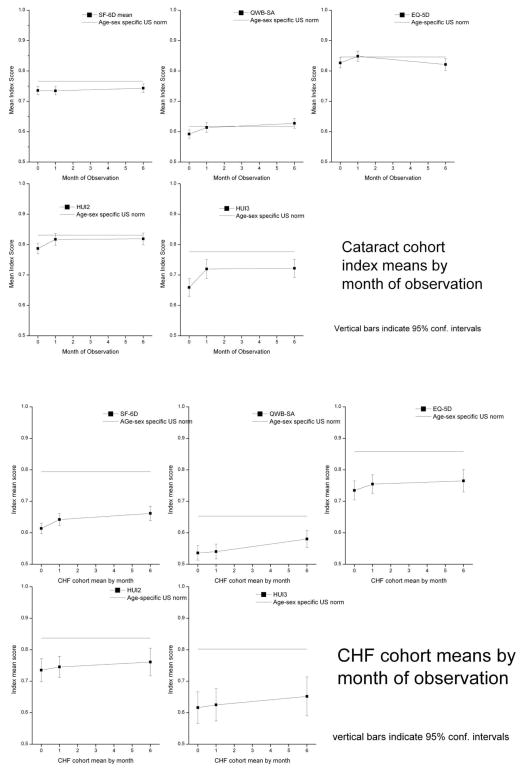
Results: For cataract patients, mean changes between baseline and 1-month follow-up for the generic indices ranged from 0.00 (SF-6D) to 0.052 (HUI3) and were statistically significant for all indexes except the SF-6D. For heart failure patients, only the SF-6D showed significant change from baseline to 1 month, whereas only the QWB-SA change was significant between 1 and 6 months.
Conclusions: Preference-based methods for measuring health outcomes are not equally responsive to change.
Copyright © 2011 Elsevier Inc. All rights reserved.
Figures
References
-
- Ware JE, Jr, Gandek B. Overview of the SF-36 Health Survey and the International Quality of Life Assessment (IQOLA) Project. Journal of Clinical Epidemiology. 1998;51:903–12. - PubMed
-
- Kosinski M, Keller SD, Hatoum HT, Kong SX, Ware JE., Jr The SF-36 Health Survey as a generic outcome measure in clinical trials of patients with osteoarthritis and rheumatoid arthritis: tests of data quality, scaling assumptions and score reliability. Medical Care. 1999;37:MS10–22. - PubMed
-
- Stewart AL, Ware JE. Measuring functioning and well-being: the medical outcomes study approach. Durham: Duke University Press; 1992.
Publication types
MeSH terms
Grants and funding
- P30AG021684/AG/NIA NIH HHS/United States
- P01 AG020679/AG/NIA NIH HHS/United States
- U48 DP000056/DP/NCCDPHP CDC HHS/United States
- 1 P01 AG020679-01A2/AG/NIA NIH HHS/United States
- U48 DP000056-04/DP/NCCDPHP CDC HHS/United States
- 5P30AG028748/AG/NIA NIH HHS/United States
- P20MD000182/MD/NIMHD NIH HHS/United States
- P20MD000148/MD/NIMHD NIH HHS/United States
- P20 MD000182/MD/NIMHD NIH HHS/United States
- P01AG020679/AG/NIA NIH HHS/United States
- P30 AG021684/AG/NIA NIH HHS/United States
- P20 MD000148/MD/NIMHD NIH HHS/United States
- P30 AG028748/AG/NIA NIH HHS/United States
LinkOut - more resources
Full Text Sources
Medical
