


Training clinicians in mental health communication skills: impact on primary care utilization
- PMID: 20685190
- PMCID: PMC2933967
- DOI: 10.1016/j.acap.2010.06.012
Training clinicians in mental health communication skills: impact on primary care utilization
Abstract
Objective: Although it is known that children with mental health problems utilize primary care services more than most other children, it is unknown how addressing mental health problems in primary care affects children's subsequent services utilization. This study measures primary care utilization in the context of a randomized trial of a communication skills training program for primary care clinicians that had a positive impact on child mental health outcomes.
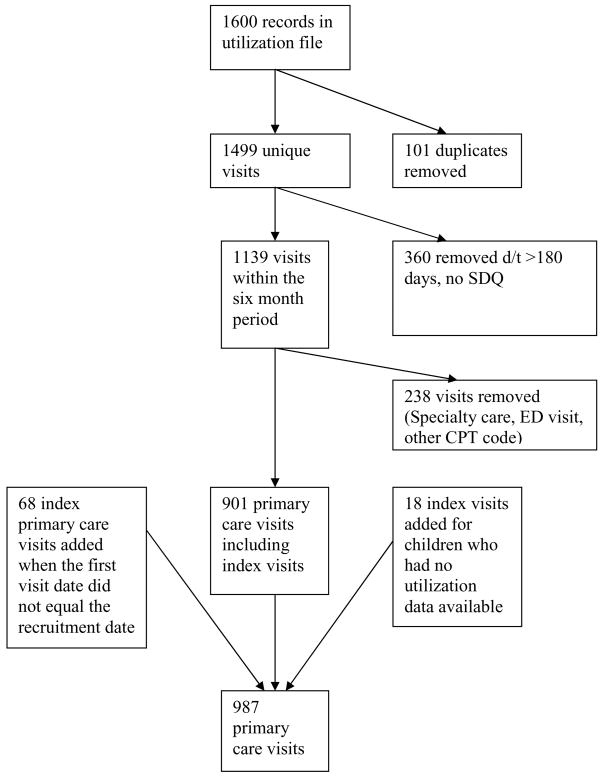
Methods: From 2002 to 2005, 48 pediatric primary care clinicians at 13 sites in rural upstate New York, urban Maryland, and Washington, DC, were randomized to in-office training or to a control group. Consecutive primary care patients between the ages of 5 and 16 years were screened for mental health problems, as indicated by a possible or probable score on the Strengths and Difficulties Questionnaire (SDQ). For 397 screened children, primary care visits during the next 6 months were identified using chart review and administrative databases. Using generalized estimating equation regression to account for clustering at the clinician level, primary care utilization was compared by study group and SDQ status.
Results: The number of primary care visits to the trained clinicians did not differ significantly from those made to control clinicians (2.5 for both groups; P = .63). Children with possible or probable SDQ scores made, on average, 0.38 or 0.65 more visits on a per child basis, respectively, during the 6-month follow-up period than SDQ unlikely children (P = .0002).
Conclusions: Seeing a trained clinician did not increase subsequent primary care utilization. However, primary care utilization was greater among children with mental health problems as measured by the SDQ. Addressing children's mental health in primary care does not increase the primary care visit burden. Research on overall health services utilization is needed.
Copyright 2010 Academic Pediatric Association. Published by Elsevier Inc. All rights reserved.
Conflict of interest statement
Figures
References
-
- Perrin E, Stancin T. A continuing dilemma: whether and how to screen for concerns about children’s behavior in primary care settings. Pediatr Rev. 2002;23:264–275. - PubMed
-
- Cooper S, Valleley RJ, Polaha J, Begeny J, Evans JH. Running out of time: physician management of behavioral health concerns in rural pediatric primary care. Pediatrics. 2006;118(1):e132–8. - PubMed
-
- Heneghan A, Garner AS, Storfer-Isser A, et al. Pediatricians’role in providing mental health care for children and adolescents: do pediatricians and child and adolescent psychiatrists agree? J Dev Behav Pediatr. 2008;29(4):262–9. - PubMed
-
- Horwitz SM, Kelleher KJ, Stein RE, et al. Barriers to the Identification and Management of Psychosocial Issues in Children and Maternal Depression. Pediatrics. 2007;119(1):e208–e218. - PubMed
-
- American Academy of Child and Adolescent Psychiatry, Committee on Health care Access and Economics; American Academy of Pediatrics, Task Force on Mental Health. Improving mental health services in primary care: reducing administrative and financial barriers to access and collaboration. Pediatrics. 2009;123(4):1248–51. - PubMed
Publication types
MeSH terms
Grants and funding
LinkOut - more resources
Full Text Sources
Medical
