


The changing epidemiology of vancomycin-resistant Enterococcus (VRE) bacteremia in allogeneic hematopoietic stem cell transplant (HSCT) recipients
- PMID: 20685257
- PMCID: PMC3670412
- DOI: 10.1016/j.bbmt.2010.05.008
The changing epidemiology of vancomycin-resistant Enterococcus (VRE) bacteremia in allogeneic hematopoietic stem cell transplant (HSCT) recipients
Abstract
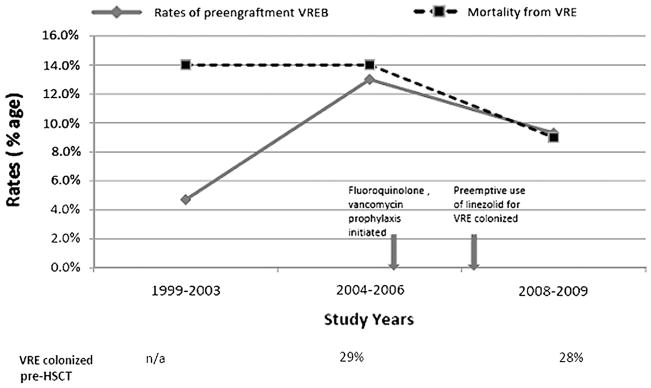
The impact of the rising prevalence of vancomycin-resistant Enterococcus (VRE) prior to hematopoietic stem cell transplantation (HSCT) and changes in transplant techniques on risk of VREB (VRE bacteremia) early after HSCT is not known. This is a retrospective study of 247 adult patients who underwent allogeneic HSCT in the years 2008 and 2009 at the Memorial Sloan-Kettering Cancer Center. Sixty-eight of 247 (27.5%) patients were VRE colonized on pretransplant screening. VRE was the leading cause of bacteremia in the first 30 days after HSCT; 23 of 43 (53.5%) patients with positive blood cultures had VRE. Only 13 (57%) of the 23 patients with early VREB were colonized with VRE on pre-HSCT screening cultures. Mortality was directly attributable to VRE infection in 9% of patients with early VREB. VRE is emerging as the most common cause of preengraftment bacteremia in patients undergoing allogeneic HSCT, and is associated with substantial mortality. Pre-HSCT screening for VRE with stool cultures will not identify all patients who are at risk for VREB. The use of alternate agents with activity against Gram-positive bacteria for fever and neutropenia early after HSCT should be evaluated further in prospective studies.
Copyright © 2010 American Society for Blood and Marrow Transplantation. Published by Elsevier Inc. All rights reserved.
Figures

References
-
- Almyroudis NG, Fuller A, Jakubowski A, et al. Pre- and post-engraftment bloodstream infection rates and associated mortality in allogeneic hematopoietic stem cell transplant recipients. Transpl Infect Dis. 2005;7:11–17. - PubMed
-
- Avery R, Kalaycio M, Pohlman B, et al. Early vancomycin-resistant enterococcus (VRE) bacteremia after allogeneic bone marrow transplantation is associated with a rapidly deteriorating clinical course. Bone Marrow Transplant. 2005;35:497–499. - PubMed
-
- Kapur D, Dorsky D, Feingold JM, et al. Incidence and outcome of vancomycin-resistant enterococcal bacteremia following autologous peripheral blood stem cell transplantation. Bone Marrow Transplant. 2000;25:147–152. - PubMed
-
- Weinstock DM, Conlon M, Iovino C, et al. Colonization, blood-stream infection, and mortality caused by vancomycin-resistant enterococcus early after allogeneic hematopoietic stem cell transplant. Biol Blood Marrow Transplant. 2007;13:615–621. - PubMed
-
- Zirakzadeh A, Gastineau DA, Mandrekar JN, Burke JP, Johnston BP, Patel R. Vancomycin-resistant enterococcal colonization appears associated with increased mortality among allogeneic hematopoietic stem cell transplant recipients. Bone Marrow Transplant. 2008;41:385–392. - PubMed
Publication types
MeSH terms
Substances
Grants and funding
LinkOut - more resources
Full Text Sources
Other Literature Sources
Medical
