PCR-based pooling of dried blood spots for detection of malaria parasites: optimization and application to a cohort of Ugandan children
- PMID: 20686079
- PMCID: PMC2953134
- DOI: 10.1128/JCM.00522-10
PCR-based pooling of dried blood spots for detection of malaria parasites: optimization and application to a cohort of Ugandan children
Abstract
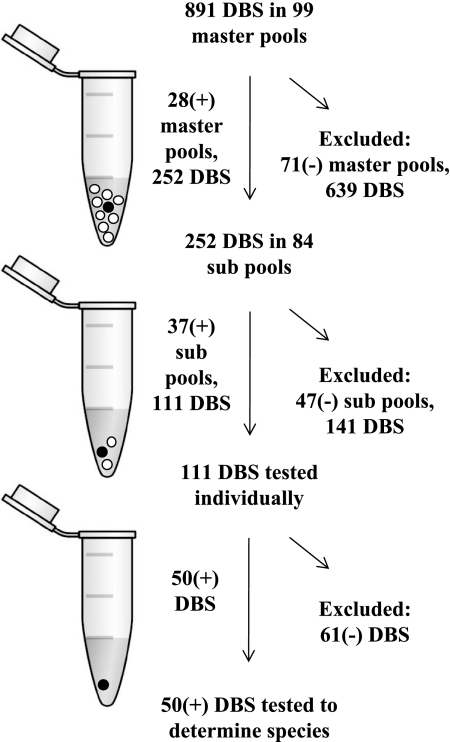
Sensitive, high-throughput methods to detect malaria parasites in low-transmission settings are needed. PCR-based pooling strategies may offer a solution. We first used laboratory-prepared samples to compare 2 DNA extraction and 4 PCR detection methods across a range of pool sizes and parasite densities. Pooled Chelex extraction of DNA, followed by nested PCR of cytochrome b, was the optimal strategy, allowing reliable detection of a single low-parasitemic sample (100 parasites/μl) in pool sizes up to 50. This PCR-based pooling strategy was then compared with microscopy using 891 dried blood spots from a cohort of 77 Ugandan children followed for 2 years in an urban setting of low endemicity. Among 419 febrile episodes, 35 cases of malaria were detected using the PCR-based pooling strategy and 40 cases using microscopy. All five cases of malaria not detected by PCR were from samples stored for >2 years with parasitemia of <6,000/μl, highlighting the issue of possible DNA degradation with long-term storage of samples. Among 472 samples collected from asymptomatic children as part of routine surveillance, 15 (3.2%) were positive by PCR-based pooling compared to 4 (0.8%) by microscopy (P = 0.01). Thus, this PCR-based pooling strategy for detection of malaria parasites using dried blood spots offers a sensitive and efficient approach for malaria surveillance in low-transmission settings, enabling improved detection of asymptomatic submicroscopic infections and dramatic savings in labor and costs.
Figures
References
-
- Boudin, C., M. Olivier, J. F. Molez, J. P. Chiron, and P. Ambroise-Thomas. 1993. High human malarial infectivity to laboratory-bred Anopheles gambiae in a village in Burkina Faso. Am. J. Trop. Med. Hyg. 48:700-706. - PubMed
-
- Busch, M. P., D. J. Wright, B. Custer, L. H. Tobler, S. L. Stramer, S. H. Kleinman, H. E. Prince, C. Bianco, G. Foster, L. R. Petersen, G. Nemo, and S. A. Glynn. 2006. West Nile virus infections projected from blood donor screening data, United States, 2003. Emerg. Infect. Dis. 12:395-402. - PMC - PubMed
-
- Clark, T. D., D. Njama-Meya, B. Nzarubara, C. Maiteki-Sebuguzi, B. Greenhouse, S. G. Staedke, M. R. Kamya, G. Dorsey, and P. J. Rosenthal. 2010. Incidence of malaria and efficacy of combination antimalarial therapies over 4 years in an urban cohort of Ugandan children. PLoS One 5:e11759. - PMC - PubMed
Publication types
MeSH terms
Substances
Grants and funding
LinkOut - more resources
Full Text Sources
Medical