


Review
doi: 10.1097/TP.0b013e3181efcfe9.
The significance of non-T-cell pathways in graft rejection: implications for transplant tolerance
- PMID: 20686444
- PMCID: PMC3015014
- DOI: 10.1097/TP.0b013e3181efcfe9
Item in Clipboard
Review
The significance of non-T-cell pathways in graft rejection: implications for transplant tolerance
Transplantation.
.
Abstract
Both innate and adaptive immune cells are actively involved in the initiation and destruction of allotransplants, and there is a true need now to look beyond T cells in the allograft response, examining various non-T-cell types in transplant models and how such cell types interact with T cells in determining the fate of an allograft. Studies in this area may lead to further improvement in transplant outcomes.
Figures
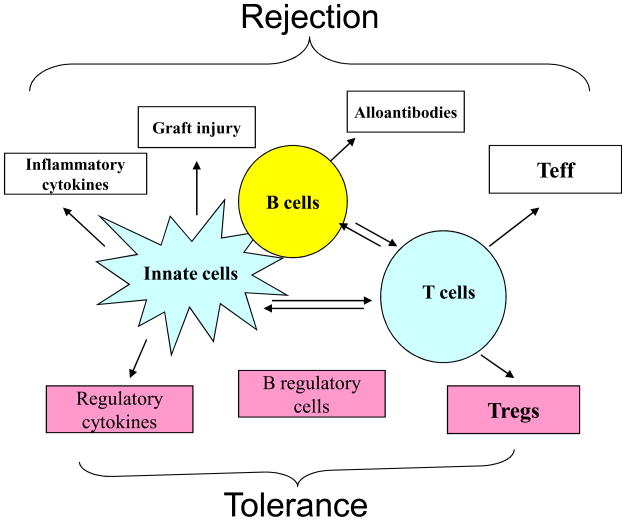
Cross-talk of non-T cells and T cells in alloimmune responses. Non-T cells can directly damage the graft or indirectly by modifying the T cell programs.
References
-
- Alegre ML, Florquin S, Goldman M. Cellular mechanisms underlying acute graft rejection: time for reassessment. Curr Opin Immunol. 2007;19:563. - PubMed
-
- Nimmeriahn F, Ravetch JV. Fc receptors as regulators of immunity. Advances in Immunology. 2007;96:179. - PubMed
-
- Jacquot S. CD27/CD70 interactions regulate T dependent B cell differentiation. Immunol Rev. 2000;21:23. - PubMed
Publication types
MeSH terms
Grants and funding
LinkOut - more resources
Full Text Sources
