


The 4q12 amplicon in malignant peripheral nerve sheath tumors: consequences on gene expression and implications for sunitinib treatment
- PMID: 20686603
- PMCID: PMC2912277
- DOI: 10.1371/journal.pone.0011858
The 4q12 amplicon in malignant peripheral nerve sheath tumors: consequences on gene expression and implications for sunitinib treatment
Abstract
Background: Malignant peripheral nerve sheath tumors (MPNST) are highly aggressive tumors which originate from Schwann cells and develop in about 10% of neurofibromatosis type 1 (NF1) patients. The five year survival rate is poor and more effective therapies are needed. Sunitinib is a drug targeting receptor tyrosine kinases (RTK) like PDGFRalpha, c-Kit and VEGFR-2. These genes are structurally related and cluster on chromosomal segment 4q12.
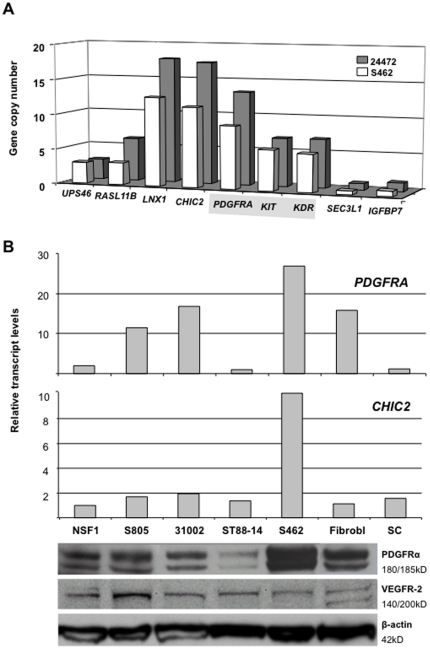
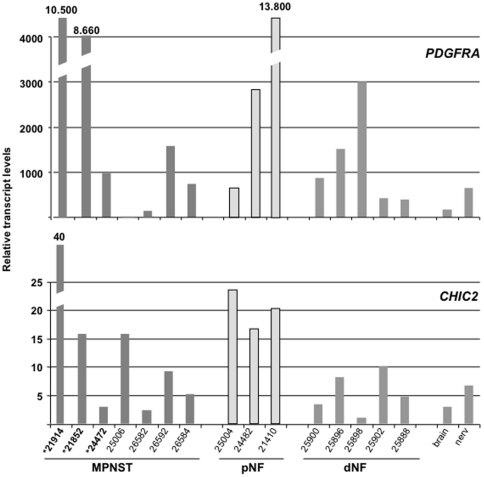
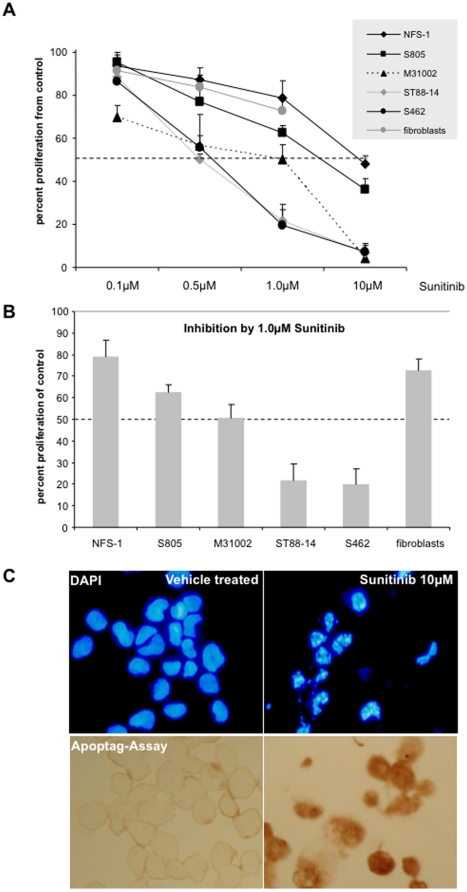
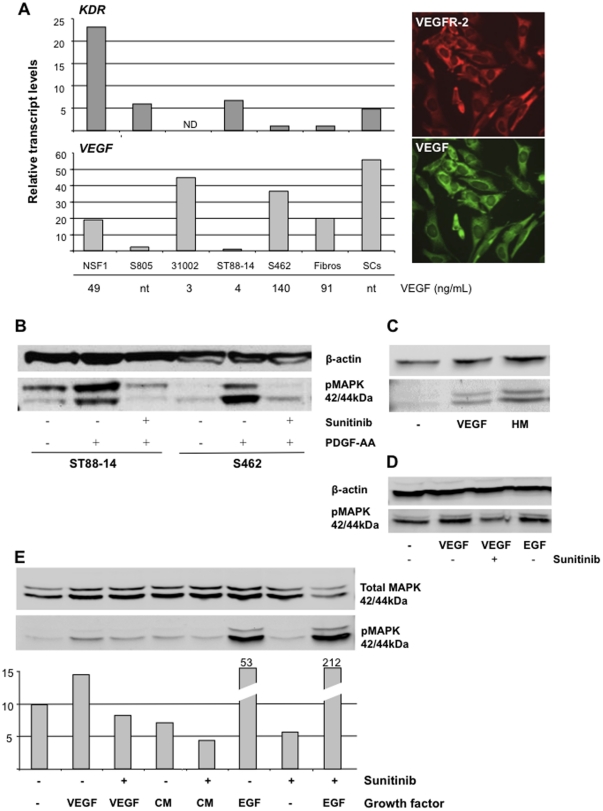
Methodology/principal findings: Here we characterize this region by multiplex ligation-dependent probe amplification (MLPA) in MPNST. Our probe set encompasses the 3 adjacent RTK genes (PDGFRA, KIT, KDR) and 6 flanking genes. We found amplification of several genes within this region in a subset of MPNST and MPNST cell lines. Transcript and protein expression of PDGFRA matched well with its increased copy number suggesting a central role of PDGFRA within the amplicon. Studying the effect of sunitinib on 5 MPNST cell lines revealed that cell line S462 harboring the 4q12 amplicon was extremely sensitive to the drug with an IC50 below 1.0 microM. Moreover, sunitinib induced apoptosis and prevented PDGF-AA induced signaling via PDGFRalpha as determined by western blotting. Co-expression of VEGF and its receptor VEGFR-2 (KDR) was present in MPNST cell lines suggesting an autocrine loop. We show that VEGF triggered signal transduction via the MAPK pathway, which could be blocked by sunitinib.
Conclusions/significance: Since multiple receptors targeted by sunitinib are expressed or over-expressed by MPNST cells sunitinib appears as an attractive drug for treatment of MPNST patients. Presence of the 4q12 amplicon and subsequent over-expression of PDGFRA might serve as predictive markers for efficacy of sunitinib.
Conflict of interest statement
Figures
References
-
- von Deimling A, Krone W, Menon A. Neurofibromatosis Type 1: Pathology, clinical features and molecular genetics. Brain Pathology. 1995;5:153–162. - PubMed
-
- Holtkamp N, Okuducu AF, Mucha J, Afanasieva A, Hartmann C, et al. Mutation and expression of PDGFRA and KIT in malignant peripheral nerve sheath tumors, and its implications for imatinib sensitivity. Carcinogenesis. 2006;27:664–671. - PubMed
-
- Joensuu H, Puputti M, Sihto H, Tynninen O, Nupponen NN. Amplification of genes encoding KIT, PDGFRalpha and VEGFR2 receptor tyrosine kinases is frequent in glioblastoma multiforme. J Pathol. 2005;207:224–231. - PubMed
-
- McIntyre A, Summersgill B, Grygalewicz B, Gillis AJ, Stoop J, et al. Amplification and overexpression of the KIT gene is associated with progression in the seminoma subtype of testicular germ cell tumors of adolescents and adults. Cancer Res. 2005;65:8085–8089. - PubMed
Publication types
MeSH terms
Substances
LinkOut - more resources
Full Text Sources
Research Materials
Miscellaneous
