. 2010 Jul 29;5(7):e11824.
doi: 10.1371/journal.pone.0011824.

Genome-wide association study of pancreatic cancer in Japanese population

Affiliations

Genome-wide association study of pancreatic cancer in Japanese population

Siew-Kee Low et al. PLoS One. .

Abstract

Pancreatic cancer shows very poor prognosis and is the fifth leading cause of cancer death in Japan. Previous studies indicated some genetic factors contributing to the development and progression of pancreatic cancer; however, there are limited reports for common genetic variants to be associated with this disease, especially in the Asian population. We have conducted a genome-wide association study (GWAS) using 991 invasive pancreatic ductal adenocarcinoma cases and 5,209 controls, and identified three loci showing significant association (P-value<5x10(-7)) with susceptibility to pancreatic cancer. The SNPs that showed significant association carried estimated odds ratios of 1.29, 1.32, and 3.73 with 95% confidence intervals of 1.17-1.43, 1.19-1.47, and 2.24-6.21; P-value of 3.30x10(-7), 3.30x10(-7), and 4.41x10(-7); located on chromosomes 6p25.3, 12p11.21 and 7q36.2, respectively. These associated SNPs are located within linkage disequilibrium blocks containing genes that have been implicated some roles in the oncogenesis of pancreatic cancer.


Conflict of interest statement

Competing Interests: Although the affiliations of the following three authors (Akira Saito [Statistical Genetics Analysis Division, StaGen Co., Ltd.], Suenori Chiku [Science Solutions Division, Mizuho Information and Research Institute, Inc.] and Hirohiko Totsuka [Bioinfomatics Group, Research and Development Center, Solution Division]) are in the private sector, each of them worked for one of the corresponding authors, Teruhiko Yoshida, as a part of a contract research solely funded by an academic research fund granted from NiBio (http://www.nibio.go.jp/english/) to T. Yoshida. Therefore, this study neither received any funding from the companies to which the above three authors belong, nor did their affiliating companies per se play any role in this research except that they sent their staff (the above three authors) to the laboratory of Teruhiko Yoshida under a research contract paid by Yoshida's grant. There is no competing interests involved between Teruhiko Yoshida and these companies, including intellectual properties. The authors also confirm that they can adhere to all the PLoS ONE policies on sharing data and materials.

Figures

Figure 1
Figure 1. Q-Q plot for GWAS of pancreatic cancer in Japanese population.
This Q-Q plot is based on logistic regression allelic P-values after standard quality control. (genomic inflation factor λ = 1.026).
Figure 2
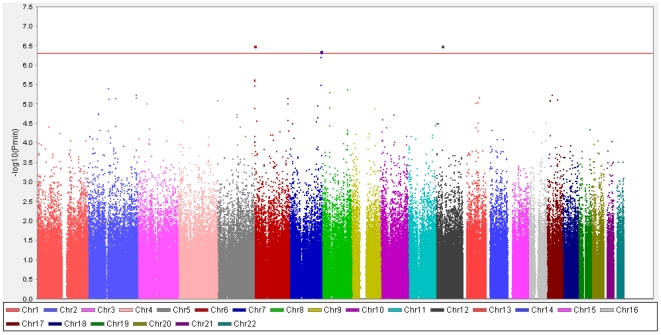
Figure 2. Manhattan plot for GWAS of pancreatic cancer in Japanese population.
The plot is based on logistic regression model after correction of age, sex and smoking status. The P min indicates the minimum P-value from logistic regression analysis for three models: allelic, dominant and recessive. Red line indicates genome-wide significant level (P-value = 5×10⁻⁷).
Figure 3
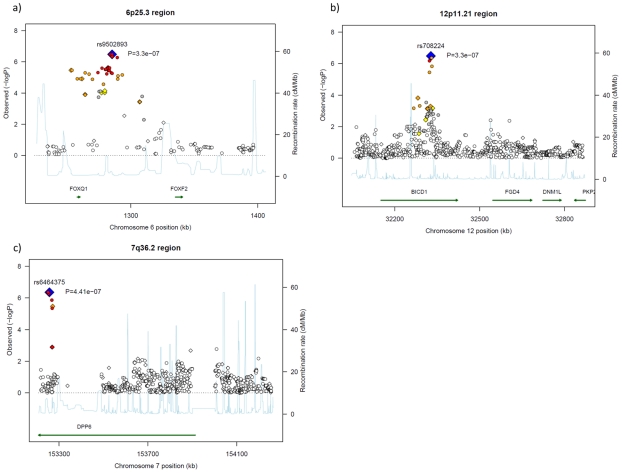
Figure 3. Regional association plots for three pancreatic cancer risk loci.
(a) 6p25.3 region, SNP rs9502893 located 25 kb upstream to gene FOXQ1. (b) 12p11.21 region, SNP rs708224 is located at the second intron of gene BICD1. (c) 7q36.2 region, SNP rs6464375 is located at the first intron of gene DPP6 transcript variant 3. Each of the marker SNPs is marked by a blue diamond. SNPs that are genotyped in the Illumina platform are plotted as diamonds; Imputed SNPs are plotted as circles. The color intensity reflects the extent of LD with the marker SNP, red (r2≥0.8), orange (0.5≤r2<0.8), yellow (0.2≤r2<0.5) and white (r2<0.2). Light blue line indicated local recombination rate.

References

    1. Kelsen DP, Portenoy R, Thaler H, Tao Y, Brennan M. Pain as a predictor of outcome in patients with operable pancreatic carcinoma. Surgery. 1997;122:53–59. - PubMed
    1. Catanzaro A, Richardson S, Veloso H, Isenberg GA, Wong RC, et al. Long-term follow-up of patients with clinically indeterminate suspicion of pancreatic cancer and normal EUS. Gastrointest Endosc. 2003;58:836–840. - PubMed
    1. Anderson KE, Mack T, Silverman D. Cancer of the pancreas. In: Schottenfeld D, Fraumeni JF Jr, editors. Cancer Epidemiology and Prevention. New York: Oxford University Press; 2006. pp. 721–762.
    1. Stevens RJ, Roddam AW, Beral V. Pancreatic cancer in type 1 and young-onset diabetes: systematic review and meta-analysis. Br J Cancer. 2007;96:507–509. - PMC - PubMed
    1. Lowenfels AB, Maisonneuve P, Cavallini G, Ammann RW, Lankisch PG, et al. Pancreatitis and the risk of pancreatic cancer. International Pancreatitis Study Group. N Engl J Med. 1993;328:1433–1437. - PubMed

Publication types