Oseltamivir-resistant pandemic H1N1/2009 influenza virus possesses lower transmissibility and fitness in ferrets
- PMID: 20686654
- PMCID: PMC2912389
- DOI: 10.1371/journal.ppat.1001022
Oseltamivir-resistant pandemic H1N1/2009 influenza virus possesses lower transmissibility and fitness in ferrets
Abstract
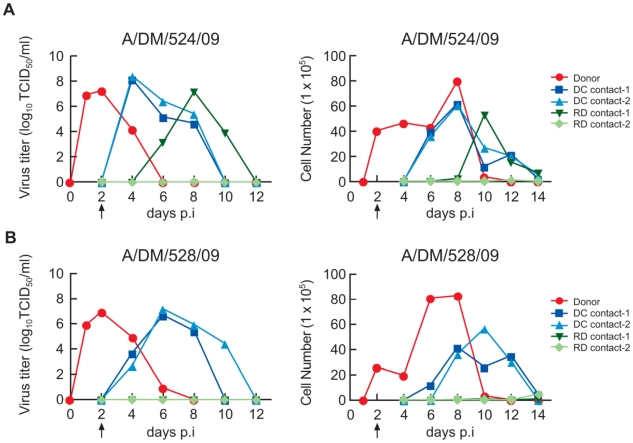
The neuraminidase (NA) inhibitor oseltamivir offers an important immediate option for the control of influenza, and its clinical use has increased substantially during the recent H1N1 pandemic. In view of the high prevalence of oseltamivir-resistant seasonal H1N1 influenza viruses in 2007-2008, there is an urgent need to characterize the transmissibility and fitness of oseltamivir-resistant H1N1/2009 viruses, although resistant variants have been isolated at a low rate. Here we studied the transmissibility of a closely matched pair of pandemic H1N1/2009 clinical isolates, one oseltamivir-sensitive and one resistant, in the ferret model. The resistant H275Y mutant was derived from a patient on oseltamivir prophylaxis and was the first oseltamivir-resistant isolate of the pandemic virus. Full genome sequencing revealed that the pair of viruses differed only at NA amino acid position 275. We found that the oseltamivir-resistant H1N1/2009 virus was not transmitted efficiently in ferrets via respiratory droplets (0/2), while it retained efficient transmission via direct contact (2/2). The sensitive H1N1/2009 virus was efficiently transmitted via both routes (2/2 and 1/2, respectively). The wild-type H1N1/2009 and the resistant mutant appeared to cause a similar disease course in ferrets without apparent attenuation of clinical signs. We compared viral fitness within the host by co-infecting a ferret with oseltamivir-sensitive and -resistant H1N1/2009 viruses and found that the resistant virus showed less growth capability (fitness). The NA of the resistant virus showed reduced substrate-binding affinity and catalytic activity in vitro and delayed initial growth in MDCK and MDCK-SIAT1 cells. These findings may in part explain its less efficient transmission. The fact that the oseltamivir-resistant H1N1/2009 virus retained efficient transmission through direct contact underlines the necessity of continuous monitoring of drug resistance and characterization of possible evolving viral proteins during the pandemic.
Conflict of interest statement
While the study reported here did not utilize corporate funding, Drs. Elena A. Govorkova and Robert G. Webster are currently performing a different research study funded by F. Hoffmann-LaRoche, Ltd., Basel, Switzerland. The authors declare no competing financial interests.
Figures


References
-
- Dawood FS, Jain S, Finelli L, Shaw MW, Lindstrom S, et al. Emergence of a novel swine-origin influenza A (H1N1) virus in humans. N Engl J Med. 2009;360:2605–2615. - PubMed
-
- WHO. Situation updates - Pandemic (H1N1) 2009. 9 A.D. November. http://www.who.int/csr/disease/swineflu/updates/en/index.html.
-
- Deyde VM, Xu X, Bright RA, Shaw M, Smith CB, et al. Surveillance of resistance to adamantanes among influenza A(H3N2) and A(H1N1) viruses isolated worldwide. J Infect Dis. 2007;196:249–257. - PubMed
-
- Bright RA, Shay DK, Shu B, Cox NJ, Klimov AI. Adamantane resistance among influenza A viruses isolated early during the 2005–2006 influenza season in the United States. JAMA. 2006;295:891–894. - PubMed
Publication types
MeSH terms
Substances
Grants and funding
LinkOut - more resources
Full Text Sources
Other Literature Sources
Medical