


Prevalence of mood and anxiety disorder in self reported irritable bowel syndrome (IBS). An epidemiological population based study of women
- PMID: 20687933
- PMCID: PMC2928181
- DOI: 10.1186/1471-230X-10-88
Prevalence of mood and anxiety disorder in self reported irritable bowel syndrome (IBS). An epidemiological population based study of women
Abstract
Background: Irritable bowel syndrome (IBS) is commonly regarded as a functional disorder, and is hypothesized to be associated with anxiety and depression. This evidence mainly rests on population-based studies utilising self-report screening instruments for psychopathology. Other studies applying structured clinical interviews are generally based on small clinical samples, which are vulnerable to biases. The extant evidence base for an association between IBS and psychopathology is hence not conclusive. The aim of this study was therefore to re-examine the hypothesis using population-based data and psychiatric morbidity established with a structured clinical interview.
Methods: Data were derived from a population-based epidemiological study (n = 1077). Anxiety and mood disorders were established using the Structured Clinical Interview for DSM-IV-TR (SCID-I/NP) and the General Health Questionnaire (GHQ-12). Current and lifetime IBS was self-reported. Hypertension and diabetes were employed as comparison groups as they are expected to be unrelated to mental health.
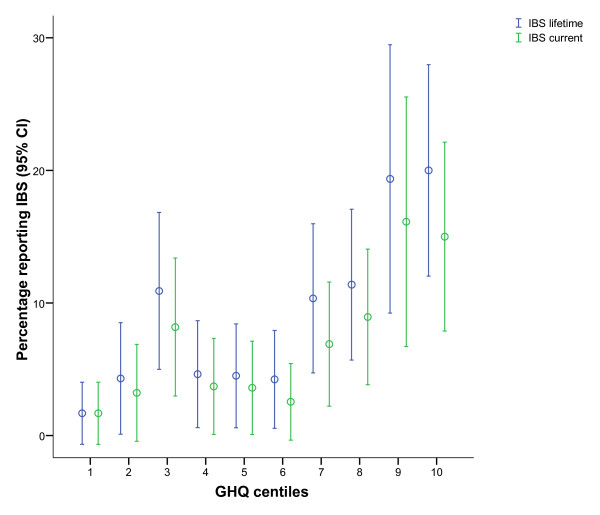
Results: Current IBS (n = 69, 6.4%) was associated with an increased likelihood of current mood and/or anxiety disorders (OR = 2.62, 95%CI 1.49 - 4.60). Half the population reporting a lifetime IBS diagnosis also had a lifetime mood or anxiety disorder. Exploratory analyses demonstrated an increased prevalence of IBS across most common anxiety and mood disorders, the exception being bipolar disorder. The association with IBS and symptoms load (GHQ-12) followed a curved dose response pattern. In contrast, hypertension and diabetes were consistently unrelated to psychiatric morbidity.
Conclusions: IBS is significantly associated with anxiety and mood disorders. This study provides indicative evidence for IBS as a disorder with a psychosomatic aspect.
Figures
References
-
- Sperber AD, Shvartzman P, Friger M, Fich A. A comparative reappraisal of the Rome II and Rome III diagnostic criteria: are we getting closer to the 'true' prevalence of irritable bowel syndrome? European Journal of Gastroenterology & Hepatology. 2007;19(6):441–447. - PubMed
-
- Han SH, Lee OY, Bae SC, Lee SH, Chang YK, Yang SY, Yoon BC, Choi HS, Hahm JS, Lee MH. et al. Prevalence of irritable bowel syndrome in Korea: Population-based survey using the Rome II criteria. Journal of Gastroenterology and Hepatology. 2006;21(11):1687–1692. doi: 10.1111/j.1440-1746.2006.04269.x. - DOI - PubMed
Publication types
MeSH terms
LinkOut - more resources
Full Text Sources
Medical
Miscellaneous
