


fMRI studies of successful emotional memory encoding: A quantitative meta-analysis
- PMID: 20688087
- PMCID: PMC2949536
- DOI: 10.1016/j.neuropsychologia.2010.07.030
fMRI studies of successful emotional memory encoding: A quantitative meta-analysis
Abstract
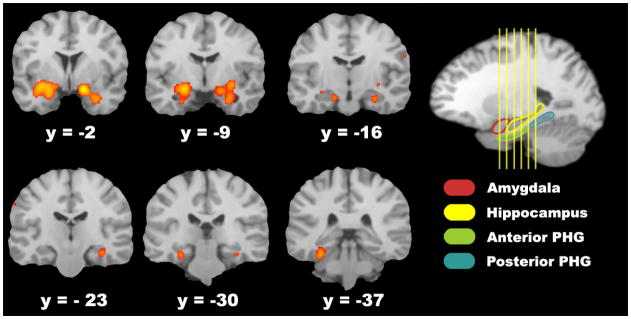
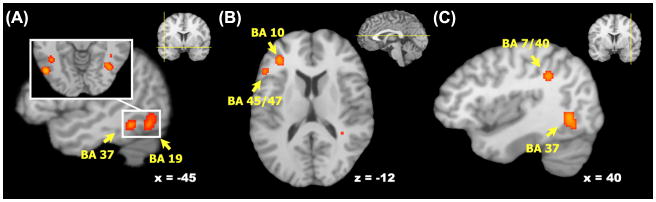
Over the past decade, fMRI techniques have been increasingly used to interrogate the neural correlates of successful emotional memory encoding. These investigations have typically aimed to either characterize the contributions of the amygdala and medial temporal lobe (MTL) memory system, replicating results in animals, or delineate the neural correlates of specific behavioral phenomena. It has remained difficult, however, to synthesize these findings into a systems neuroscience account of how networks across the whole-brain support the enhancing effects of emotion on memory encoding. To this end, the present study employed a meta-analytic approach using activation likelihood estimates to assess the anatomical specificity and reliability of event-related fMRI activations related to successful memory encoding for emotional versus neutral information. The meta-analysis revealed consistent clusters within bilateral amygdala, anterior hippocampus, anterior and posterior parahippocampal gyrus, the ventral visual stream, left lateral prefrontal cortex and right ventral parietal cortex. The results within the amygdala and MTL support a wealth of findings from the animal literature linking these regions to arousal-mediated memory effects. The consistency of findings in cortical targets, including the visual, prefrontal, and parietal cortices, underscores the importance of generating hypotheses regarding their participation in emotional memory formation. In particular, we propose that the amygdala interacts with these structures to promote enhancements in perceptual processing, semantic elaboration, and attention, which serve to benefit subsequent memory for emotional material. These findings may motivate future research on emotional modulation of widespread neural systems and the implications of this modulation for cognition.
Copyright © 2010 Elsevier Ltd. All rights reserved.
Figures
Republished in
-
Reprint of: fMRI studies of successful emotional memory encoding: a quantitative meta-analysis.Neuropsychologia. 2011 Mar;49(4):695-705. doi: 10.1016/j.neuropsychologia.2011.02.031. Neuropsychologia. 2011. PMID: 21414466
References
-
- Adolphs R, Cahill L, Schul R, Babinsky R. Impaired declarative memory for emotional material following bilateral amygdala damage in humans. Learning & Memory. 1997;4(3):291–300. - PubMed
-
- Adolphs R, Denburg NL, Tranel D. The amygdala’s role in long-term declarative memory for gist and detail. Behav Neurosci. 2001;115(5):983–992. - PubMed
-
- Adolphs R, Tranel D, Buchanan TW. Amygdala damage impairs emotional memory for gist but not details of complex stimuli. Nat Neurosci. 2005;8(4):512–518. - PubMed
Publication types
MeSH terms
Substances
Grants and funding
LinkOut - more resources
Full Text Sources
Medical
Miscellaneous
