Hepatitis B virus infection and risk of non-Hodgkin lymphoma in South Korea: a cohort study
- PMID: 20688564
- PMCID: PMC2933963
- DOI: 10.1016/S1470-2045(10)70167-4
Hepatitis B virus infection and risk of non-Hodgkin lymphoma in South Korea: a cohort study
Abstract
Background: Hepatitis B virus (HBV) infection is common throughout Asia and Africa. Whether chronic HBV infection increases risk of non-Hodgkin lymphoma (NHL) is unclear. We aimed to assess the association between chronic HBV infection and subsequent development of NHL in a South Korean cohort.
Methods: The Korean Cancer Prevention Study is a cohort study of South Korean workers and their dependants enrolled during 1992-95. From this cohort, we excluded individuals who died before Jan 1, 1993, who had cancer at or before the initial visit, who had missing information about weight, height, alanine aminotransferase or aspartate aminotransferase concentrations, or alcohol use, or who had evidence of HIV or HCV infection. Of 1,284,586 eligible participants, 603,585 had baseline data for serum hepatitis B surface antigen (HBsAg) status and were included in our study. We regarded HBsAg positivity at baseline as evidence of chronic HBV infection. Participants were followed up from baseline until Dec 31, 2006. We used national databases of inpatient and outpatient diagnoses and mortality records to ascertain occurrence of haematological malignancies. We assessed incidence of NHL overall and of NHL subtypes, malignant immunoproliferation, Hodgkin's lymphoma, multiple myeloma, and various leukaemias. We used Cox regression to evaluate associations with HBsAg status, adjusting for sex, age, and enrolment year.
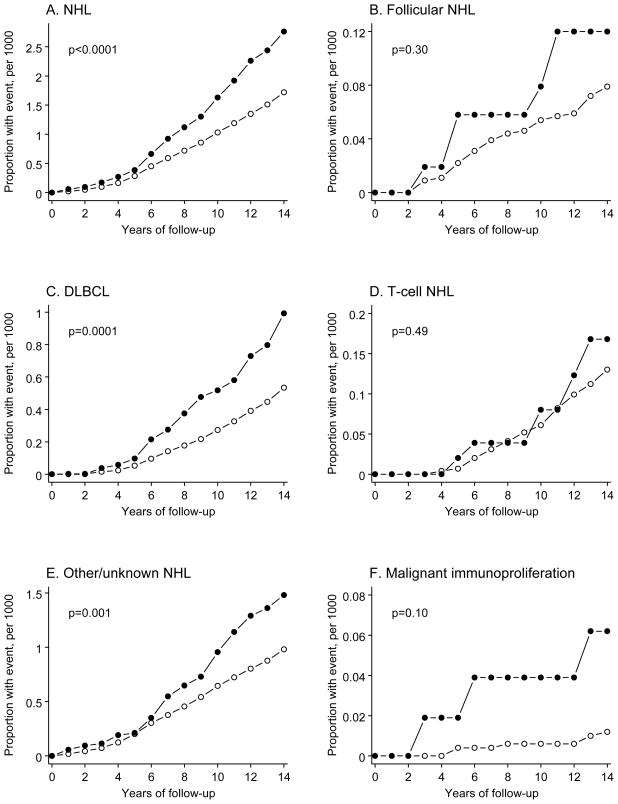
Findings: 53,045 (9%) of 603,585 participants tested positive for HBsAg at baseline. Subsequently, 133 HBsAg-positive and 905 HBsAg-negative individuals developed NHL. HBsAg-positive participants had an increased risk of NHL overall compared with those who were HBsAg-negative (incidence 19.4 vs 12.3 per 100,000 person-years; hazard ratio [HR] 1.74, 95% CI 1.45-2.09, adjusted for sex, age at baseline, and enrolment year). Among NHL subtypes, HBsAg positivity was associated with increased risk of diffuse large B-cell lymphoma (n=325, incidence 6.86 vs 3.79 per 100,000 person-years; adjusted HR 2.01, 1.48-2.75) and other or unknown subtypes (n=591, incidence 10.5 vs 7.07 per 100,000 person-years; adjusted HR 1.65, 1.29-2.11), compared with HBsAg negativity. Increased risk was also recorded for malignant immunoproliferation (n=14, incidence 0.44 vs 0.15 per 100,000 person-years; adjusted HR 3.79, 1.05-13.7). Risk of these malignancies was consistently raised in HBsAg-positive participants throughout 14 years of follow-up. HBsAg positivity was not associated with follicular or T-cell NHL, Hodgkin's lymphoma, multiple myeloma, or various leukaemias.
Interpretation: During extended follow-up, HBsAg-positive individuals had an increased risk of NHL, suggesting that chronic HBV infection promotes lymphomagenesis.
Funding: Korean Seoul City Research and the National Research and Development Program for Cancer Control, Ministry for Health, Welfare and Family Affairs, Republic of Korea; US National Cancer Institute.
Copyright 2010 Elsevier Ltd. All rights reserved.
Conflict of interest statement
The authors do not have any conflicts of interest to disclose.
Figures
Comment in
-
HBV infection as a risk factor for non-Hodgkin lymphoma.Lancet Oncol. 2010 Sep;11(9):806. doi: 10.1016/S1470-2045(10)70182-0. Epub 2010 Aug 3. Lancet Oncol. 2010. PMID: 20688565 No abstract available.
References
-
- Liaw YF, Chu CM. Hepatitis B virus infection. Lancet. 2009;373:582–92. - PubMed
-
- Parkin DM. The global health burden of infection-associated cancers in the year 2002. Int J Cancer. 2006;118:3030–3044. - PubMed
-
- Park SC, Jeong SH, Kim J, Han CJ, Kim YC, Choi KS, Cho JH, Lee M, Jung HH, Ki SS, Chang YH, Lee SS, Park YH, Lee KH. High prevalence of hepatitis B virus infection in patients with B-cell non-Hodgkin’s lymphoma in Korea. J Med Virol. 2008;80:960–966. - PubMed
-
- Chen MH, Hsiao LT, Chiou TJ, Liu JH, Gau JP, Teng HW, Wang WS, Chao TC, Yen CC, Chen PM. High prevalence of occult hepatitis B virus infection in patients with B cell non-Hodgkin’s lymphoma. Ann Hematol. 2008;87:475–80. - PubMed
Publication types
MeSH terms
Grants and funding
LinkOut - more resources
Full Text Sources
Research Materials