


Configural and featural processing in humans with congenital prosopagnosia
- PMID: 20689639
- PMCID: PMC2916664
- DOI: 10.2478/v10053-008-0074-4
Configural and featural processing in humans with congenital prosopagnosia
Abstract
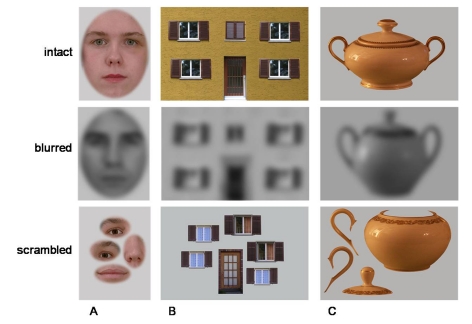
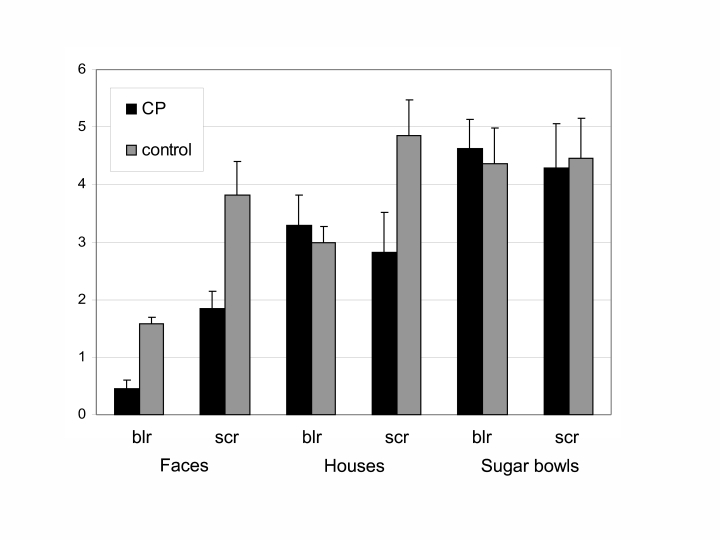
Prosopagnosia describes the failure to recognize faces, a deficiency that can be devastating in social interactions. Cases of acquired prosopagnosia have often been described over the last century. In recent years, more and more cases of congenital prosopagnosia (CP) have been reported. In the present study we tried to determine possible cognitive characteristics of this impairment. We used scrambled and blurred images of faces, houses, and sugar bowls to separate featural processing strategies from configural processing strategies. This served to investigate whether congenital prosopagnosia results from process-specific deficiencies, or whether it is a face-specific impairment. Using a delayed matching paradigm, 6 individuals with CP and 6 matched healthy controls indicated whether an intact test stimulus was the same identity as a previously presented scrambled or blurred cue stimulus. Analyses of d values indicated that congenital prosopagnosia is a face-specific deficit, but that this shortcoming is particularly pronounced for processing configural facial information.
Keywords: face perception; object perception; prosopagnosia; visual cognition.
Figures
References
-
- Avidan G., Hasson U., Malach R., Behrmann M. Detailed exploration of face-related processing in congenital prosopagnosia: 2. Functional neuroimaging findings. Journal of Cognitive Neuroscience. 2005;17:1150–1167. - PubMed
-
- Bartlett J. C., Searcy J., Abdi H. What are the routes to face recognition? In: Petersen M. A., Rhodes G., editors. Perception of faces, objects, and scenes. New York: Oxford University Press; 2003. pp. 21–52.
-
- Barton J. J., Cherkasova M., O’Connor M. Covert recognition in acquired and developmental prosopagnosia. Neurology. 2001;57:1161–1168. - PubMed
-
- Barton J. J., Press D. Z., Keenan J. P., O’Connor M. Lesions of the fusiform face area impair perception of facial configuration in prosopagnosia. Neurology. 2002;58:71–78. - PubMed
-
- Behrmann M., Avidan G. Congenital prosopagnosia: Face-blind from birth. Trends in Cognitive Sciences. 2005;9:180–187. - PubMed
LinkOut - more resources
Full Text Sources
Miscellaneous