


Differential effects of prolonged work on performance measures in self-paced speed tests
- PMID: 20689668
- PMCID: PMC2916666
- DOI: 10.2478/v10053-008-0070-8
Differential effects of prolonged work on performance measures in self-paced speed tests
Abstract
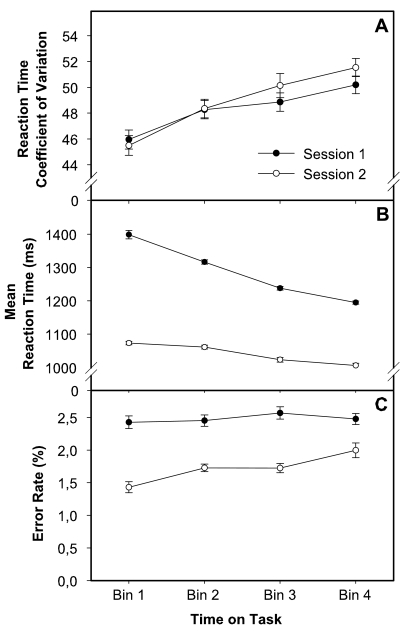
Time-related changes in the speeded performance of complex cognitive tasks are considered to arise from the combined effects of practice and mental fatigue. Here we explored the differential contributions of practice and fatigue to performance changes in a self-paced speeded mental addition and comparison task of about 50 min duration, administered twice within one week's time. Performance measures included average response speed, accuracy, and response speed variability. The results revealed differential effects of prolonged work on different performance indices: Practice effects, being more pronounced in the first session, were reflected in an improvement of average response speed, whereas mental fatigue, occurring in both sessions, was reflected in an increase of response speed variability. This demonstrates that effects of mental fatigue on average speed of performance may be masked by practice effects but still be detectable in the variability of performance. Therefore, besides experimental factors such as the length and complexity of tasks, indices of response speed variability should be taken into consideration when interpreting different aspects of performance in self-paced speed tests.
Keywords: mental fatigue; practice effects; reaction time; sustained performance; time on task.
Figures
References
-
- Ackerman P. L., Kanfer R. Test length and cognitive fatigue: An empirical examination of effects on performance and test-taker reactions. Journal of Experimental Psychology: Applied. 2009;15:163–181. - PubMed
-
- Archer E. J., Bourne L. E. Inverted-alphabet printing as a function of intertrial rest and sex. Journal of Experimental Psychology. 1956;52:322–328. - PubMed
-
- Bertelson P., Joffe R. Blockings in prolonged serial responding. Ergonomics. 1963;6:109–116.
-
- Bills A. G. Blocking: A new principle of mental fatigue. American Journal of Psychology. 1931;43:230–245.
-
- Bratzke D., Rolke B., Steinborn M. B., Ulrich R. The effect of 40 hours constant wakefulness on task switching efficiency. Journal of Sleep Research. 2009;18:167–172. - PubMed
LinkOut - more resources
Full Text Sources