. 2010 Jun 1;1(13):1952-1956.
doi: 10.1021/jz100564j.

Broadband Heteronuclear Solid-State NMR Experiments by Exponentially Modulated Dipolar Recoupling without Decoupling

Affiliations

Broadband Heteronuclear Solid-State NMR Experiments by Exponentially Modulated Dipolar Recoupling without Decoupling

Anders B Nielsen et al. J Phys Chem Lett. .

Abstract

We present a novel solid-state NMR method for heteronuclear dipolar recoupling without decoupling. The method, which introduces the concept of exponentially modulated rf fields, provides efficient broadband recoupling with large flexibility with respect to hetero- or homonuclear applications, sample spinning frequency, and operation without the need for high-power (1)H decoupling. For previous methods, the latter has been a severe source of sample heating which may cause detoriation of costly samples. The so-called EXPonentially mOdulated Recoupling Technique (EXPORT) is described analytically and numerically, and demonstrated experimentally by 1D (13)C spectra and 2D (13)C-(15)N correlation spectra of (13)C,(15)N-labeled samples of GB1, ubiquitin, and fibrils of the SNNFGAILSS fragment of amylin. Through its flexible operation, robustness, and strong performance, it is anticipated that EXPORT will find immediate application for both hetero- and homonuclear dipolar recoupling in solid-state NMR of (13)C,(15)N-labeled proteins and compounds of relevance in chemistry.


Figures
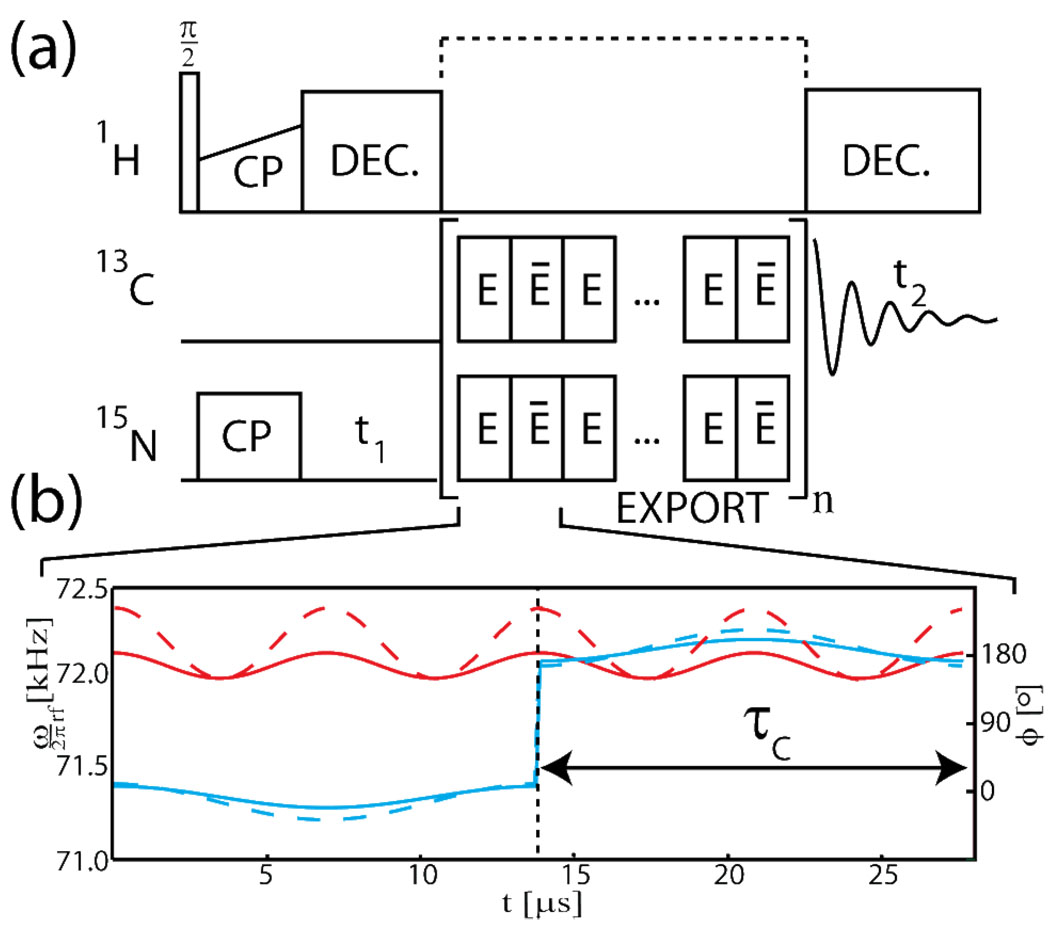
Figure 1
Figure 1
(a) The EXPORT pulse sequence for heteronuclear dipolar recoupling without decoupling embedded in a typical 2D NCO/NCA chemical shift correlation experiment. (b) The amplitude (red) and phase (blue) modulation schemes of the basic elements with the 13C and 15N fields represented by solid and broken lines, respectively, for EXPORT with C=6ωr, BI=3ωr/8, BS=5ωr/8, and ωr/2π=12 kHz.
Figure 2
Figure 2
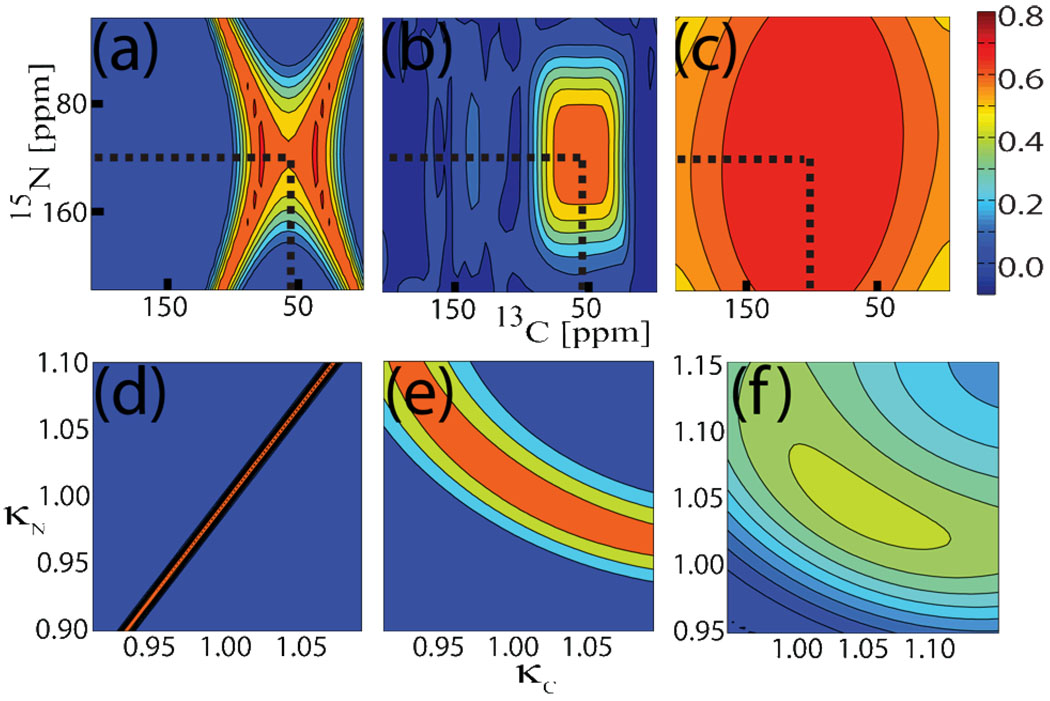
15N to 13Cα coherence transfer efficiencies calculated for EXPORT using the parameters in Fig. 1b. (a–c) 2D 15N vs 13C offset plots for EXPORT (c), an OCNCA optimal control sequence (b), and DCP (a). (d–f) 2D 15N vs 13C rf field strength plots (scaling factors relative to the nominal values) for DCP (d), EXPORT with high digitization of the rf field (100 points over 1 rotor period) (e), and EXPORT with lower digitization (20 points over 1 rotor period) (f). Simulations were made using SIMPSON with parameters for a directly bonded 15N-13Cα spin system, powder averaging with 5 γCR and 144 REPULSION angles, and a spinning frequency of 12 kHz at 16.4 T. Broken lines mark carrier frequencies.
Figure 3
Figure 3
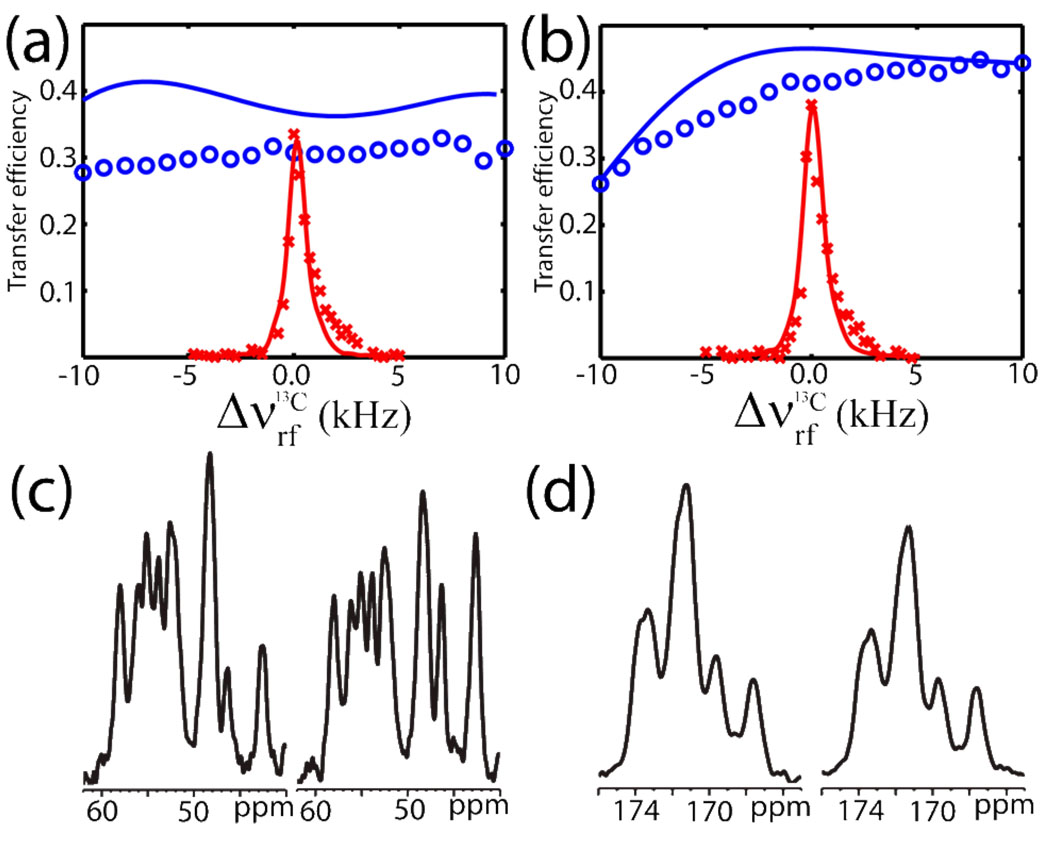
Experimental (signal integrals for the target spin spectral region) and simulated 15N to 13C’ (a) and 15N to 13Cα (b) coherence transfer efficiencies for DCP (experiment: red crosses, simulation: red line) and EXPORT (experiment: blue circles, simulation: blue line) as function of the 13C rf field strength mismatch. Experimental spectra were obtained for U-13C,15N-labeled FGAIL in a SNNFGAILSS fibril sample. Representative 13C spectra following (c) 15N to 13Cα and (d) 15N to 13C’ transfer for EXPORT (left) and DCP (right). In accord with Fig. 1a, the spectra were recorded using CP for the initial 1H-15N transfer and SPINAL-64 decoupling32 (80 kHz) was used during acqusition. All spectra were recorded at 11.9 kHz spinning with carrier frequencies at 120 ppm for 15N and 50/172 ppm for NCA/NCO transfer. DCP used ωrf,C/2π = 50.2 kHz, ωrf,N/2π = 39.3 kHz, and 120 kHz 1H decoupling. EXPORT used C=7ωr, BI=3ωr/8, BS=5ωr/8, and no 1H decoupling.
Figure 4
Figure 4
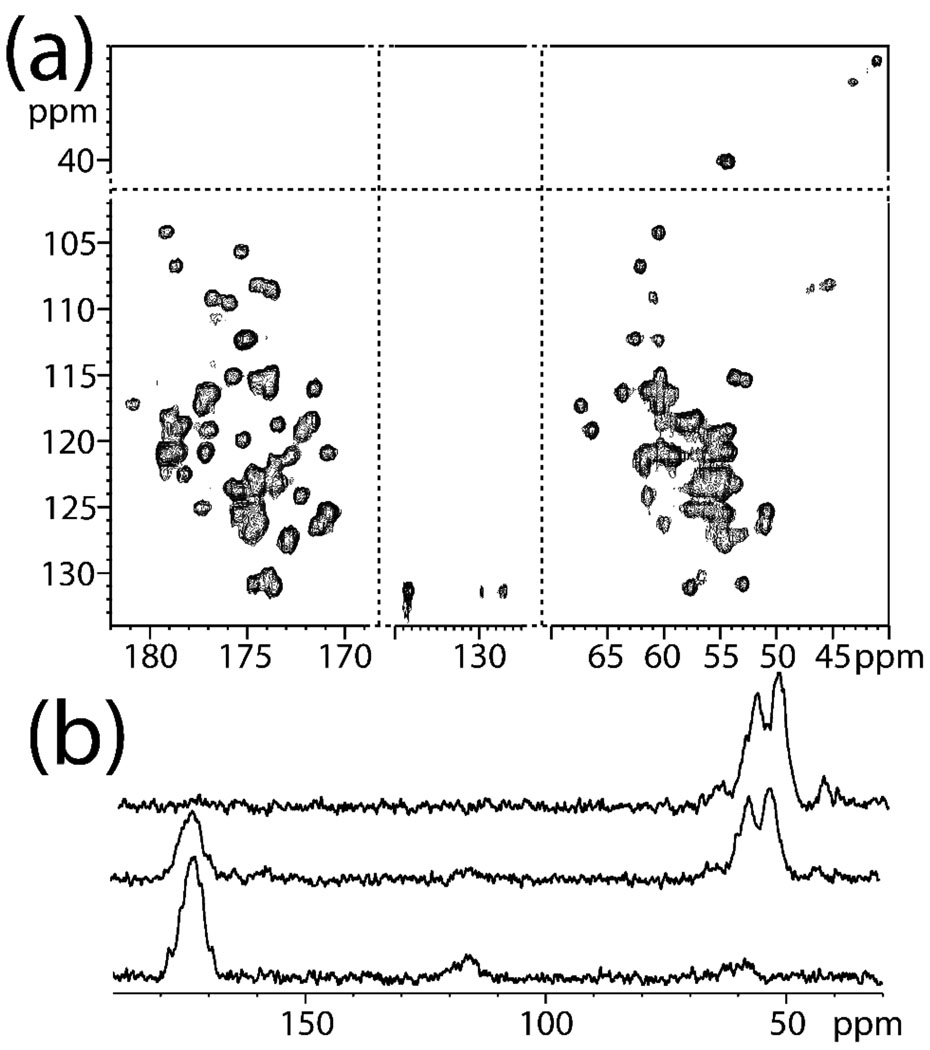
Experimental spectra for U-13C,15N-labeled samples of (a) GB1 and (b) ubiquitin recorded at 16.4 T using EXPORT for 15N-13C transfer with C =3ωr, BI=3ωr/8, BS=5ωr/8, and τmix=2.35 ms. In accord with Fig. 1a, the spectra were recorded using CP for the initial 1H-15N transfer. SPINAL-64 decoupling (70 kHz) was used in the detection periods. The 2D spectrum (a) used 23.81 kHz sample spinning without 1H decoupling during EXPORT, 560 points in the indirect and 4096 point in the direct dimensions. The 1D spectra (b) used 10.02 kHz spinning, carrier frequencies at 40 (top), 120 (middle), and 180 (bottom) ppm, and 90 kHz 1H decoupling during EXPORT.

References

    1. Etzkorn M, Martell S, Andronesi OC, Seidel K, Engelhard M, Baldus M. Secondary Structure, Dynamics, and Topology of a Seven-Helix Receptor in Native Membranes, Studied by Solid-State NMR Spectroscopy. Angew. Chem. Int. Ed. 2007;46:459–462. - PubMed
    1. Li Y, Berthold DA, Gennis RB, Rienstra CM. Chemical shift assignment of the transmembrane helices of DsbB, a 20-kDa integral membrane enzyme, by 3D magic-angle spinning NMR spectroscopy. Protein Science. 2008;17:199–204. - PMC - PubMed
    1. Hiller M, Higman VA, Jehle S, van Rossum BJ, Kuhlbrandt W, Oschkinat H. [2,3-C-13]-labeling of aromatic residues-getting a head start in the magic-angle-spinning NMR assignment of membrane proteins. J. Am. Chem. Soc. 2008;130:408–409. - PubMed
    1. Vosegaard T, Kamihira-Ishijima M, Watts A, Nielsen NC. Helix conformations in 7TM membrane proteins determined using oriented-sample solid-state NMR with multiple residue-specific N-15 labeling. Biophys. J. 2008;94:241–250. - PMC - PubMed
    1. Yi MG, Cross TA, Zhou HX. Conformational heterogeneity of the M2 proton channel and a structural model for channel activation. Proc. Natl. Acad. Sci. 2009;106:13311–13316. - PMC - PubMed