


Adolescents' heightened risk-seeking in a probabilistic gambling task
- PMID: 20689728
- PMCID: PMC2896475
- DOI: 10.1016/j.cogdev.2009.11.003
Adolescents' heightened risk-seeking in a probabilistic gambling task
Abstract
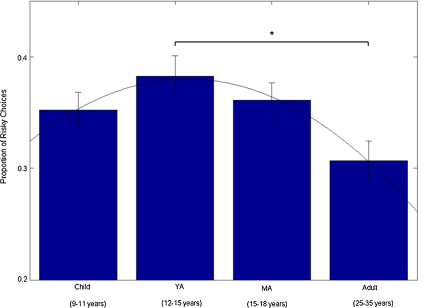
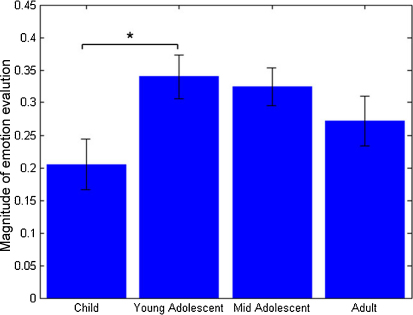
This study investigated adolescent males' decision-making under risk, and the emotional response to decision outcomes, using a probabilistic gambling task designed to evoke counterfactually mediated emotions (relief and regret). Participants were 20 adolescents (aged 9-11), 26 young adolescents (aged 12-15), 20 mid-adolescents (aged 15-18) and 17 adults (aged 25-35). All were male. The ability to maximize expected value improved with age. However, there was an inverted U-shaped developmental pattern for risk-seeking. The age at which risk-taking was highest was 14.38 years. Although emotion ratings overall did not differ across age, there was an increase between childhood and young adolescence in the strength of counterfactually mediated emotions (relief and regret) reported after receiving feedback about the gamble outcome. We suggest that continuing development of the emotional response to outcomes may be a factor contributing to adolescents' risky behaviour.
Figures
References
-
- Bossaerts P., Hsu M. In: Neuroeconomics: decision making and the brain. Glimcher P.W., Camerer C.F., Fehr E., Poldrack R.A., editors. Elsevier; New York: 2008. pp. 351–364.
-
- Boyer T.W. The development of risk-taking: A multi-perspective review. Developmental Review. 2006;26:291–345.
-
- Camille N., Coricelli G., Sallet J., Pradat-Diehl P., Duhamel J.R., Sirigu A. The involvement of the orbitofrontal cortex in the experience of regret. Science. 2004;304(5674):1167–1170. - PubMed
LinkOut - more resources
Full Text Sources