. 2010 Sep;11(3):191-9.
doi: 10.1007/s10969-010-9094-7. Epub 2010 Aug 6.

The New York Consortium on Membrane Protein Structure (NYCOMPS): a high-throughput platform for structural genomics of integral membrane proteins

Affiliations

The New York Consortium on Membrane Protein Structure (NYCOMPS): a high-throughput platform for structural genomics of integral membrane proteins

James Love et al. J Struct Funct Genomics. 2010 Sep.

Abstract

The New York Consortium on Membrane Protein Structure (NYCOMPS) was formed to accelerate the acquisition of structural information on membrane proteins by applying a structural genomics approach. NYCOMPS comprises a bioinformatics group, a centralized facility operating a high-throughput cloning and screening pipeline, a set of associated wet labs that perform high-level protein production and structure determination by x-ray crystallography and NMR, and a set of investigators focused on methods development. In the first three years of operation, the NYCOMPS pipeline has so far produced and screened 7,250 expression constructs for 8,045 target proteins. Approximately 600 of these verified targets were scaled up to levels required for structural studies, so far yielding 24 membrane protein crystals. Here we describe the overall structure of NYCOMPS and provide details on the high-throughput pipeline.


Figures
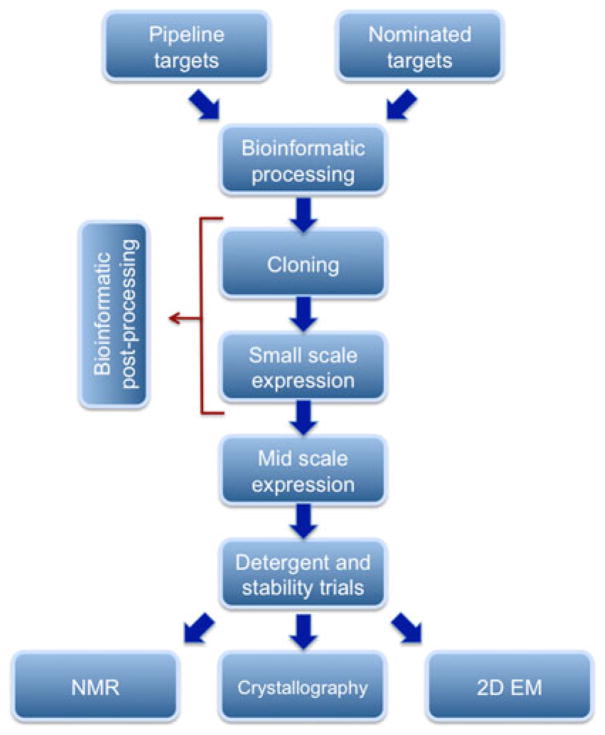
Fig. 1
Fig. 1
Flow chart depicting the pipeline workflow at NYCOMPS
Fig. 2
Fig. 2
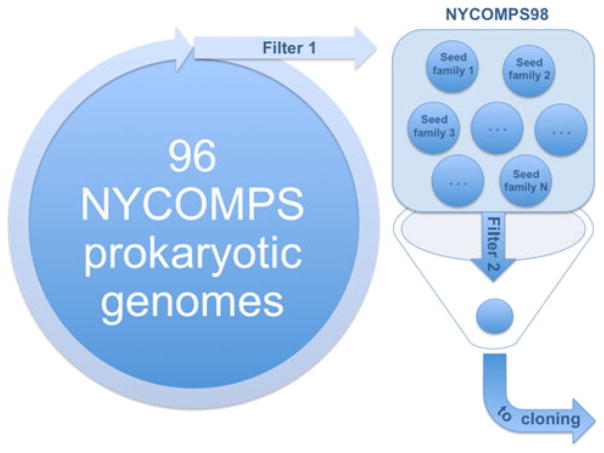
Target selection at NYCOMPS. We start from 96 prokaryotic genomes and we create (Filter 1) a set of valid targets (NYCOMPS98, see text). We then select proteins of interest (seeds) and expand them into the set of valid targets to create seed families (we use sequence similarity in the predicted TM region as a criterion for family membership). All members in a selected seed family are subjected to additional filtering steps (Filter 2) to ensure novelty or increase feasibility. Finally, remaining targets are sent to cloning
Fig. 3
Fig. 3
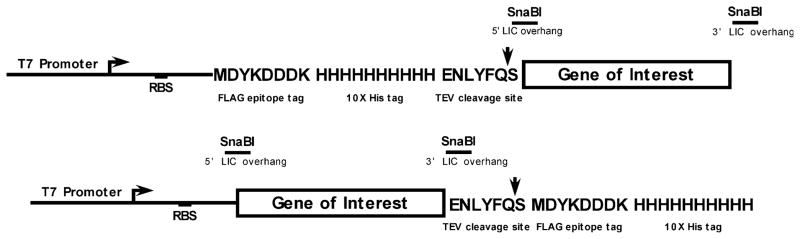
N-terminal (upper panel) and C-terminal (lower panel) fusion expression vectors for the production of His/FLAG-tagged membrane proteins in E. coli
Fig. 4
Fig. 4
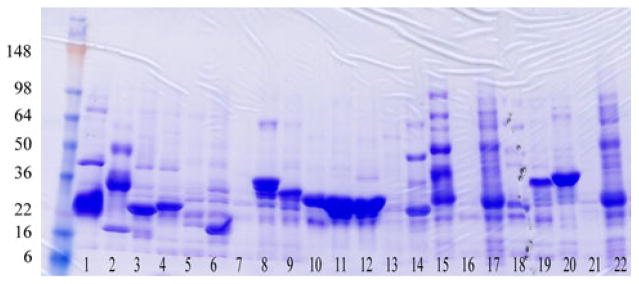
Coommassie blue stained SDS–PAGE showing expression and purification results of 22 different membrane proteins. Cells were grown in 0.6 ml of media in a deep well block, and metal affinity purified and eluted in a buffer containing Dodecyl-maltoside detergent. Well-expressed proteins can clearly be identified (without western blot or GFP labeling methods). Clones producing membrane proteins of approximately the correct molecular weight are re-grown at a larger scale prior to detergent stability analysis. For membrane proteins, molecular weights judged by electrophoretic mobility are often underestimated by ~10%. Also, SDS-resistant multimers are frequently observed, as is the case for samples in lanes 1, 2, 14, 15, 17 and 22
Fig. 5
Fig. 5
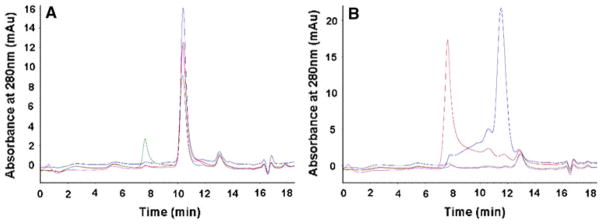
UV absorbance monitored elution profiles from a size exclusion column for two membrane proteins post detergent stability testing. Metal affinity elution’s of membrane proteins in DDM containing buffer are treated at an elevated temperature with a large excess of various short chain ‘harsh’ detergents and a DDM control. After a time period, the reactions are clarified to remove large aggregates and the samples are subjected to size exclusion chromatography in a mobile phase containing DDM. a Shows a membrane protein that is largely detergent insensitive, as the peak shape and height (as measured by mAU) are not significantly altered by the detergent treatment. b Shows a detergent sensitive membrane protein, where the detergent stability treatment has resulted in the peak shifting to the void or being absent, in the short chain detergents, but not the more mild DDM control. Blue, DDM; Green, C8E4; Red, LDAO; Pink β-OG
Fig. 6
Fig. 6
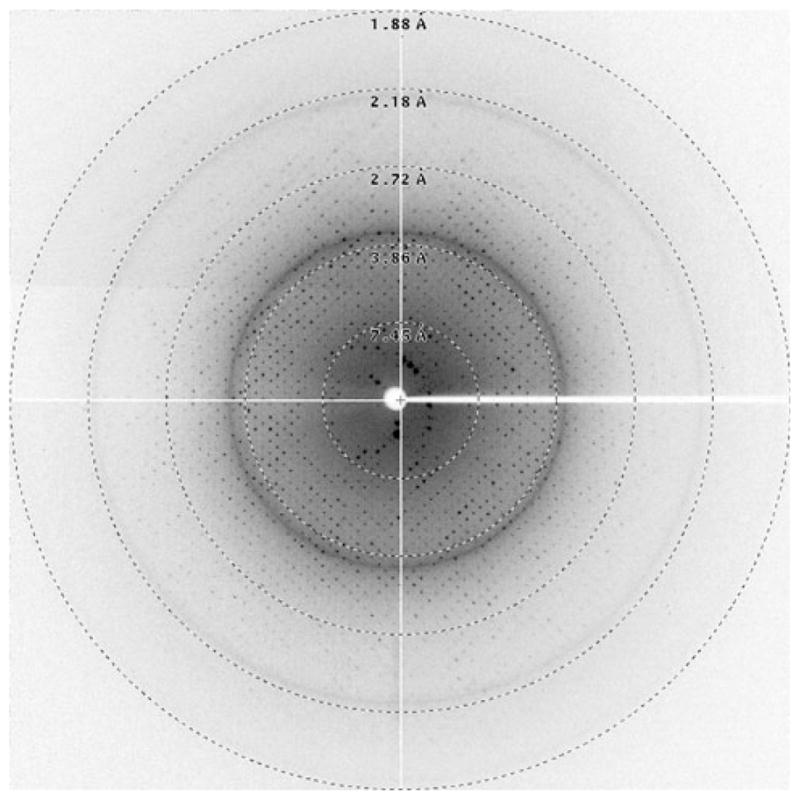
X-ray diffraction pattern of a membrane protein crystal. The highest resolution spots are visible to 2.0 Å. The resolution of the edge of the screen is indicated

References

    1. Altschul SF, Madden TL, Schaffer AA, Zhang J, Zhang Z, Miller W, Lipman DJ. Gapped BLAST and PSI-BLAST: a new generation of protein database search programs. Nucleic Acids Res. 1997;25:3389–3402. - PMC - PubMed
    1. Aslanidis C, de Jong PJ. Ligation-independent cloning of PCR products (LIC-PCR) Nucleic Acids Res. 1990;18:6069–6074. - PMC - PubMed
    1. Baas BJ, Denisov IG, Sligar SG. Homotropic cooperativity of monomeric cytochrome P450 3A4 in a nanoscale native bilayer environment. Arch Biochem Biophys. 2004;430:218–228. - PubMed
    1. Bernard P, Couturier M. Cell killing by the F plasmid CcdB protein involves poisoning of DNA-topoisomerase II complexes. J Mol Biol. 1992;226:735–745. - PubMed
    1. Bowie JU. Stabilizing membrane proteins. Curr Opin Struct Biol. 2001;11:397–402. - PubMed

Publication types

Substances

LinkOut - more resources