Review
doi: 10.1146/annurev-physiol-042210-121137.
Role of tissue factor in venous thrombosis
Affiliations
- PMID: 20690821
- PMCID: PMC3076951
- DOI: 10.1146/annurev-physiol-042210-121137
Item in Clipboard
Review
Role of tissue factor in venous thrombosis
Annu Rev Physiol.
2011.
Abstract
Venous thromboembolism (VTE) is a leading cause of morbidity and mortality worldwide. However, the mechanisms by which clots are formed in the deep veins have not been determined. Tissue factor (TF) is the primary initiator of the coagulation cascade and is essential for hemostasis. Under pathological conditions, TF is released into the circulation on small-membrane vesicles termed microparticles (MPs). Recent studies suggest that elevated levels of MP TF may trigger thrombosis. This review provides an overview of the role of TF in VTE.
Figures
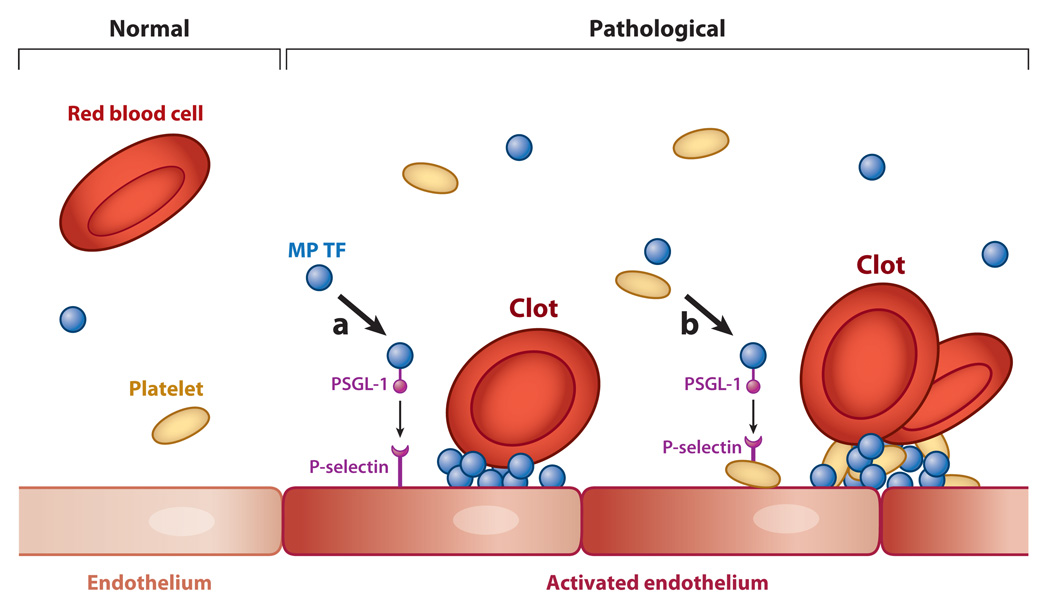
Formation of a venous clot. Venous thrombi are fibrin-rich clots that develop in the absence of gross endothelial damage. In a healthy vein (left), high levels of tissue factor pathway inhibitor (TFPI), thrombomodulin (TM), and endothelial cell protein C receptor (EPCR) maintain an antithrombotic phenotype (normal endothelium). In pathological conditions (right), elevated levels of tissue factor (TF)-positive microparticles (MPs) are present in the blood, and reduced blood flow, activation of the venous endothelium, and deposition of platelets may conspire to trigger formation of a thrombotic clot. Here we present two potential mechanisms that initiate activation of the coagulation system: (a) TF-positive MPs expressing P-selectin glycoprotein-1 (PSGL-1) dock to an activated endothelium expressing P-selectin, and (b) TF-positive MPs bind to activated platelets that adhere to the activated endothelium. In both cases, the presence of MP TF serves as a potent trigger of coagulation activation, and the continuous delivery of TF-positive MPs may enhance propagation of the thrombus.
References
-
- Mackman N, Tilley RE, Key NS. Role of the extrinsic pathway of blood coagulation in hemostasis and thrombosis. Arterioscler. Thromb. Vasc. Biol. 2007;27(8):1687–1693. - PubMed
-
- Komiyama Y, Pedersen AH, Kisiel W. Proteolytic activation of human factors IX and X by recombinant human factor VIIa: effects of calcium, phospholipids, and tissue factor. Biochemistry. 1990;29(40):9418–9425. - PubMed
-
- Fleck RA, Rao LV, Rapaport SI, Varki N. Localization of human tissue factor antigen by immunostaining with monospecific, polyclonal antihuman tissue factor antibody. Thromb. Res. 1990;59(2):421–437. - PubMed
Publication types
MeSH terms
Substances
Grants and funding
LinkOut - more resources
Full Text Sources
Other Literature Sources
Medical
Miscellaneous