


Testing a new cognitive behavioural treatment for obesity: A randomized controlled trial with three-year follow-up
- PMID: 20691328
- PMCID: PMC2923743
- DOI: 10.1016/j.brat.2010.03.008
Testing a new cognitive behavioural treatment for obesity: A randomized controlled trial with three-year follow-up
Abstract
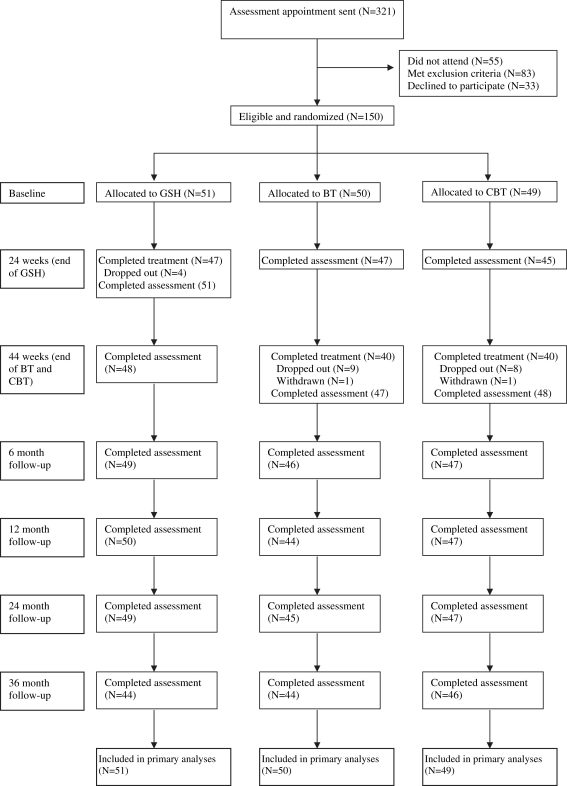
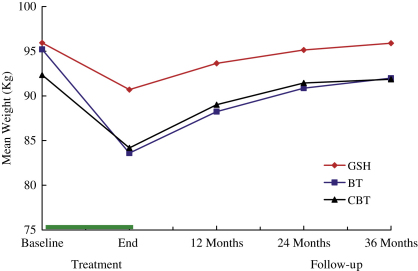
It is remarkably difficult for people with obesity to maintain a new lower weight following weight loss. The aim of the present study was to examine the immediate and longer-term effects of a new cognitive behavioural treatment that was explicitly designed to minimise this post-treatment weight regain. One hundred and fifty female participants with obesity were randomized to the new treatment, behaviour therapy (the leading alternative psychological treatment) or guided self-help (a minimal intervention). Both of the main treatments resulted in an average weight loss of about ten percent of initial weight whereas weight loss was more modest with guided self-help. The participants were subsequently followed-up for three years post-treatment. The great majority regained almost all the weight that they had lost with the new treatment being no better than the behavioural treatment in preventing weight regain. These findings lend further support to the notion that obesity is resistant to psychological methods of treatment, if anything other than a short-term perspective is taken. It is suggested that it is ethically questionable to claim that psychological treatments for obesity "work" in the absence of data on their longer-term effects.
Copyright 2010 Elsevier Ltd. All rights reserved.
Figures
Comment in
-
Overgeneralization from limited data: A commentary on Cooper et al., 2010.Behav Res Ther. 2010 Aug;48(8):714-6. doi: 10.1016/j.brat.2010.05.016. Behav Res Ther. 2010. PMID: 20691329 Free PMC article.
References
-
- American Psychiatric Association . 4th ed. Author; Washington, DC: 1994. Diagnostic and statistical manual of mental disorders.
-
- Brownell K.D. American Health Publishing Company; Dallas: 1997. The LEARN program for weight control.
-
- Carter J.C., Fairburn C.G. Cognitive-behavioral self-help for binge eating disorder: a controlled effectiveness study. Journal of Consulting and Clinical Psychology. 1998;66:616–623. - PubMed
-
- Cussler E.C., Teixeira P.J., Going S.B., Houtkooper L.B., Metcalfe L.L., Blew R.M. Maintenance of weight loss in overweight middle-aged women through the internet. Obesity. 2008;16:1052–1060. - PubMed
-
- Cooper Z., Fairburn C.G. A new cognitive behavioural approach to the treatment of obesity. Behaviour Research and Therapy. 2001;39:499–511. - PubMed
Publication types
MeSH terms
Grants and funding
LinkOut - more resources
Full Text Sources
Medical
