


Treatment with docosahexaenoic acid after hypoxia-ischemia improves forepaw placing in a rat model of perinatal hypoxia-ischemia
- PMID: 20691409
- PMCID: PMC2947568
- DOI: 10.1016/j.ajog.2010.06.017
Treatment with docosahexaenoic acid after hypoxia-ischemia improves forepaw placing in a rat model of perinatal hypoxia-ischemia
Abstract
Objective: Docosahexaenoic acid (DHA) is a dietary fatty acid with neuroprotective properties. We hypothesized that DHA treatment after hypoxia-ischemia would improve function and reduce brain volume loss in a perinatal rat model.
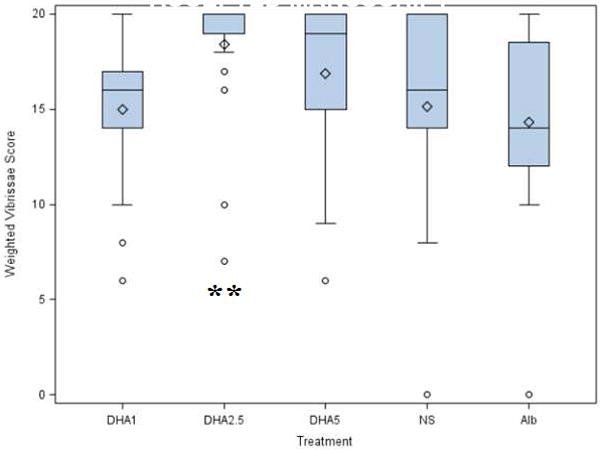
Study design: Seven-day-old Wistar rat pups from 7 litters (n = 84) underwent right carotid ligation, followed by 8% O(2) for 90 minutes. Fifteen minutes after hypoxia-ischemia, pups were divided into 3 treatment groups (intraperitoneal injections of DHA 1, 2.5, or 5 mg/kg) and 2 control groups (25% albumin or saline). At 14 days, rats underwent vibrissae-stimulated forepaw placing testing, and bilateral regional volumes were calculated for cortex, striatum, hippocampus, and hemisphere.
Results: Posthypoxia-ischemia treatment with DHA acid significantly improved vibrissae forepaw placing (complete responses: 8.5 ± 2 treatment vs 7.4 ± 2 controls; normal = 10; P = .032, t test). Postinjury DHA treatment did not attenuate brain volume loss in any region.
Conclusion: Posthypoxia-ischemia DHA treatment significantly improves functional outcome.
Copyright © 2010 Mosby, Inc. All rights reserved.
Figures
References
-
- Graham EM, Ruis KA, Hartman AL, Northington FJ, Fox HE. A systematic review of the role of intrapartum hypoxia-ischemia in the causation of neonatal encephalopathy. Am J Obstet Gynecol. 2008;199:587–95. - PubMed
-
- Wu YW, Backstrand KH, Zhao S, Fullerton HJ, Johnston SC. Declining diagnosis of birth asphyxia in California: 1991-2000. Pediatrics. 2004;114:1584–90. - PubMed
-
- Thornberg E, Thiringer K, Odeback A, Milsom I. Birth asphyxia: Incidence, clinical course and outcome in a Swedish population. Acta Pædiatr. 1995;84:927. - PubMed
-
- de Vries LS, Cowan FM. Evolving understanding of hypoxic-ischemic encephalopathy in the term infant. Semin Pediatr Neurol. 2009;16:216–25. - PubMed
-
- Ambalavanan N, Carlo W, Shankaran S, Bann C, Emrich S, Higgins R, et al. Predicting outcomes of neonates diagnosed with hypoxemic-ischemic encephalopathy. Pediatrics. 2006;118:2084. - PubMed
Publication types
MeSH terms
Substances
Grants and funding
LinkOut - more resources
Full Text Sources
