Review
. 2010 Sep;16(9):426-34.
doi: 10.1016/j.molmed.2010.06.003. Epub 2010 Aug 5.

Lessons for cardiac regeneration and repair through development

Affiliations
Review

Lessons for cardiac regeneration and repair through development

Jeffrey M Alexander et al. Trends Mol Med. 2010 Sep.

Abstract

Cell-based regenerative strategies have the potential to revolutionize the way cardiovascular injury is treated, but successful therapies will require a precise understanding of the mechanisms that dictate cell fate, survival and differentiation. Recent advances in the study of cardiac development hold promise for unlocking the keys for successful therapies. Using mouse models and embryonic stem cells, researchers are uncovering cardiac progenitor cells in both embryonic and adult contexts. Furthermore, the signaling molecules and transcriptional regulators that govern these cells and their behavior are being revealed. Here, we focus on the recent advances in these areas of cardiac developmental research and their impact on the expanding field of regenerative medicine.


Figures

Figure 1
Figure 1
Precursors of the mouse heart. Cardiac precursors have been identified and isolated from mouse embryos and ESC cultures (a). Multiple different precursors have emerged, including Flk1+ [24], Isl1+/Nkx2–5+/Flk1+ [25], and Nkx2–5+/c-kit+ [26] cell populations. These cells demonstrate multipotency for resident cell types of the heart, including cardiomyocytes, smooth muscle cells and endothelial cells. The interrelationship between these different precursors and how they contribute to the heart in vivo is still unclear (b). These populations might consist of similar or identical precursors that appear distinct because they were isolated using different approaches (top). In contrast, they might represent completely distinct lineages that independently contribute to the heart (center) or discrete stages of differentiation within a common cardiac lineage (bottom).
Figure 2
Figure 2
Molecular regulators of cardiac differentiation. Multiple signaling inputs are important for cardiac differentiation, and each have distinct effects at each developmental stage (a). BMPs, canonical Wnts, and Activin/Nodal all promote early mesodermal specification. Wnts also have both positive and negative effects on cardiac differentiation. Wnts block the specification of CPCs, but promote their expansion; Wnts repress the differentiation of these progenitor cells. Transcription factors regulate cardiac differentiation (b–d). Overexpression of Mesp1 increases cardiac differentiation, most likely by promoting the specification of cardiogenic mesoderm and CPCs from mesodermal cell types. Overexpression of Tbx5, Gata4 and Baf60c transdifferentiates mesodermal cells into cardiomyocytes, and overexpression of Tbx5, Gata4, and Mef2c can reprogram cardiac or skin fibroblasts from the adult into cardiomyocytes.
Figure 3
Figure 3
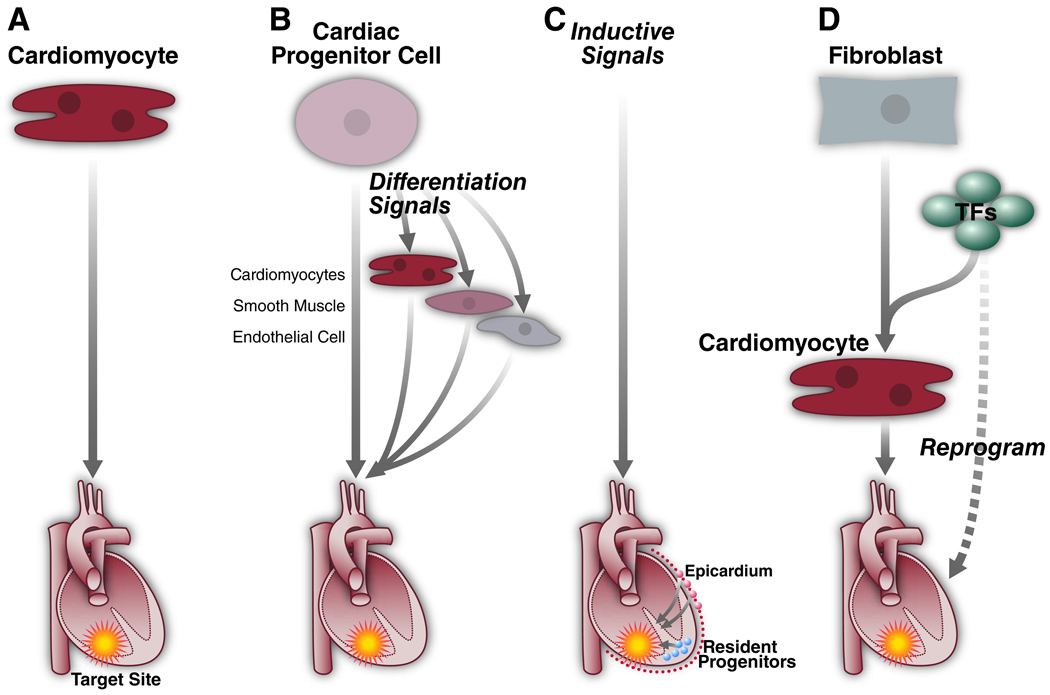
Strategies for regenerative cardiac treatment. Current approaches for cell-based regenerative heart therapy focus on utilizing ESC-derived cardiomyocytes for direct implantation onto an infarcted area (yellow asterisk) (a). Multiple novel approaches might prove more effective. Multipotent cardiac progenitors might be directly implanted into an injured heart or guided to differentiate in vitro followed by transplantation of the mature cardiac cell types (b). Alternatively, inductive signals or chemical agonists could mobilize resident progenitors within the heart or surrounding epicardium to regenerate injured areas, bypassing the need for transplantation (c). Cardiogenic factors such as transcription factors and chromatin regulators might be used to transdifferentiate cells in vitro into cardiomyocytes (d), making the generation of patient-specific cardiomyocytes feasible and improving the quantity and efficiency of cardiomyocyte generation in vitro. These factors or chemical agonists might also be applied directly to the heart to transdifferentiate residual cardiac fibroblasts into functional heart muscle.
Figure 4 within Box 1
Generation of iPS cells. In both humans and mice, somatic cells such as fibroblasts can be reprogrammed into induced pluripotent stem cells through introduction of reprogramming factors. In the mice, iPS cells have been used to generate differentiated cell types from all germ layers as well as entire mice. For human iPS cells, differentiated cells can be used for transplantation and other medically important applications.

References

    1. Lloyd-Jones D, et al. Heart Disease and Stroke Statistics--2010 Update. A Report From the American Heart Association. Circulation. 2009 - PubMed
    1. Murry CE, et al. Cell-based cardiac repair: reflections at the 10-year point. Circulation. 2005;112:3174–3183. - PubMed
    1. Hansson EM, et al. Regeneration Next: Toward Heart Stem Cell Therapeutics. Cell Stem Cell. 2009;5:364–377. - PubMed
    1. Laflamme MA, Murry CE. Regenerating the heart. Nature Biotechnology. 2005;23:845–856. - PubMed
    1. Alvarez-Dolado M, et al. Fusion of bone-marrow-derived cells with Purkinje neurons, cardiomyocytes and hepatocytes. Nature. 2003;425:968–973. - PubMed