Review
. 2011 Jan;121(1):69-77.
doi: 10.1007/s00401-010-0735-5. Epub 2010 Aug 8.

Molecular pathology of human prion disease

Affiliations
Review

Molecular pathology of human prion disease

Jonathan D F Wadsworth et al. Acta Neuropathol. 2011 Jan.

Abstract

Human prion diseases are associated with a range of clinical presentations and are classified by both clinicopathological syndrome and aetiology with sub-classification according to molecular criteria. Considerable experimental evidence suggests that phenotypic diversity in human prion disease relates in significant part to the existence of distinct human prion strains encoded by abnormal PrP isoforms with differing physicochemical properties. To date, however, the conformational repertoire of pathological isoforms of wild-type human PrP and the various forms of mutant human PrP has not been fully defined. Efforts to produce a unified international classification of human prion disease are still ongoing. The ability of genetic background to influence prion strain selection together with knowledge of numerous other factors that may influence clinical and neuropathological presentation strongly emphasises the requirement to identify distinct human prion strains in appropriate transgenic models, where host genetic variability and other modifiers of phenotype are removed. Defining how many human prion strains exist allied with transgenic modelling of potentially zoonotic prion strains will inform on how many human infections may have an animal origin. Understanding these relationships will have direct translation to protecting public health.


Figures
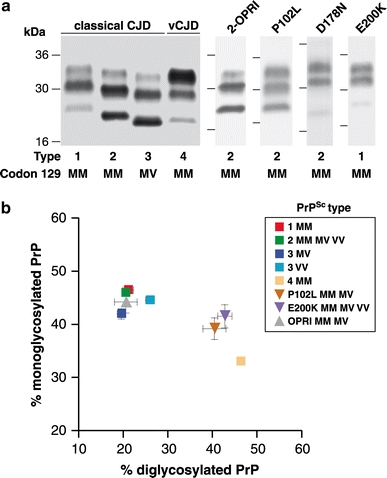
Fig. 1
Fig. 1
Immunoblot analysis of human prion disease brain. a Proteinase K digested brain homogenates analysed with monoclonal antibody 3F4 and enhanced chemiluminescence showing the PrPSc types seen in sporadic, acquired and inherited prion disease. Types 1–3 PrPSc are seen in the brain of classical forms of CJD (either sporadic or iatrogenic CJD), while type 4 PrPSc is uniquely seen in vCJD brain. Distinct PrPSc types are seen in cases with PRNP point mutations. Classification according to Hill et al. [53, 54]. b Proteinase K digestion of brain homogenate and analysis with anti-PrP monoclonal antibody 3F4 by enhanced chemifluorescence enables calculation of the proportions of di-, mono-, and non-glycosylated PrP. The key shows PrPSc type or mutation and PRNP codon 129 genotype (M methionine, V valine). Data points represent the mean relative proportions of di- and mono-glycosylated PrP as percentage ± SEM. In some cases, the error bars were smaller than the symbols used
Fig. 2
Fig. 2
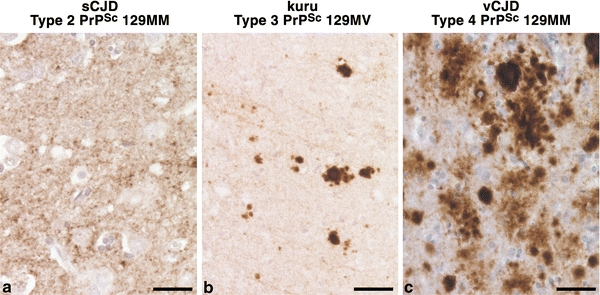
Distinct patterns of PrP deposition in brain in human prion disease. The disease aetiology, PRNP codon 129 genotype of the patient (M methionine, V valine) and the type of PrPSc detected in each sample (using the London classification of human PrPSc types [54]) is designated above each brain sample. The most common subtype of sporadic CJD (a) typically shows a diffuse, synaptic pattern of abnormal PrP deposition, while kuru (b) shows not only variably diffuse PrP deposition but also striking formation of PrP plaques in various areas of the brain. These PrP plaques are consistently distinct from those seen in vCJD (c), where PrP plaques are often surrounded by conspicuous vacuolation, designated ‘florid plaques’. Scale bars a, c 25 μm; b 50 μm

References

    1. Aguzzi A. Prions and the immune system: a journey through gut, spleen, and nerves. Adv Immunol. 2003;81:123–171. doi: 10.1016/S0065-2776(03)81004-0. - DOI - PubMed
    1. Alpers MP (1987) Epidemiology and clinical aspects of kuru. In: Prusiner SB, McKinley MP (eds) Prions: novel infectious pathogens causing scrapie and Creutzfeldt-Jakob disease. Academic Press, San Diego, pp 451–465
    1. Alpers MP. The epidemiology of kuru: monitoring the epidemic from its peak to its end. Philos Trans R Soc Lond B Biol Sci. 2008;363:3707–3713. doi: 10.1098/rstb.2008.0071. - DOI - PMC - PubMed
    1. Armitage WJ, Tullo AB, Ironside JW. Risk of Creutzfeldt-Jakob disease transmission by ocular surgery and tissue transplantation. Eye. 2009;23:1926–1930. doi: 10.1038/eye.2008.381. - DOI - PubMed
    1. Asano M, Mohri S, Ironside JW, Ito M, Tamaoki N, Kitamoto T. vCJD prion acquires altered virulence through trans-species infection. Biochem Biophys Res Commun. 2006;342:293–299. doi: 10.1016/j.bbrc.2006.01.149. - DOI - PubMed