


Atherosclerosis, dementia, and Alzheimer disease in the Baltimore Longitudinal Study of Aging cohort
- PMID: 20695015
- PMCID: PMC3030772
- DOI: 10.1002/ana.22055
Atherosclerosis, dementia, and Alzheimer disease in the Baltimore Longitudinal Study of Aging cohort
Abstract
Objective: Although it is now accepted that asymptomatic cerebral infarcts are an important cause of dementia in the elderly, the relationship between atherosclerosis per se and dementia is controversial. Specifically, it is unclear whether atherosclerosis can cause the neuritic plaques and neurofibrillary tangles that define Alzheimer neuropathology and whether atherosclerosis, a potentially reversible risk factor, can influence cognition independent of brain infarcts.
Methods: We examined the relationship between systemic atherosclerosis, Alzheimer type pathology, and dementia in autopsies from 200 participants in the Baltimore Longitudinal Study of Aging, a prospective study of the effect of aging on cognition, 175 of whom had complete body autopsies.
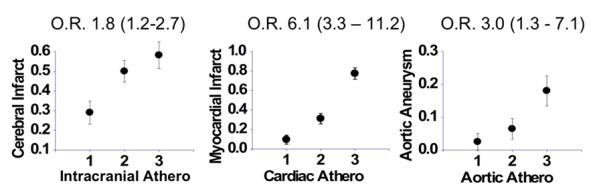
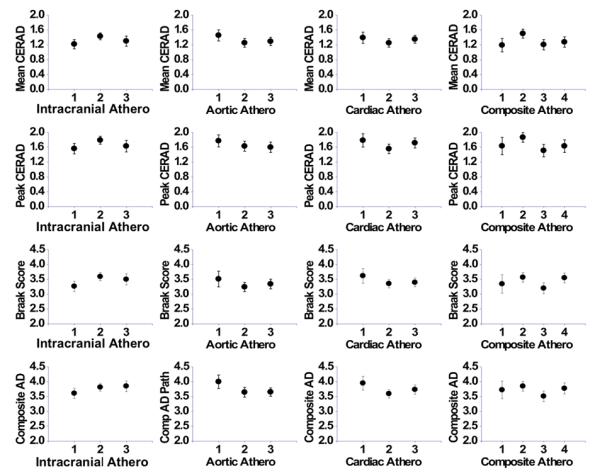
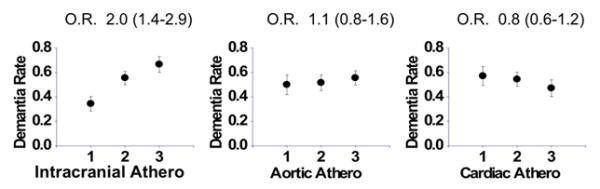
Results: Using a quantitative analysis of atherosclerosis in the aorta, heart, and intracranial vessels, we found no relationship between the degree of atherosclerosis in any of these systems and the degree of Alzheimer type brain pathology. However, we found that the presence of intracranial but not coronary or aortic atherosclerosis significantly increased the odds of dementia, independent of cerebral infarction. Given the large number of individuals with intracranial atherosclerosis in this cohort (136/200), the population attributable risk of dementia related to intracranial atherosclerosis (independent of infarction) is substantial and potentially reversible.
Interpretation: Atherosclerosis of the intracranial arteries is an independent and important risk factor for dementia, suggesting potentially reversible pathways unrelated to Alzheimer pathology and stroke through which vascular changes may influence dementia risk.
Figures
References
-
- Snowdon DA, Greiner LH, Mortimer JA, Riley KP, Greiner PA, Markesbery WR. Brain infarction and the clinical expression of Alzheimer disease. The Nun Study. JAMA. 1997;277:813–17. - PubMed
-
- Schneider JA, Wilson RS, Cochran EJ, Bienias JL, Arnold SE, Evans DA, Bennett DA. Relation of cerebral infarctions to dementia and cognitive function in older persons. Neurology. 2003;60(7):1082–8. - PubMed
-
- Schneider JA, Wilson RS, Bienias JL, Evans DA, Bennett DA. Cerebral infarctions and the likelihood of dementia from Alzheimer disease pathology. Neurology. 2004;62:1148–55. - PubMed
-
- Schneider JA, Arvanitakis Z, Bang W, Bennett DA. Mixed brain pathologies account for most dementia cases in community-dwelling older persons. Annals of Neurology. 2007;69(24):2197–2204. - PubMed
-
- Esiri MM, Nagy Z, Smith MZ, Barnetson L, Smith AD. Cerebrovascular disease and threshold for dementia in the early stages of Alzheimer’s disease. Lancet. 1999;354:919–20. - PubMed
Publication types
MeSH terms
Grants and funding
LinkOut - more resources
Full Text Sources
Medical
