. 2010 Sep;11(5):641-9.
doi: 10.1111/j.1364-3703.2010.00634.x.

The silencing suppressor P25 of Potato virus X interacts with Argonaute1 and mediates its degradation through the proteasome pathway

Affiliations

The silencing suppressor P25 of Potato virus X interacts with Argonaute1 and mediates its degradation through the proteasome pathway

Meng-Hsuen Chiu et al. Mol Plant Pathol. 2010 Sep.

Abstract

Previous evidence has indicated that the P25 protein encoded by Potato virus X (PVX) inhibits either the assembly or function of the effector complexes in the RNA silencing-based antiviral defence system (Bayne et al., Cell-to-cell movement of Potato Potexvirus X is dependent on suppression of RNA silencing. Plant J.44, 471-482). This finding prompted us to investigate the possibility that P25 targets the Argonaute (AGO) effector nuclease of RNA silencing. Co-immunoprecipitation and Western blot analysis indicated that there is a strong interaction between P25 and AGO1 of Arabidopsis when these proteins are transiently co-expressed in Nicotiana benthamiana. P25 also interacts with AGO1, AGO2, AGO3 and AGO4, but not with AGO5 and AGO9. As an effective suppressor, the amount of AGO1 accumulated in the presence of P25 was dramatically lower than that infiltrated with HcPro, but was restored when treated with a proteasome inhibitor MG132. These findings are consistent with the idea that RNA silencing is an antiviral defence mechanism and that the counter-defence role of P25 is through the degradation of AGO proteins via the proteasome pathway. Further support for this idea is provided by the observation that plants treated with MG132 are less susceptible to PVX and its relative Bamboo mosaic virus.


Figures
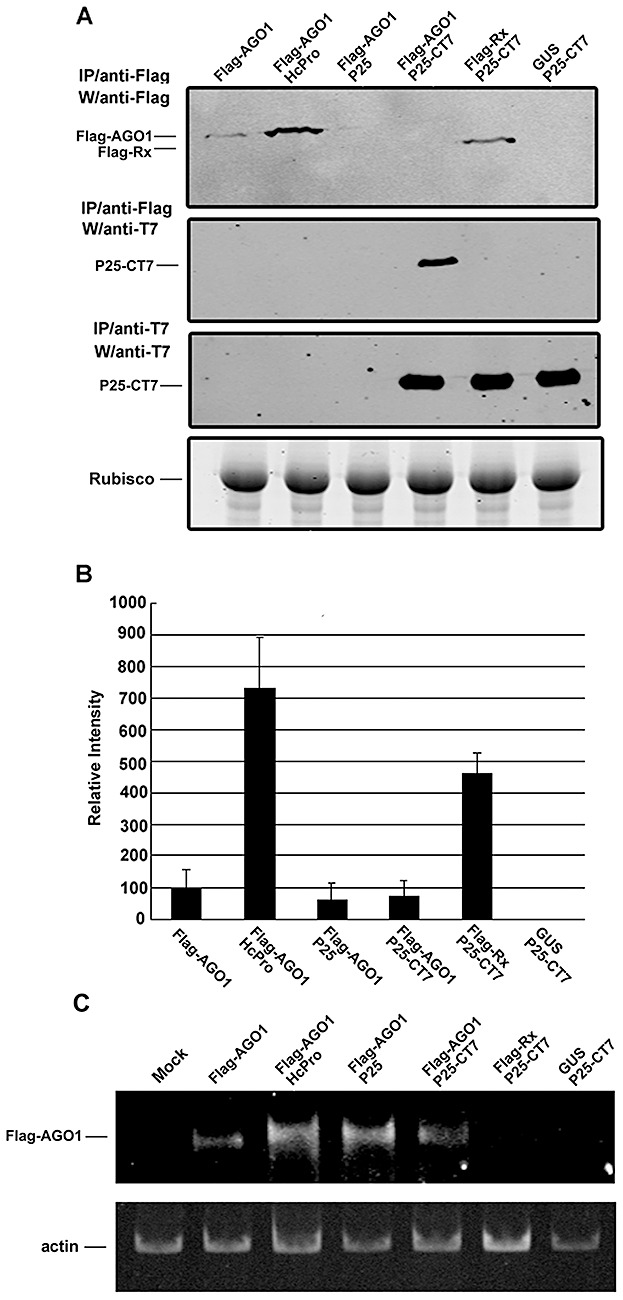
Figure 1
Figure 1
Interaction between P25 and Argonaute1 (AGO1) protein resulting in lower levels of AGO1 accumulation. (A) Immunoprecipitation of transiently expressed Flag‐tagged or T7‐tagged proteins from the total protein extracts of Agrobacterium‐infiltrated Nicotiana benthamiana leaves. Construct 35S:FLAG‐AGO1 (AGO1) was infiltrated alone or with 35S:HcPro (HcPro), 35S:P25 (P25) or 35S:P25‐T7 (P25‐CT7), indicated above each lane. Two controls 35S:Flag‐Rx (Rx) and 35S:GUS (GUS) were co‐infiltrated with 35S:P25‐T7 (P25‐CT7). Total proteins were extracted 3 days post‐infiltration. The Flag‐ or T7‐tagged proteins were immunoprecipitated (IP) with affinity gels or agarose beads containing anti‐Flag or anti‐T7 antibody, respectively. Western blot analysis (W) was performed using the antibody indicated to the left of each panel. Ribulose‐1,5‐bisphosphate carboxylase/oxygenase (Rubisco) protein stained with Coomassie blue served as a loading control. (B) The average of the accumulation levels of AGO1 from five independent experiments together with the standard error. (C) Flag‐AGO1 RNA accumulation in N. benthamiana leaves infiltrated with various constructs indicated at the top of each lane and inspected by reverse transcription‐polymerase chain reaction (RT‐PCR). The expression of the actin gene was used as a control.
Figure 2
Figure 2
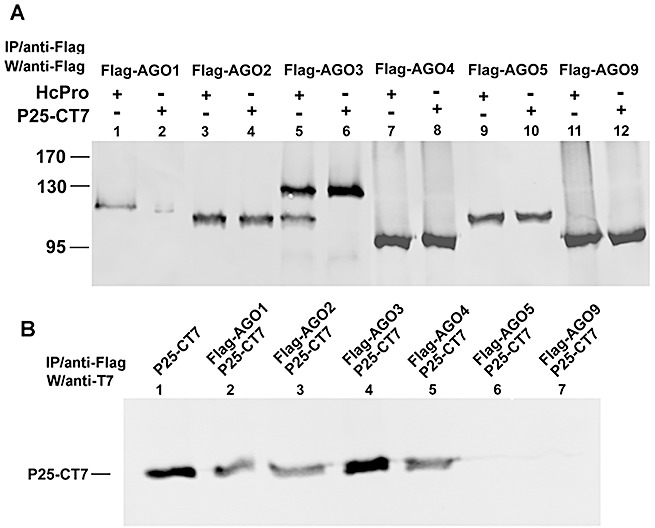
P25 interacts with Argonaute1 (AGO1), AGO2, AGO3 and AGO4, but not with AGO5 and AGO9. Immunoprecipitation of transiently expressed Flag‐tagged proteins from the total protein extracts of Agrobacterium‐infiltrated Nicotiana benthamiana leaves. (A) Constructs of 35S:FLAG‐AGOs (AGO1 in lanes 1 and 2; AGO2 in lanes 3 and 4; AGO3 in lanes 5 and 6; AGO4 in lanes 7 and 8; AGO5 in lanes 9 and 10; AGO9 in lanes 11 and 12) were co‐infiltrated with 35S:HcPro (HcPro) or 35S:P25‐T7 (P25‐CT7), indicated above each lane. Total proteins were extracted 72 h post‐infiltration. (B) The Flag‐tagged proteins were immunoprecipitated (IP) with the anti‐Flag antibody, except lane 1, and the samples were probed with anti‐T7 antibody. Lane 1 is the plant extract of transiently expressed P25‐CT7 loaded as a positive control.
Figure 3
Figure 3
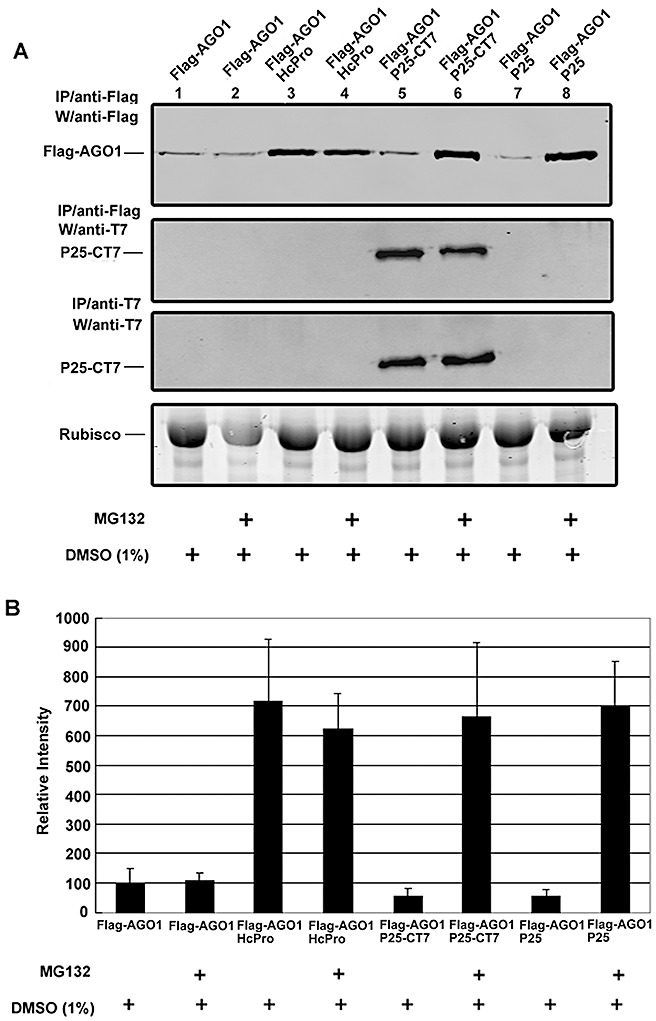
Proteasome inhibitor MG132 blocks the P25‐mediated destabilization of AGO1 in Nicotiana benthamiana. (A) 35S:FLAG‐AGO1 (AGO1) co‐expressed with 35S:HcPro (HcPro), 35S:P25‐T7 (P25‐CT7) or35S:P25 (P25) in N. benthamiana leaves, and then treated with 100 µm of MG132 or 1% dimethylsulphoxide (DMSO) as indicated at the bottom of each lane. The levels of FLAG‐AGO1 protein were analysed 24 h later by Western blotting. The Flag‐ or T7‐tagged proteins were immunoprecipitated (IP) with affinity gels or agarose beads containing anti‐Flag or anti‐T7 antibody, respectively. Western blot analysis (W) was performed using the antibody indicated to the left of each panel. Ribulose‐1,5‐bisphosphate carboxylase/oxygenase (Rubisco) protein stained with Coomassie blue served as a loading control. (B) The average of the accumulation levels of AGO1 from three independent experiments together with the standard error.
Figure 4
Figure 4
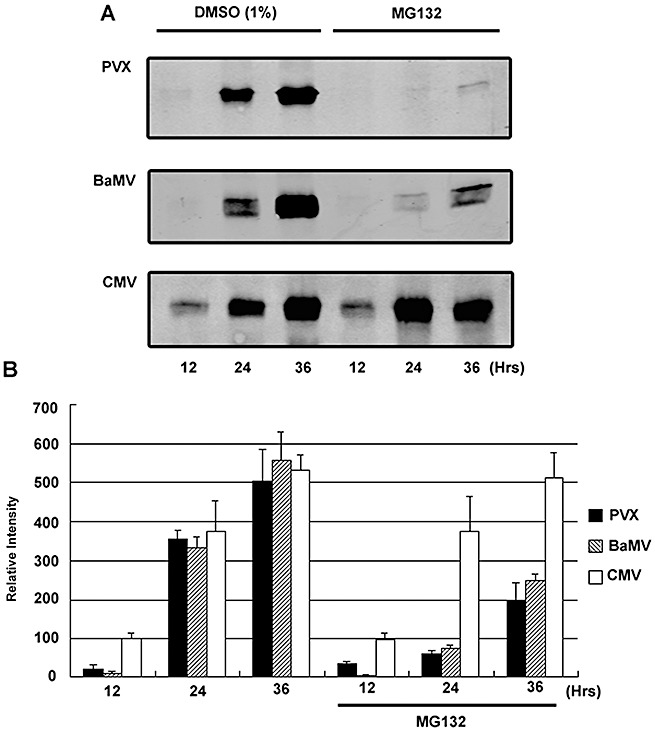
Potexvirus accumulation is reduced by proteasome inhibitor MG132. (A) Western blot analysis of the coat protein accumulation from Nicotiana benthamiana leaves inoculated with Potato virus X (PVX), Bamboo mosaic virus (BaMV) and Cucumber mosaic virus (CMV). Proteasome inhibitor MG132 was infiltrated into the leaves immediately after virus inoculation. Total proteins were harvested after 12, 24 and 36 h, indicated at the bottom of each lane. The coat protein accumulations of the viruses were detected with antiserum against PVX, BaMV and CMV. (B) The average of the coat protein accumulation at 12, 24 and 36 h, with or without proteasome inhibitor MG132, from three independent experiments is indicated, together with the standard error.
Figure 5
Figure 5
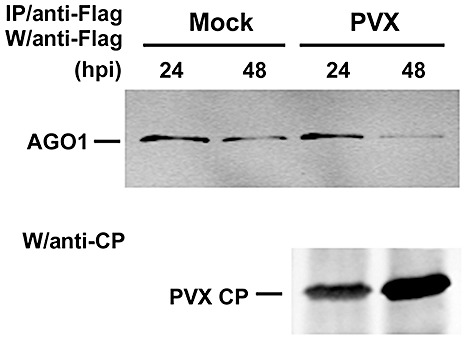
Argonaute1 (AGO1) is destabilized during Potato virus X (PVX) inoculation in Nicotiana benthamiana protoplasts. Immunoprecipitation of transiently expressed Flag‐tagged AGO1 from the total protein extracts of PVX‐inoculated protoplasts derived from Agrobacterium‐infiltrated N. benthamiana leaves. The levels of FLAG‐AGO1 (AGO1) protein were analysed 24 and 48 h post‐inoculation (hpi) by Western blotting. The Flag‐tagged proteins were immunoprecipitated (IP) with affinity gels containing anti‐Flag antibody. Western blot analysis (W) was performed using the antibody indicated. CP, coat protein.

References

    1. Anandalakshmi, R. , Pruss, G.J. , Ge, X. , Marathe, R. , Smith, T.H. and Vance, V.B. (1998) A viral suppressor of gene silencing in plants. Proc. Natl. Acad. Sci. USA, 95, 13 079–13 084. - PMC - PubMed
    1. Angell, S.M. , Davies, C. and Baulcombe, D.C. (1996) Cell‐to‐cell movement of potato virus X is associated with a change in the size exclusion limit of plasmodesmata in trichome cells of Nicotiana clevelandii . Virology, 215, 197–201. - PubMed
    1. Baulcombe, D. (2004) RNA silencing in plants. Nature, 431, 356–363. - PubMed
    1. Baumberger, N. and Baulcombe, D.C. (2005) Arabidopsis ARGONAUTE1 is an RNA Slicer that selectively recruits micro RNAs and short interfering RNAs. Proc. Natl. Acad. Sci. USA, 102, 11 928–11 933. - PMC - PubMed
    1. Baumberger, N. , Tsai, C.H. , Lie, M. , Havecker, E. and Baulcombe, D.C. (2007) The Polerovirus silencing suppressor P0 targets ARGONAUTE proteins for degradation. Curr. Biol. 17, 1609–1614. - PubMed

Publication types

MeSH terms