


Novel epidermal growth factor receptor mutation-specific antibodies for non-small cell lung cancer: immunohistochemistry as a possible screening method for epidermal growth factor receptor mutations
- PMID: 20697298
- PMCID: PMC2946481
- DOI: 10.1097/JTO.0b013e3181e9da60
Novel epidermal growth factor receptor mutation-specific antibodies for non-small cell lung cancer: immunohistochemistry as a possible screening method for epidermal growth factor receptor mutations
Abstract
Background: Epidermal growth factor receptor (EGFR) mutations in non-small cell lung cancer (NSCLC) predict better outcome to EGFR tyrosine kinase inhibitors. The most common mutations are exon 19 deletions (most frequently E746-A750) and L858R point mutation in exon 21. Here, we evaluated the accuracy of novel EGFR mutation-specific antibodies in a Japanese cohort with NSCLC and compared with direct DNA sequencing and clinical outcome.
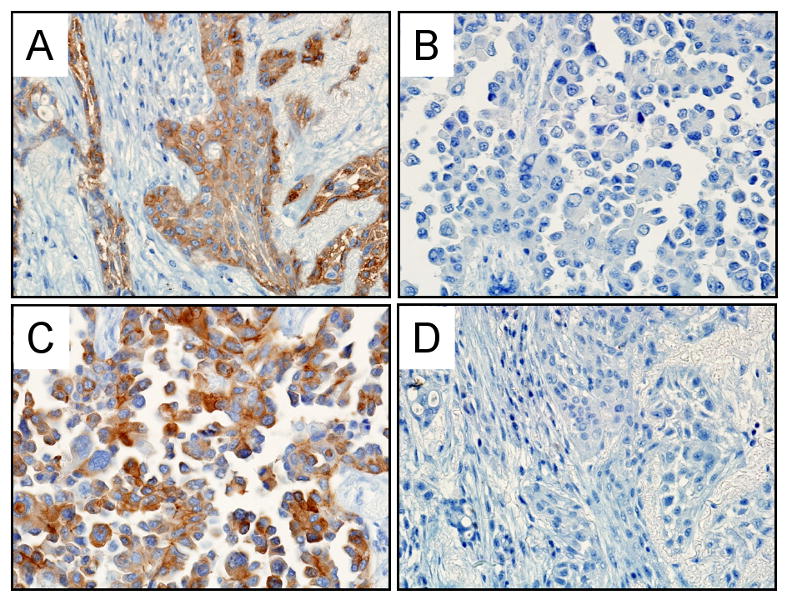
Materials and methods: Immunohistochemistry (IHC) using antibodies specific for the E746-A750 and L858R mutations in EGFR was performed on tissue microarrays of tumors from 70 gefitinib treated NSCLC patients. Extracted DNA was sequenced for mutational analysis of EGFR exons 18 to 21.
Results: DNA sequencing showed EGFR mutations in 41 patients (58.6%) and exon 19 deletions in 18 patients (25.7%), 11 of 18 (61%) had a deletion in the range of E746-A750 and 12 (17.1%) had exon 21 mutations (L858R). IHC showed, for the E746-A750 and L858R mutations, sensitivity (81.8 and 75%), specificity (100 and 96.6%), positive predictive value (100 and 81.8%), and negative predictive value (96.7 and 94.9%). Analysis for objective response rates and survival were not correlated to IHC staining, although the combined staining showed nonsignificant trends toward better overall survival for patients with EGFR mutations.
Conclusions: The mutation-specific IHC antibodies have high sensitivity and specificity for predefined EFGR mutations and may be suitable for screening for these predefined mutations. However, negative IHC results require further mutation analyses before excluding EGFR-targeted therapy.
Figures

References
-
- Mok TS, Wu YL, Thongprasert S, et al. Gefitinib or carboplatin-paclitaxel in pulmonary adenocarcinoma. N Engl J Med. 2009;361:947–57. - PubMed
-
- Rosell R, Moran T, Queralt C, et al. Screening for epidermal growth factor receptor mutations in lung cancer. N Engl J Med. 2009;361:958–67. - PubMed
-
- Hirsch FR, Dziadziuszko R, Camidge DR, et al. Biomarker Status Correlates with Clinical Benefit: Phase 2 Study of Single-agent Erlotinib (E) or E Intercalated with Carboplatin and Paclitaxel (ECP) in an EGFR Biomarkerselected NSCLC Population. J Thorac Oncol. 2008;3:S267.
-
- Lynch TJ, Bell DW, Sordella R, et al. Activating mutations in the epidermal growth factor receptor underlying responsiveness of non-small-cell lung cancer to gefitinib. The New England journal of medicine. 2004;350:2129–39. - PubMed
Publication types
MeSH terms
Substances
Grants and funding
LinkOut - more resources
Full Text Sources
Other Literature Sources
Research Materials
Miscellaneous
