. 2010 Dec;212(4):485-99.
doi: 10.1007/s00213-010-1970-0. Epub 2010 Aug 10.

Effects of prazosin, clonidine, and propranolol on the elevations in brain reward thresholds and somatic signs associated with nicotine withdrawal in rats

Affiliations

Effects of prazosin, clonidine, and propranolol on the elevations in brain reward thresholds and somatic signs associated with nicotine withdrawal in rats

Adrie W Bruijnzeel et al. Psychopharmacology (Berl). 2010 Dec.

Abstract

Rationale: Tobacco withdrawal is characterized by a negative mood state and relatively mild somatic symptoms. Increased noradrenergic transmission has been reported to play an important role in opioid withdrawal, but little is known about the role of noradrenergic transmission in nicotine withdrawal.

Objectives: The aim of these experiments was to investigate the effects of prazosin, clonidine, and propranolol on the negative mood state and somatic signs associated with nicotine withdrawal in rats.

Methods: A discrete-trial intracranial self-stimulation procedure was used to assess the negative affective state of nicotine withdrawal. Elevations in brain reward thresholds are indicative of a deficit in brain reward function.

Results: In all the experiments, the nicotinic acetylcholine receptor antagonist mecamylamine (3 mg/kg) elevated the brain reward thresholds of the nicotine-treated rats and did not affect those of the control rats. The α1-adrenergic receptor antagonist prazosin (0.0625 and 0.125 mg/kg) dose-dependently attenuated the elevations in brain reward thresholds associated with precipitated nicotine withdrawal. The α2-adrenergic receptor agonist clonidine (10-40 μg/kg) and the nonselective β-adrenergic receptor antagonist propranolol (2.5-10 mg/kg) did not attenuate the elevations in brain reward thresholds associated with nicotine withdrawal. Furthermore, mecamylamine (2 mg/kg) induced more somatic signs in the nicotine-treated rats than in the control rats. Clonidine and propranolol, but not prazosin, decreased the total number of somatic signs associated with nicotine withdrawal.

Conclusion: Blockade of α1-adrenergic receptors attenuates the deficit in brain reward function associated with nicotine withdrawal. Antagonism of β-adrenergic receptors or stimulation of α2-adrenergic receptors attenuates the somatic symptoms of nicotine withdrawal.


Figures

Figure 1
Figure 1
Effect of the α1-adrenergic receptor antagonist prazosin (0.25–1 mg/kg) on the elevations in brain reward thresholds associated with mecamylamine-precipitated nicotine withdrawal (A; saline, n = 8; nicotine, n = 9) and response latencies (B). Asterisks (** P<0.01) indicate elevations in brain reward thresholds compared to those of the corresponding saline-treated control group. Plus signs (+ P<0.05) indicate lower brain reward thresholds compared to those of rats chronically treated with nicotine and acutely treated with mecamylamine and vehicle. Data are expressed as means ± SEM.
Figure 1
Figure 1
Effect of the α1-adrenergic receptor antagonist prazosin (0.25–1 mg/kg) on the elevations in brain reward thresholds associated with mecamylamine-precipitated nicotine withdrawal (A; saline, n = 8; nicotine, n = 9) and response latencies (B). Asterisks (** P<0.01) indicate elevations in brain reward thresholds compared to those of the corresponding saline-treated control group. Plus signs (+ P<0.05) indicate lower brain reward thresholds compared to those of rats chronically treated with nicotine and acutely treated with mecamylamine and vehicle. Data are expressed as means ± SEM.
Figure 2
Figure 2
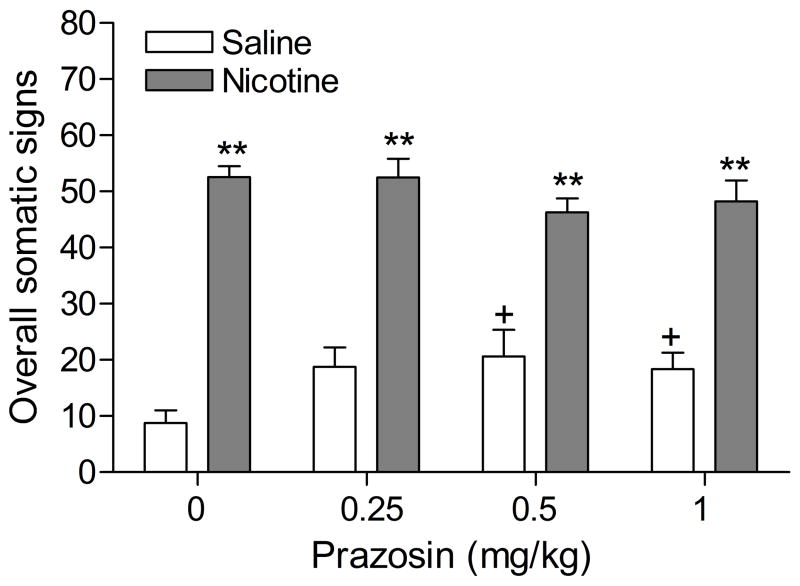
Effect of the α1-adrenergic receptor antagonist prazosin (0.25–1 mg/kg) on overall somatic signs associated with mecamylamine-precipitated nicotine withdrawal (A; saline, n = 8; nicotine, n = 10). Asterisks (** P<0.01) indicate a greater number of somatic signs in the nicotine-treated rats than in the saline-treated control group. Plus signs (+ P<0.05) indicate a greater number of somatic signs compared to those in rats chronically treated with saline and acutely treated with mecamylamine and vehicle. Data are expressed as means ± SEM.
Figure 3
Figure 3
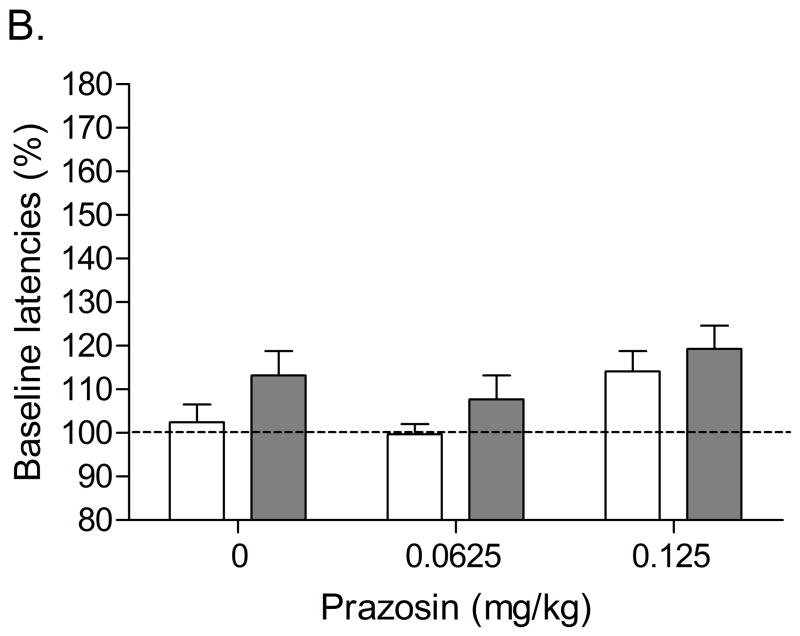
Effect of the α1-adrenergic receptor antagonist prazosin (0.0625 and 0.125 mg/kg) on the elevations in brain reward thresholds associated with mecamylamine-precipitated nicotine withdrawal (A; saline, n = 9; nicotine, n = 9) and response latencies (B). Asterisks (** P<0.01) indicate elevations in brain reward thresholds compared to those of the corresponding saline-treated control group. Plus signs (++ P<0.01) indicate lower brain reward thresholds compared to those of rats chronically treated with nicotine and acutely treated with mecamylamine and vehicle. Pound signs (## P<0.01) indicate lower brain reward thresholds compared to those of rats chronically treated with nicotine and acutely treated with mecamylamine and vehicle or mecamylamine and 0.0625 mg/kg of prazosin. Data are expressed as means ± SEM.
Figure 3
Figure 3
Effect of the α1-adrenergic receptor antagonist prazosin (0.0625 and 0.125 mg/kg) on the elevations in brain reward thresholds associated with mecamylamine-precipitated nicotine withdrawal (A; saline, n = 9; nicotine, n = 9) and response latencies (B). Asterisks (** P<0.01) indicate elevations in brain reward thresholds compared to those of the corresponding saline-treated control group. Plus signs (++ P<0.01) indicate lower brain reward thresholds compared to those of rats chronically treated with nicotine and acutely treated with mecamylamine and vehicle. Pound signs (## P<0.01) indicate lower brain reward thresholds compared to those of rats chronically treated with nicotine and acutely treated with mecamylamine and vehicle or mecamylamine and 0.0625 mg/kg of prazosin. Data are expressed as means ± SEM.
Figure 4
Figure 4
Effect of the α2-adrenergic/imidazoline-1 receptor agonist clonidine on the elevations in brain reward thresholds associated with mecamylamine-precipitated nicotine withdrawal (A; saline, n = 10; nicotine, n =11) and response latencies (B). Asterisks (** P<0.01) indicate elevations in brain reward thresholds compared to those of the corresponding saline-treated control group. Plus signs (+ P<0.05) indicate elevations in brain reward thresholds compared to those of rats chronically treated with saline and acutely treated with mecamylamine and vehicle. Data are expressed as means ± SEM.
Figure 4
Figure 4
Effect of the α2-adrenergic/imidazoline-1 receptor agonist clonidine on the elevations in brain reward thresholds associated with mecamylamine-precipitated nicotine withdrawal (A; saline, n = 10; nicotine, n =11) and response latencies (B). Asterisks (** P<0.01) indicate elevations in brain reward thresholds compared to those of the corresponding saline-treated control group. Plus signs (+ P<0.05) indicate elevations in brain reward thresholds compared to those of rats chronically treated with saline and acutely treated with mecamylamine and vehicle. Data are expressed as means ± SEM.
Figure 5
Figure 5
Effect of the α2-adrenergic/imidazoline-1 receptor agonist clonidine on overall somatic signs associated with mecamylamine-precipitated nicotine withdrawal (A; saline, n = 8; nicotine, n = 10). Asterisks (** P<0.01) indicate a greater number of somatic signs in the nicotine-treated rats than in the saline-treated control group. Plus signs (++ P<0.01) indicate fewer somatic signs compared to those of rats chronically treated with nicotine and acutely treated with mecamylamine and vehicle. Pound signs (# P<0.05) indicate fewer somatic signs compared to those of rats chronically treated with nicotine and acutely treated with mecamylamine and 10 μg/kg of clonidine. Data are expressed as means ± SEM.
Figure 6
Figure 6
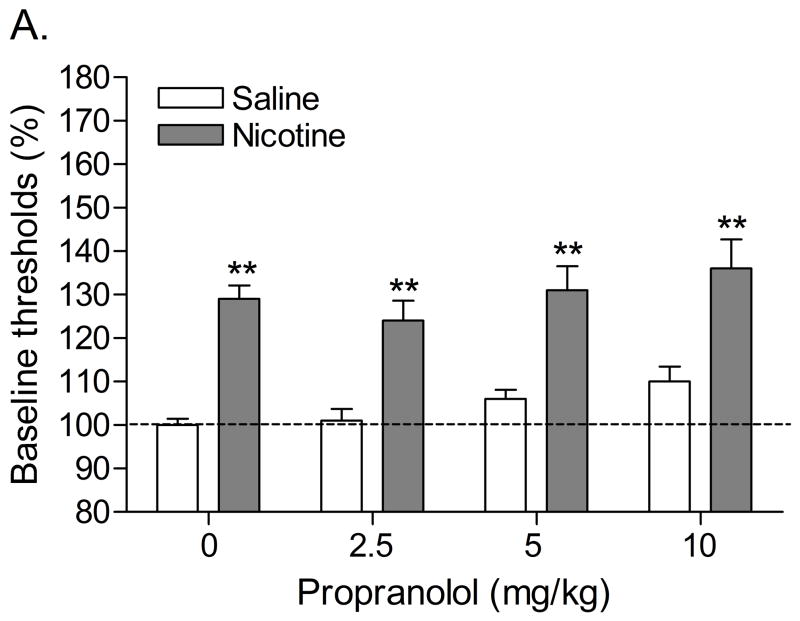
Effect of the nonselective β-adrenergic receptor antagonist propranolol on the elevations in brain reward thresholds associated with mecamylamine-precipitated nicotine withdrawal (A; saline, n = 11; nicotine, n =12) and response latencies (B). Brain reward thresholds and response latencies are expressed as a percentage of the pre-test day values. Asterisks (** P<0.01) indicate elevations in brain reward thresholds compared with those of the corresponding saline-treated control group. Data are expressed as means ± SEM.
Figure 6
Figure 6
Effect of the nonselective β-adrenergic receptor antagonist propranolol on the elevations in brain reward thresholds associated with mecamylamine-precipitated nicotine withdrawal (A; saline, n = 11; nicotine, n =12) and response latencies (B). Brain reward thresholds and response latencies are expressed as a percentage of the pre-test day values. Asterisks (** P<0.01) indicate elevations in brain reward thresholds compared with those of the corresponding saline-treated control group. Data are expressed as means ± SEM.
Figure 7
Figure 7
Effect of the nonselective β-adrenergic receptor antagonist propranolol on overall somatic signs associated with mecamylamine-precipitated nicotine withdrawal (A; saline, n = 11; nicotine, n = 12). Asterisks (** P<0.01) indicate a greater number of somatic signs in the nicotine-treated rats than in the saline-treated control group. Plus signs (++ P<0.01) indicate fewer somatic signs compared to those of rats chronically treated with nicotine and acutely treated with mecamylamine and vehicle. Data are expressed as means ± SEM.

References

    1. Ahmed SH, Kenny PJ, Koob GF, Markou A. Neurobiological evidence for hedonic allostasis associated with escalating cocaine use. Nat Neurosci. 2002;5:625–626. - PubMed
    1. American Psychiatric Association. Diagnostic and Statistical Manual of Mental Disorders. 4. American Psychiatric Press; Washington, DC: 2000. text revision edn.
    1. Barr AM, Markou A. Psychostimulant withdrawal as an inducing condition in animal models of depression. Neurosci Biobehav Rev. 2005;29:675–706. - PubMed
    1. Bruijnzeel AW, Gold MS. The role of corticotropin-releasing factor-like peptides in cannabis, nicotine, and alcohol dependence. Brain Res Brain Res Rev. 2005;49:505–528. - PubMed
    1. Bruijnzeel AW, Lewis B, Bajpai LK, Morey TE, Dennis DM, Gold M. Severe deficit in brain reward function associated with fentanyl withdrawal in rats. Biol Psychiatry. 2006;59:477–480. - PubMed

Publication types

MeSH terms

LinkOut - more resources