Review
. 2010 Nov;67(21):3699-710.
doi: 10.1007/s00018-010-0493-5. Epub 2010 Aug 10.

Targeting abnormal DNA double strand break repair in cancer

Affiliations
Review

Targeting abnormal DNA double strand break repair in cancer

Feyruz V Rassool et al. Cell Mol Life Sci. 2010 Nov.

Abstract

A major challenge in cancer treatment is the development of therapies that target cancer cells with little or no toxicity to normal tissues and cells. Alterations in DNA double strand break (DSB) repair in cancer cells include both elevated and reduced levels of key repair proteins and changes in the relative contributions of the various DSB repair pathways. These differences can result in increased sensitivity to DSB-inducing agents and increased genomic instability. The development of agents that selectively inhibit the DSB repair pathways that cancer cells are more dependent upon will facilitate the design of therapeutic strategies that exploit the differences in DSB repair between normal and cancer cells. Here, we discuss the pathways of DSB repair, alterations in DSB repair in cancer, inhibitors of DSB repair and future directions for cancer therapies that target DSB repair.


Figures
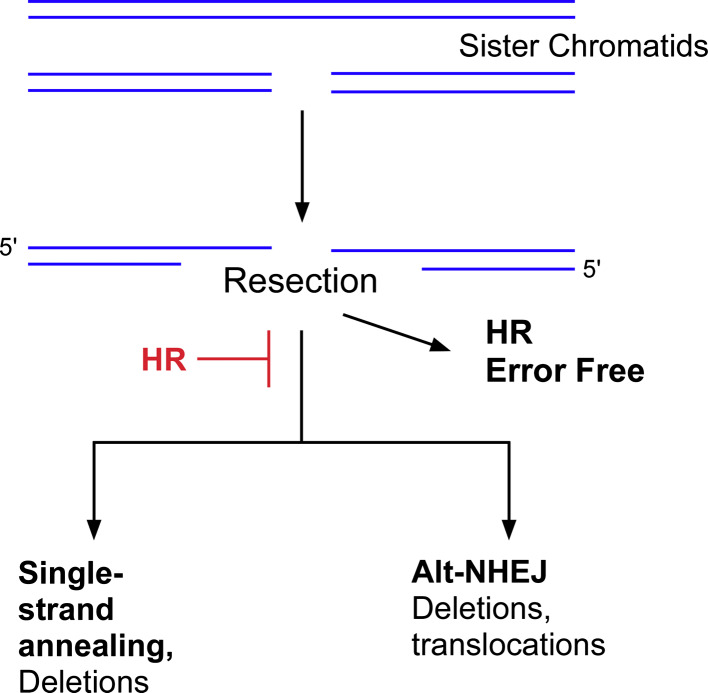
Fig. 1
Fig. 1
DSB repair in the S and G2 phases of the cell cycle. In late S and the G2 phase of the cell cycle, DSBs can be repaired by homologous recombination (HR) using the undamaged sister chromatid. In the initial stage of HR, the ends of the DSBs are resected to generate 3′ single stranded regions. If the ends are resected but HR is inactivated, the DSBs can be joined by back-up pathways, single strand annealing and alternative non-homologous end joining. In contrast to the error-free homolgous recombination pathways, the back-up pathways generate genomic rearrangements
Fig. 2
Fig. 2
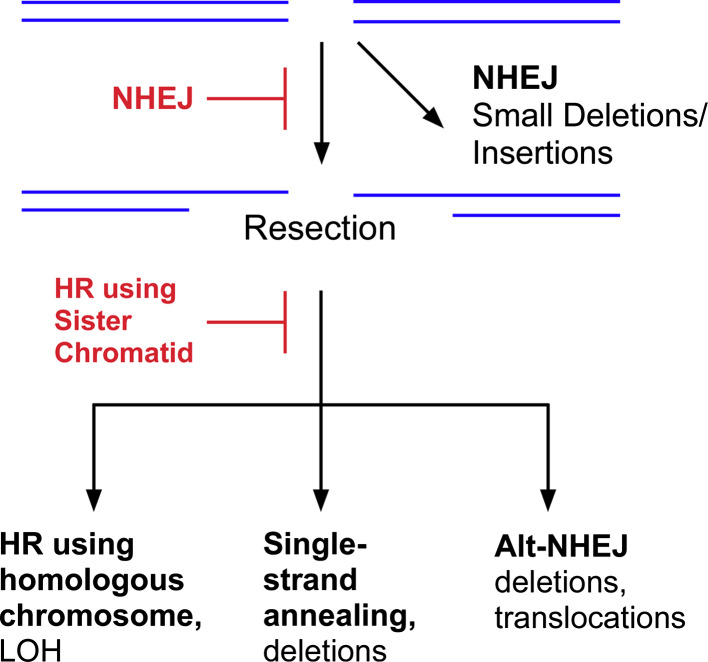
DSB repair in the G1 phases of the cell cycle and in non-dividing cells. In the G1 phase of the cell cycle and non-dividing cells, the majority of DSBs are repaired by DNA-PK-dependent NHEJ. If this pathway is inactivated, the DSBs can be repaired by homologous recombination (HR) but, in the absence of the sister chromatid, the homologous chromsome will be used to guide the repair. Alternatively, the DSBs can be joined by back-up pathways, single strand annealing and alternative non-homologous end joining
Fig. 3
Fig. 3
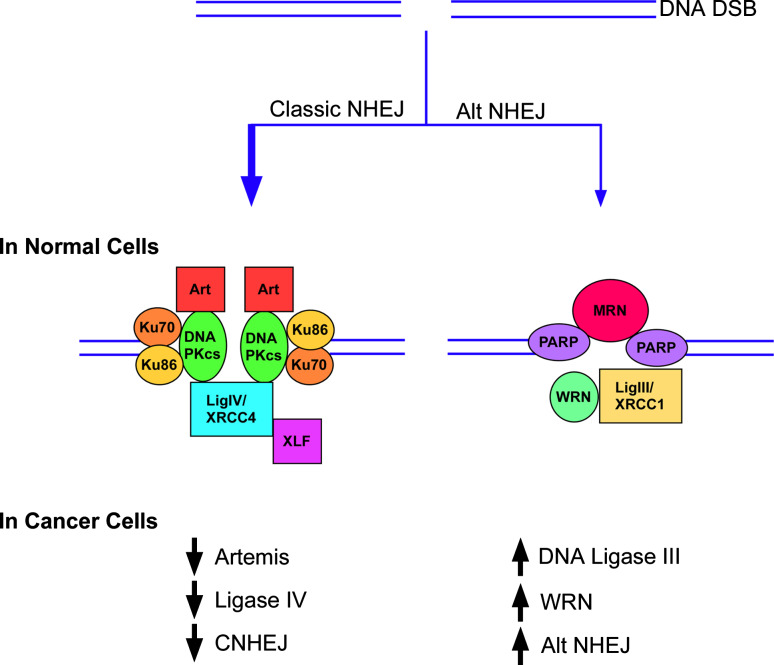
In normal cells (upper panel), alternative NHEJ pathway (Alt NHEJ) is a minor DSB pathway repair pathway compared with DNA-PK-dependent NHEJ (Classic NHEJ). In cancer cells (lower panel), the steady state levels of key DNA-PK-dependent NHEJ proteins are reduced whereas the steady state levels of key alternative NHEJ are increased. This results in increased activity of the Alt NHEJ pathway and reduced activity of the DNA-PK-dependent NHEJ (CNHEJ) pathway

References

    1. Khanna KK, Jackson SP. DNA double-strand breaks: signaling, repair and the cancer connection. Nat Genet. 2001;27:247–254. doi: 10.1038/85798. - DOI - PubMed
    1. O’Driscoll M, Jeggo PA. The role of double-strand break repair—insights from human genetics. Nat Rev Genet. 2006;7:45–54. doi: 10.1038/nrg1746. - DOI - PubMed
    1. Futreal PA, Liu Q, Shattuck-Eidens D, Cochran C, Harshman K, Tavtigian S, Bennett LM, Haugen-Strano A, Swensen J, Miki Y, et al. BRCA1 mutations in primary breast and ovarian carcinomas. Science. 1994;266:120–122. doi: 10.1126/science.7939630. - DOI - PubMed
    1. Negrini S, Gorgoulis VG, Halazonetis TD. Genomic instability—an evolving hallmark of cancer. Nat Rev Mol Cell Biol 11:220–228 - PubMed
    1. Hartlerode AJ, Scully R. Mechanisms of double-strand break repair in somatic mammalian cells. Biochem J. 2009;423:157–168. doi: 10.1042/BJ20090942. - DOI - PMC - PubMed

Publication types

MeSH terms

Substances

LinkOut - more resources