


Review and meta-analysis of couple-oriented interventions for chronic illness
- PMID: 20697859
- PMCID: PMC4101802
- DOI: 10.1007/s12160-010-9216-2
Review and meta-analysis of couple-oriented interventions for chronic illness
Abstract
Background: Evidence continues to build for the impact of the marital relationship on health as well as the negative impact of illness on the partner. Targeting both patient and partner may enhance the efficacy of psychosocial or behavioral interventions for chronic illness.
Purpose: The purpose of this report is to present a cross-disease review of the characteristics and findings of studies evaluating couple-oriented interventions for chronic physical illness.
Methods: We conducted a qualitative review of 33 studies and meta-analyses for a subset of 25 studies.
Results: Identified studies focused on cancer, arthritis, cardiovascular disease, chronic pain, HIV, and Type 2 diabetes. Couple interventions had significant effects on patient depressive symptoms (d = 0.18, p < 0.01, k = 20), marital functioning (d = 0.17, p < 0.01, k = 18), and pain (d = 0.19, p < 0.01, k = 14) and were more efficacious than either patient psychosocial intervention or usual care.
Conclusions: Couple-oriented interventions have small effects that may be strengthened by targeting partners' influence on patient health behaviors and focusing on couples with high illness-related conflict, low partner support, or low overall marital quality. Directions for future research include assessment of outcomes for both patient and partner, comparison of couple interventions to evidence-based patient interventions, and evaluation of mechanisms of change.
Conflict of interest statement
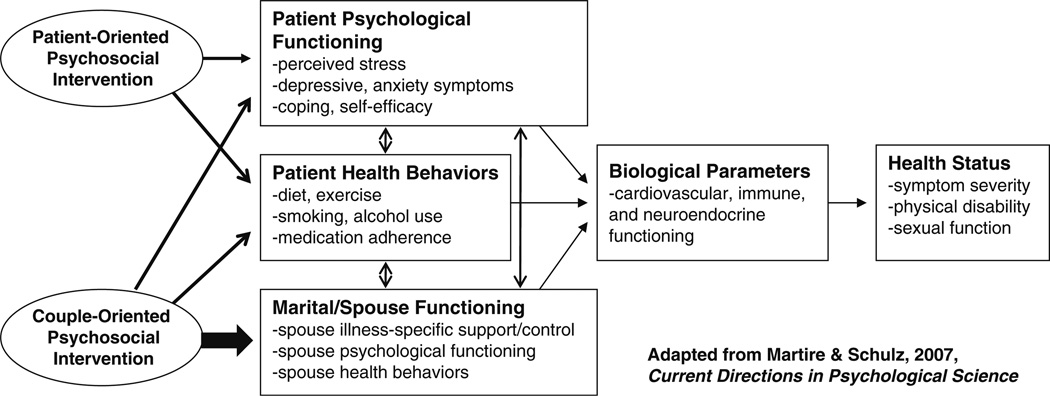
Figures
Comment in
-
Are couple-oriented interventions effective across chronic illnesses? A commentary on Martire et al.Ann Behav Med. 2011 Aug;42(1):134-5. doi: 10.1007/s12160-011-9276-y. Ann Behav Med. 2011. PMID: 21541827 No abstract available.
-
Are couple-oriented interventions effective across chronic illnesses?: a reply to arthurs and colleagues.Ann Behav Med. 2011 Aug;42(1):136-8. doi: 10.1007/s12160-011-9277-x. Ann Behav Med. 2011. PMID: 21562904 Free PMC article. No abstract available.
References
-
- Kiecolt-Glaser JK, Newton TL. Marriage and health: His and hers. Psychological Bulletin. 2001;127:472–503. - PubMed
-
- Baker B, Helmers K, O’Kelly B, et al. Marital cohesion and ambulatory blood pressure in early hypertension. Am J Hypertens. 1999;12:227–230. - PubMed
-
- Rohrbaugh MJ, Shoham V, Coyne JC. Effect of marital quality on eight-year survival of patients with heart failure. Am J Cardiol. 2006;98:1069–1072. - PubMed
-
- Orth-Gomer K, Wamala SP, Horsten M, et al. Marital stress worsens prognosis in women with coronary heart disease: The Stockholm Female Coronary Risk Study. JAMA. 2000;284:3008–3014. - PubMed
-
- Weihs KL, Enright TM, Simmens SJ. Close relationships and emotional processing predict decreased mortality in women with breast cancer: Preliminary evidence. Psychosom Med. 2008;70:117–124. - PubMed
